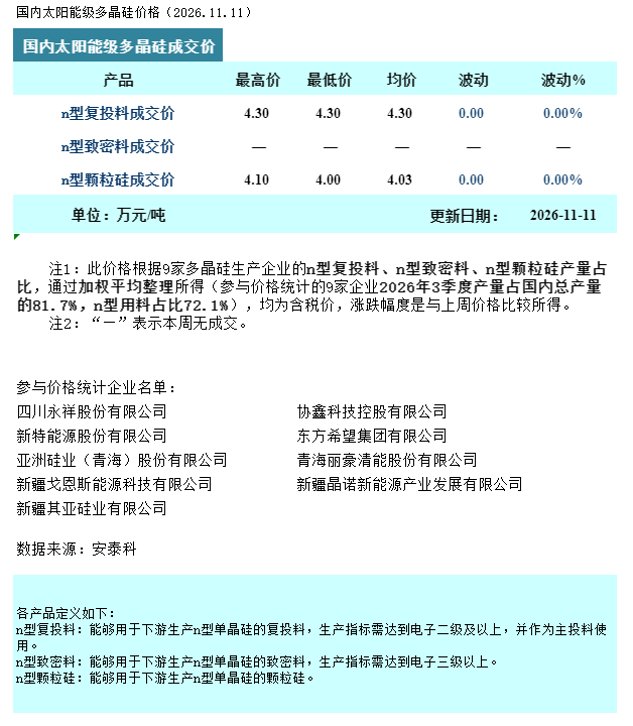
The Zhitong Finance App learned that according to Antech statistics, the transaction price of n-type composite feed (rod-shaped silicon) was 43,000 yuan/ton this week, which was the same; the transaction price range for n-type granular silicon was 4.00-4.100,000 yuan/ton, and the average transaction price was 40,300 yuan/ton, which was flat from month to month. Overall, production adjustments of various enterprises continue to advance, and the supply-side contraction pattern continues. However, downstream silicon wafer profit pressure and battery module price constraints constrain spot transactions, and price transmission in the industrial chain needs to be cleared up. In the later stages, we need to pay attention to the degree of implementation of production adjustments by various enterprises, the implementation of energy consumption limit standards, and the starting pace of downstream inventory replenishment requirements.
The number of spot orders signed in the domestic polysilicon market this week decreased compared to last week. The actual number of trading companies was about 1-2. The overall market has limited orders. The main reason is that downstream silicon wafer prices have declined recently, while polysilicon manufacturers insist on selling at no less than full cost, upstream and downstream price coordination is still ongoing, and price transmission in the industrial chain is poor. The price of the battery module sector is relatively stable, and the price relationship between various aspects is gradually being reconciled.
As of this week, the number of domestic polysilicon production remained at 10. According to statistics from the Silicon Industry Branch, domestic polysilicon production in October was about 109,500 tons, a decrease of 9.0% over the previous month, and a net decrease of 10,850 tons in monthly output. The increase was mainly due to 3 companies' resumption of production climbing or normal fluctuations, with a total increase of 4,400 tons; the reduction was reflected in maintenance and production cuts or reduced volatility in 7 other companies, which reduced the total amount of 15,250 tons. According to the company's production schedule, 1 company will resume production and be released incrementally in November, and 4 other companies plan to cut production and operation. The overall forecast is that domestic polysilicon production will drop to about 84,000 tons in November, a year-on-month decrease of about 23.3%.