


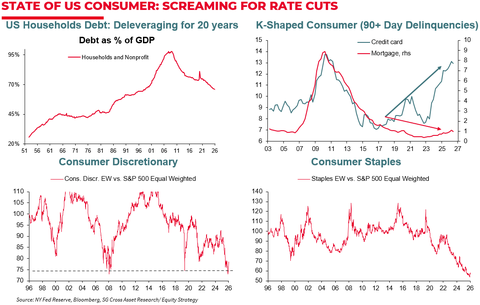
The Zhitong Finance App learned that Société Générale strategist Manish Kabra believes that the inflation problem facing the Federal Reserve is changing: the problem is no longer that demand is too hot, but that American consumers have split into two economies. Credit card defaults have risen to the highest level since the 2008-09 financial crisis, yet mortgage defaults are still near cyclical lows — the same policy interest rate must serve both groups of people at the same time.
“The world is becoming more and more like a K-type. We have K-type consumers and K-type capital expenses. But it is impossible for the Federal Reserve to have a K-type policy interest rate.” Kabra wrote, “An interest rate has to serve an increasingly divided economy, which limits the central bank's room to get ahead of the curve.”
One interest rate, two balance sheets
Let's look at credit cards first: According to the Federal Reserve data, the net credit card write-off rate of American commercial banks in the second quarter was 3.82% (annualized) and the overdue rate was 2.85%; the New York Federal Reserve had a higher inventory level, and 12.8% of credit card balances in the first quarter were seriously overdue for more than 90 days. The Philadelphia Federal Reserve's study is more direct: In the past year, the ratio of severely overdue borrowers to credit cards and auto loans hit a 20-year high, surpassing the two peaks of the Great Recession and the Pandemic.
Looking at mortgages, the style of painting is completely different. The American Mortgage Bankers Association (MBA) full-caliber overdue rate for the second quarter was 4.37%, up 44 basis points year over year, but loans in foreclosure process were only 0.67%, with a severe overdue rate of 2.06% — the absolute level is still low, and the pressure is highly concentrated: the FHA loan overdue rate of 11.79% is more than four times that of 2.72% for conventional loans.
The two sides of the field are not only about default rates, but also about the origin of money. Moody's analysis estimates that the top 20% of households currently account for 60% of the nation's consumer spending; from June 2025 to June 2026, this group's expenses increased by 6.5%, higher than the 3.5% inflation rate, while 80% of expenses only increased by 2.6%, outperforming prices. What supports the former is assets: the net assets of US households increased by 12.8 trillion US dollars in the second quarter, mainly due to stock surpluses. The latter is supported by savings and credit cards — the personal savings rate fell to 4.1% in August, a four-year low; the average annualized interest rate for credit cards was 23.8%, with a balance of 1.26 trillion US dollars, approaching an all-time peak.
Why do interest rate hikes have different effects on both ends
The Federal Reserve's own research gave microscopic evidence. According to an October 2026 FEDS Note, in terms of income distribution, the bottom 10% of households spent 28.3% of their windfall income on consumption, while the top 1% spent only 14.0%.
This explains what Kabra says “can't be rushed”: the latter 80% of cash flow is sensitive to policy interest rates (credit card floating interest rates, car loans are repriced on a monthly basis), and the first 20% of expenses are tied to asset prices, and interest rates have to hit them first. Interest rate hikes are mainly suppressing demand from the former, and part of the impetus for inflation comes from the latter's wealth effect.
Add two more K's. On the capital expenditure side, AI investment is concentrated in the hands of a few hyperscale manufacturers, and financing is also shifting from operating cash flow to the bond market: Google launched Hong Kong dollar and Singapore dollar bonds this week, and Meta and Oracle issued 15 billion and 10 billion US dollar bonds respectively last week. Those who can borrow money to expand and those who don't dare to spend money are originally two ends of the same batch of K.
One interest rate, two mistakes
Looking at the three Ks together, the Federal Reserve's dilemma is technical, not an attitude issue. If inflation mainly comes from supply — the Iran war boosts energy, tariffs since 2025 — interest rate hikes do not reduce oil prices, and the cost will only be reduced by the latter 80%; if inflation comes from a top-level wealth effect, interest rates must hit asset prices, at the cost that the asset side collapses first, and there is no buffer at the bottom.
The federal funds rate target range is 3.75% — 4.00%. Interest rates were raised by 25 basis points in September, and remained unchanged by 10 votes to 2 in October (two votes advocated interest rate hikes); December 8 to 9 is the next node. After the October CPI announcement, the 25 basis point rate hike has been fully priced, and 50 basis points have also been put on the table, and the two-year US Treasury yield rose to 4.68%. Chairman Walsh categorically rejected “soft inflation targets.”
Nevertheless, differences also exist. Chicago Federal Reserve Chairman Goulsby publicly questioned the K-type narrative measurement in October: According to the Bureau of Labor Statistics, the latter 90% of households still account for about 75% of expenses. If the wealth effect were the main engine, the consumption growth gap between the top management and the rest of the population should be even larger. Treasury Secretary Bezent said in August that the K-type economy “is over,” but the bottom wage growth rate since 2026 has not really opposed the ultra-high income groups.
The other side of Kabra: supply shocks are peaking
Kabra isn't entirely pessimistic. His judgment is that the two rounds of supply-side inflationary shocks, oil prices and tariffs are peaking, and only then is the central bank's reaction, and the suppressed consumers will be relieved. Brent crude has fallen from $112 in April to around $90, and WTI is around $86; he gave S&P 500 a year-end target of 8,000 points, which is about 7% upside compared to the current year, and believes that the Fed's “hawkish peak” was in early 2027. If the price of oil falls to $80 and the 10-year US Treasury yield falls back to 4%, his upward scenario is 10,000 points.
However, the focus of this optimistic scenario is still on the asset side. Moody's chief economist Mark Zandy's statement is closer to K's other half: “The future of the economy is tied to the wealth and expenses of the rich.” For the Federal Reserve, not raising interest rates in December is a question about inflation; the real question of the K-type economy is how interest rates do not cause irreversible damage in both directions — there is currently no solution.