


Autoliv (ALV) just paired a higher quarterly dividend of US$1.00 per share with the appointment of veteran Volvo executive Joachim Rosenberg to its board, a twin signal on capital returns and governance.
Recent trading tells a mixed story. The share price has slipped 2.7% over the past day but logged a 10.2% 1 month share price return. Total shareholder return of 1.2% over one year and around 30% over three and five years points to steadier long run compounding as Autoliv couples richer dividends with board refreshment.
Scan beyond Autoliv and compare this dividend story with hand picked income ideas in our 5 dividend fortresses for yield focused portfolios.
Bulls point to Autoliv's relatively higher dividend, cash generation and fresh board expertise. Bears highlight the flat 90 day return and question how much is already in the US$120.93 share price. Which side do current valuation markers lean toward?
Most Popular Narrative: 10% Undervalued
Autoliv's analyst consensus Narrative on Simply Wall St pegs fair value at $134.81, above the last close of $120.93. This frames the dividend lift and governance updates against a valuation that still screens as discounted using an 8.74% discount rate.
Recent success with new product launches in China and strengthening relationships with major Chinese OEMs now lines up with China sales growing more than 40 percentage points faster than local light vehicle production and rising to 55% of Autoliv’s China mix. This supports the view that higher safety content and deeper local penetration can continue to lift revenue and earnings quality.
Heightened global focus on vehicle safety and increasingly strict automotive safety regulations align with Autoliv’s rising content per vehicle in India, where sales have almost tripled to about 6% of group revenue and content per vehicle has grown roughly 20% annually for two years. This points to further potential uplift in revenue and operating margin as safety content scales in these markets.
See why 21 investors see Autoliv as 10% undervalued.
Result: Fair Value of $134.81 (UNDERVALUED)
Still, the story can flip if raw material costs in 2026 bite harder than expected, or if China and India stop pulling as much weight as recent data suggests.
Find out about the key risks to this Autoliv narrative.
Another View: Autoliv Through The P/E Lens
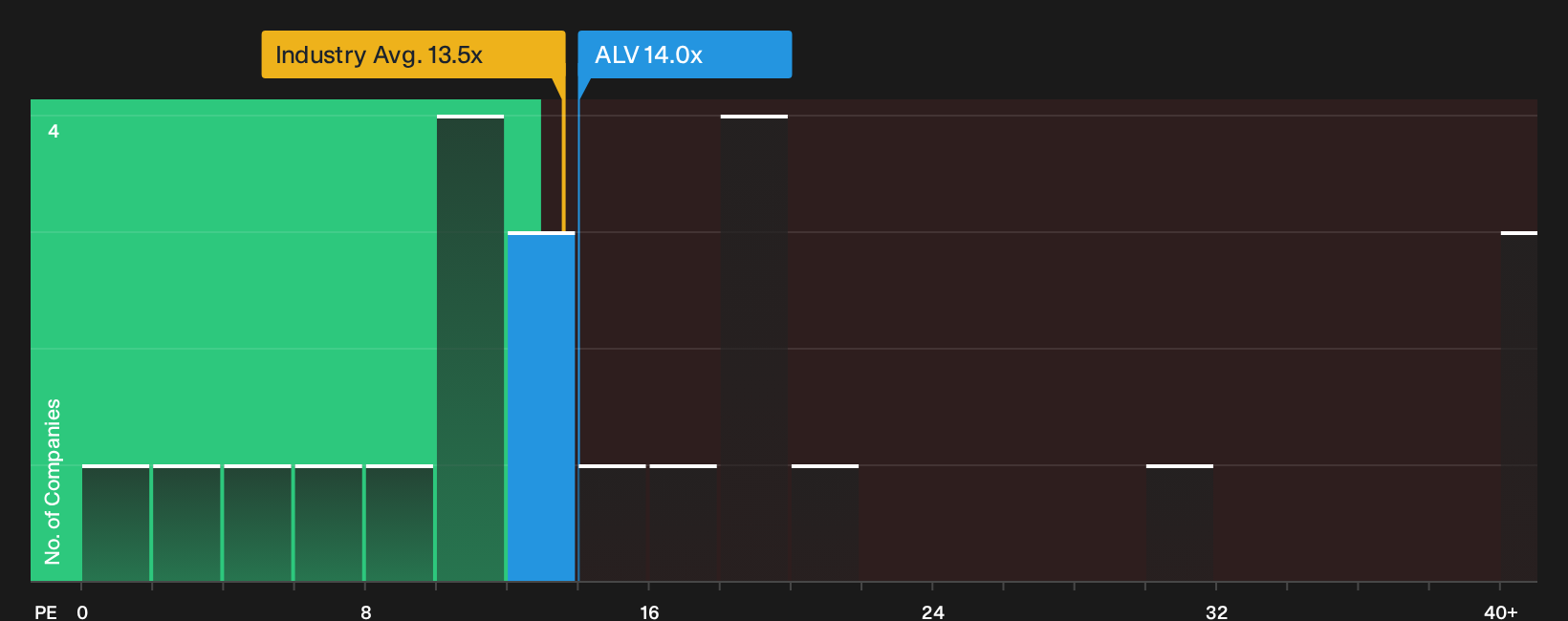
Autoliv looks cheaper on cash flows, yet the picture shifts when you focus on the P/E ratio. At roughly 14x earnings, the stock trades above both its peer group on 11.8x and the US Auto Components sector on 13.9x, while the fair ratio sits at 14.6x. That narrower gap points to less clear upside and raises the question of how much valuation risk investors want to carry.
For a deeper look at how earnings based pricing compares with cash flow estimates, including where the fair ratio might move next, See what the numbers say about this price — find out in our valuation breakdown..
Next Steps
Mixed signals on Autoliv can feel like a push and pull, so move quickly, test the data yourself, and weigh the 2 key rewards and 2 important warning signs.
Looking for more investment ideas beyond Autoliv?
Do not stop with Autoliv. Cast a wider net and use the Simply Wall St screener to spot other opportunities before they move out of reach.
- Target stability first and stress test your watchlist against market shocks with the 30 resilient stocks with low risk scores.
- Hunt for value and build a shortlist of quality companies trading below what their fundamentals suggest through the 35 high quality undervalued stocks.
- Strengthen your income stream by zeroing in on reliable payers inside the list of solid balance sheet and fundamentals (24 results).
Have feedback on this article? Concerned about the content? Get in touch with us directly. Alternatively, email editorial-team@simplywallst.com