


While several names in the equities space have enjoyed recovery rallies, Netflix (NFLX) ranks among one of the more disappointing players. Since the start of the year, NFLX stock has dropped roughly 33%, reflecting steep business challenges. In particular, the market was unimpressed with the streaming giant’s downgrade of its full-year advertising revenue guidance.
Still, the red ink raises an intriguing question. With Netflix stock suffering heavy losses, can traders expect a contrarian response?
It’s a compelling thought because of the popular mean-reversion theory. What we have with Netflix is a powerhouse in content entertainment. Not long ago, it appeared that the brand would completely take over the media landscape. Legacy producers were caught with their pants down, scrambling for an answer. Under this context, NFLX stock may actually be a discount rather than a spiraling entity.
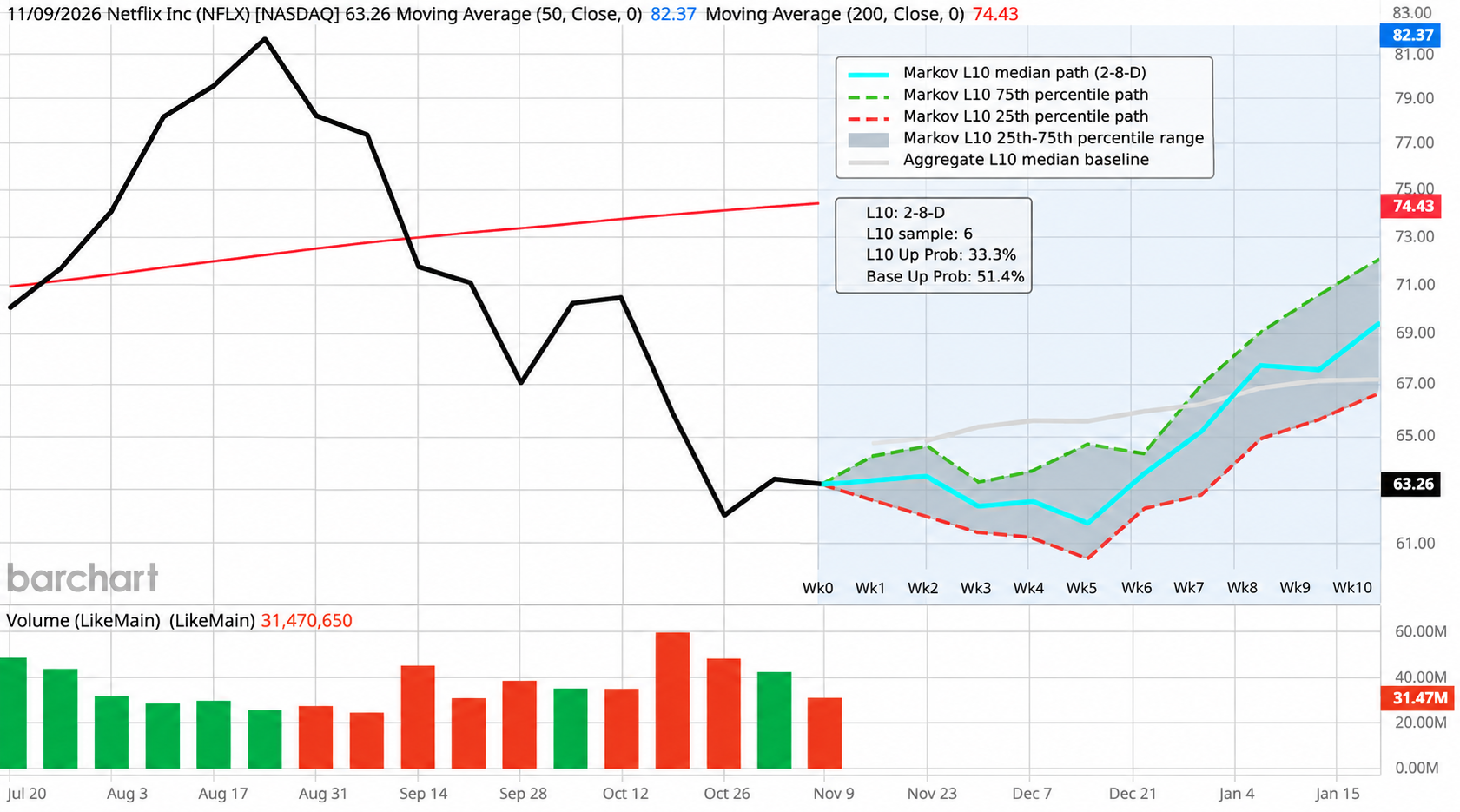
From a quantitative perspective, the matter is even more compelling. When analyzing the technical chart, you can clearly see that the balance of negative weekly candlesticks far outnumbers the total of positive candlesticks by a ratio of eight to two. In other words, over the last 10 weeks, only 20% of unit-wise volume was net positive.
On the surface, that’s bad news. However, in many cases, when the volume balance is that heavily skewed, traders often presume that the market will naturally seek a corrective equilibrium. In my opinion, that’s a very reasonable assumption because Netflix stock is fundamentally a quality name.
From a gut reaction, it would be very tempting for an options trader to go bullish on NFLX stock in anticipation of a recovery pop. But while I understand the basic premise behind the move, the historical data actually says something different.
Why the Numbers Don’t Support Bullishness on NFLX Stock (Yet)
As mentioned earlier, the imbalance toward red-stained weekly candlesticks arguably represents the quantitative motivation behind a contrarian move on Netflix stock. Overall, I agree with the sentiment but I disagree with the timing. Based on the data, the current quant setup suggests that there could be further downside before an eventual recovery in late December to mid-January.
How can I be so sure? I’m not. No one can tell the future. Moreover, a Netflix historian would argue (correctly) that NFLX stock enjoys a long-term upward bias. So, if we were to place NFLX in a theoretical laboratory condition — let’s say an artificial, risk-neutral environment free from volatility shocks — we would statistically be better off maintaining a perpetual bullish position.
That environment doesn’t exist, unfortunately. Therefore, when we model our expectations for NFLX stock, we must be mindful of the nonrandom nature of the equities market.
What does nonrandomness have to do with our quandary here? Again, part of the reason why contrarians are excited about Netflix stock is that it appears to be a discount (thanks to its 32.53% YTD loss). We also tend to believe that deeply sold-off quality names like NFLX are “due” for a recovery. Well, that appears to be a nonrandom dynamic — contrarians are anticipating a strong, upward bias following a rough down period.
If the market were purely random, we wouldn’t know what to expect next, irrespective of whether the previous move was up, down or sideways.
However, whenever NFLX stock has printed the eight-to-two (negative-to-positive weekly candlestick) ratio going back to the last five years, the tendency has been for the security to tumble for the next five to six weeks before rising higher.
To be fair, that’s an inductive inference — there’s no guarantee that the pattern will repeat itself this time around. But if we’re going by the data (as opposed to our emotions), it may behoove the options trader to wait before placing a bullish bet.
For the Aggressive, a Bearish Opportunity Awaits
I think it’s a common opinion among content writers that only a few of us enjoy writing bearish articles. It’s also a trickier proposition because the U.S. equities market generally enjoys an upward bias. That said, historical patterns don’t really bode well for Netflix stock in the short term.
There’s a technical argument to be noted. At time of writing, NFLX stock trades at $63.26 per share. That’s pretty close to the $60 psychological level, a downside target that might be on the bears’ mind.
For me, the more convincing data is the inductive analysis above. If we were to juxtapose the observed pattern onto today’s price, we would expect NFLX’s median share price to briefly drop around $57 over the next five to six weeks before eventually marching above $70 by mid-January.
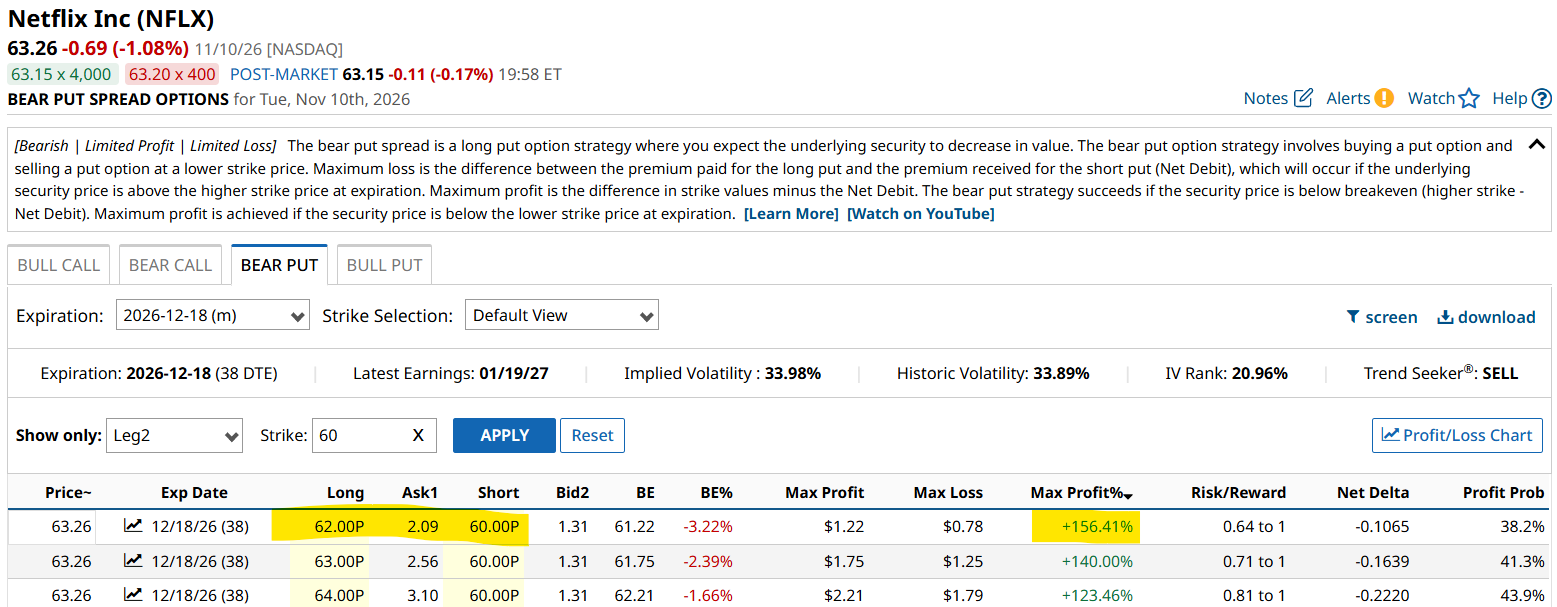
Because the eight-to-two ratio is so rare for Netflix stock, the confidence interval for a bearish trade (for NFLX to drop to $60) is extremely wide. I’m looking at a probabilistic range of 67% at best and 33% at worst.
If you do want to take a speculative shot, you might consider the 62/60 bear put spread expiring Dec. 18. With a net debit required of $78 to generate a maximum payout of 156.41%, this put spread would feature an expected value of $42 (or a return on capital of 53.85%) if we assume a probability of 60%.
Now, a 60% win probability may be pie in the sky. However, with the above stats, a 40% win probability would still generate a +$2 EV. So yes, it’s speculative but it’s not off-the-charts irrational.
On the date of publication, Josh Enomoto did not directly have a position in any of the securities mentioned in this article. All information and data in this article is solely for informational purposes. For more information please view the Barchart Disclosure Policy here.