


For a company that has spent years making headlines for its artificial intelligence (AI) dominance, Nvidia (NVDA) is suddenly making news for something far removed from chips, data centers, and AI ambitions, which is not exactly flattering. Its CEO, Jensen Huang, has found himself at the center of a controversy involving an alleged affair, a Chinese businesswoman, and a staggering $7.5 billion worth of chip shipments to China. Quite an unexpected addition to Nvidia’s otherwise technology-driven story.
According to a report by The Information, Huang’s alleged relationship with Alice Huang (no relation), a businesswoman suspected of having links to Chinese intelligence, helped facilitate shipments of Nvidia chips to Chinese firms. Alice reportedly worked with her husband and sister to establish a network of companies across China and Singapore, which allegedly moved around 240,000 H100 and H200 chips, along with some A100s, into China. One of the companies, Shanghai Century Litong, reportedly secured preferred cloud partner status with Nvidia just months after its founding in June 2023. Reuters, however, could not independently verify the allegations.
The story has since become much bigger than a personal controversy. Nvidia’s board has reportedly launched an internal investigation, while the FBI is also looking into the matter. Huang reportedly acknowledged being unfaithful to his wife when addressing employees, without disclosing any details. Meanwhile, Nvidia’s market value has taken a massive hit, falling by around $1.7 trillion from its Oct. 6 record and facing a $470 billion wipeout in just two days as scrutiny surrounding its CEO weighs on sentiment.
A personal controversy has become a corporate and export-control question. When billions of dollars in chips are involved, the stakes are anything but personal. So, where does Nvidia stand now? Let’s take a closer look.
About Nvidia Stock
Nvidia has come a long way from its early days of making graphics cards primarily for video game enthusiasts and 3D modelers. Founded in 1993 and headquartered in Santa Clara, the company has grown into a central player in the global technology industry. Its graphics processing units (GPUs), once primarily associated with gaming and 3D rendering, are now powering everything from AI models and cloud computing to robotics, autonomous vehicles, and high-performance computing.
As businesses rushed to build AI infrastructure, Nvidia found itself right at the center of the action. And Wall Street certainly was not complaining. That rise turned Nvidia into one of the most valuable companies in the world, with its market capitalization reaching unprecedented heights.
However, the ride has become considerably bumpier in 2026, particularly in recent weeks. The chipmaker’s market cap has contracted sharply to approximately $4.08 trillion, as concerns over slowing AI spending, intensifying competition, and the latest controversy surrounding CEO Jensen Huang’s alleged relationship and reported $7.5 billion in chip shipments to Chinese firms have added to investor uncertainty.
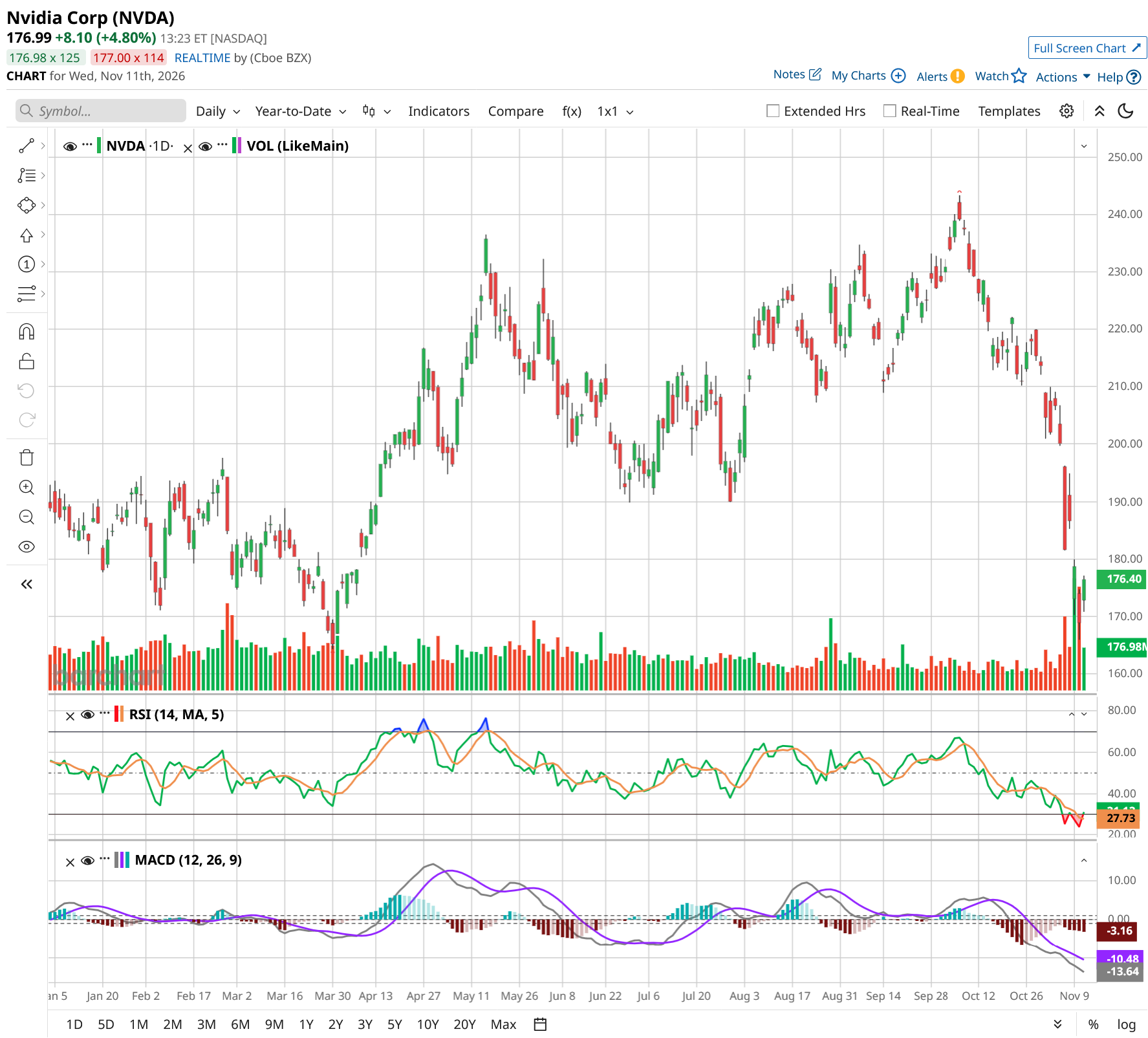
Nvidia’s shares reached an all-time high of $243.37 on Oct. 6 but have since lost nearly 31% of their value, bringing the stock closer to its 52-week low of $164.27, recorded on March 30. The shares are down 19% over the past 52 weeks and 5% on a year-to-date (YTD) basis. The shorter-term picture is even less encouraging. NVDA stock has fallen 19% over the past three months, 23% over the past month, and 12% in just five trading sessions.
Nvidia’s technicals are hardly giving investors a reason to celebrate. The 14-day RSI sits at around 27, roughly in oversold territory, suggesting the recent selloff may have gone a little overboard. The MACD line remains near its signal line, with red histogram bars flashing bearish momentum. The bulls are yet to make a convincing comeback, and the chart is not exactly screaming recovery.
As for valuation, the recent selloff has made Nvidia look relatively less expensive than it once did. NVDA currently trades at 19.18 times forward earnings, below both its sector average and historical multiple. Its 10.47x forward price-to-sales (P/S) ratio is still richer than many peers but also sits below its historical average.
And it is not as if Nvidia has stopped rewarding its shareholders amid the turbulence. The company pays a quarterly dividend of $0.25 per share. Sure, the payout is hardly going to make income investors jump out of their seats, especially given the stock’s valuation. But its dividend payout ratio of around 4% signals plenty of room for Nvidia to retain earnings, reinvest in its business, and potentially increase shareholder returns over time.
A Snapshot of Q2's Numbers
The AI chip giant reported its fiscal 2027 second-quarter results on Aug. 26. Revenue soared 106% year-over-year (YoY) to $96.2 billion, comfortably beating Wall Street’s expectations. Non-GAAP earnings per share climbed an equally impressive 120% to $2.22, while non-GAAP gross margin expanded by 2.5 percentage points to 75%.
The Data Center segment generated $89 billion in revenue, up 117% annually, and accounted for more than 92% of Nvidia’s total sales. Demand from hyperscalers building AI infrastructure remained the biggest growth engine, while enterprise adoption of accelerated computing continued to widen. Sequential growth also benefited from the initial volume rollout of Nvidia’s next-generation Vera Rubin architecture, alongside full-scale Blackwell production for major cloud customers, including Azure, Google Cloud, and OCI.
There was growth beyond the data center, too. Nvidia’s Edge Computing business brought in $7.2 billion, up 27% annually, as AI increasingly moves closer to devices and real-world commercial applications.
Nvidia also confirmed its first H200 data center chip shipments to China under a new U.S. licensing arrangement, although the sales represented less than 1% of its Data Center revenue in Q2.
Operating cash flow reached $24.1 billion, while free cash flow came in at $21.3 billion. NVDA returned approximately $26 billion to shareholders through buybacks and dividends during the quarter, with another $99 billion available under its share repurchase authorization. Cash, cash equivalents, and marketable debt securities stood at $56.6 billion at quarter-end.
The company is gearing up to release its Q3 2027 numbers on Tuesday, Nov. 17. Management anticipates Q3 revenue to be around $108 billion, plus or minus 2%, with GAAP and non-GAAP gross margins expected at 74%, plus or minus 50 basis points. Looking further ahead, management expects fiscal 2028 revenue to grow approximately 70%, although supply is expected to remain a bottleneck through at least the end of that year.
Analysts tracking Nvidia project fiscal Q3 2027 revenue around $109 billion, while EPS is projected to climb by 100.8% YoY to $2.49 per share. Zooming out, EPS is expected to be $9.30 in fiscal 2027, representing annual growth of 103.5%, and the bottom line could rise by another 69.4% YoY in fiscal 2028 to $15.75 per share.
What Do Analysts Expect for NVDA Stock?
Wall Street is beginning to reassess its Nvidia exposure, and the latest analyst moves suggest that the scandal is becoming more than just a headline risk. Bank of America has removed NVDA stock from its US 1 List, its shortlist of highest-conviction stock ideas, although it has not explained the decision.
Meanwhile, Citi’s Atif Malik maintained a “Buy” rating but trimmed his price target to $285 from $315, citing the board-led investigation as an overhang that could overshadow Nvidia’s Nov. 17 earnings and guidance. Wells Fargo analyst Joe Quatrochi also lowered its target to $300 from $315 while retaining an “Overweight” rating.
The bigger concern is what happens if Jensen Huang’s position becomes uncertain. Bernstein’s Stacy Rasgon flagged significant key-man risk, questioning whether Huang could continue leading the company.
However, former Wedbush, now Yorkville Ives, analyst Dan Ives believes Huang will survive the controversy, estimating just a 15% chance of his removal. He expects the board investigation to take four to six weeks, potentially keeping the stock under pressure. Ives maintained his “Outperform” rating and $300 target but warned that Huang's departure could knock 25% to 30% off Nvidia’s value and reshape the global AI GPU competitive landscape.
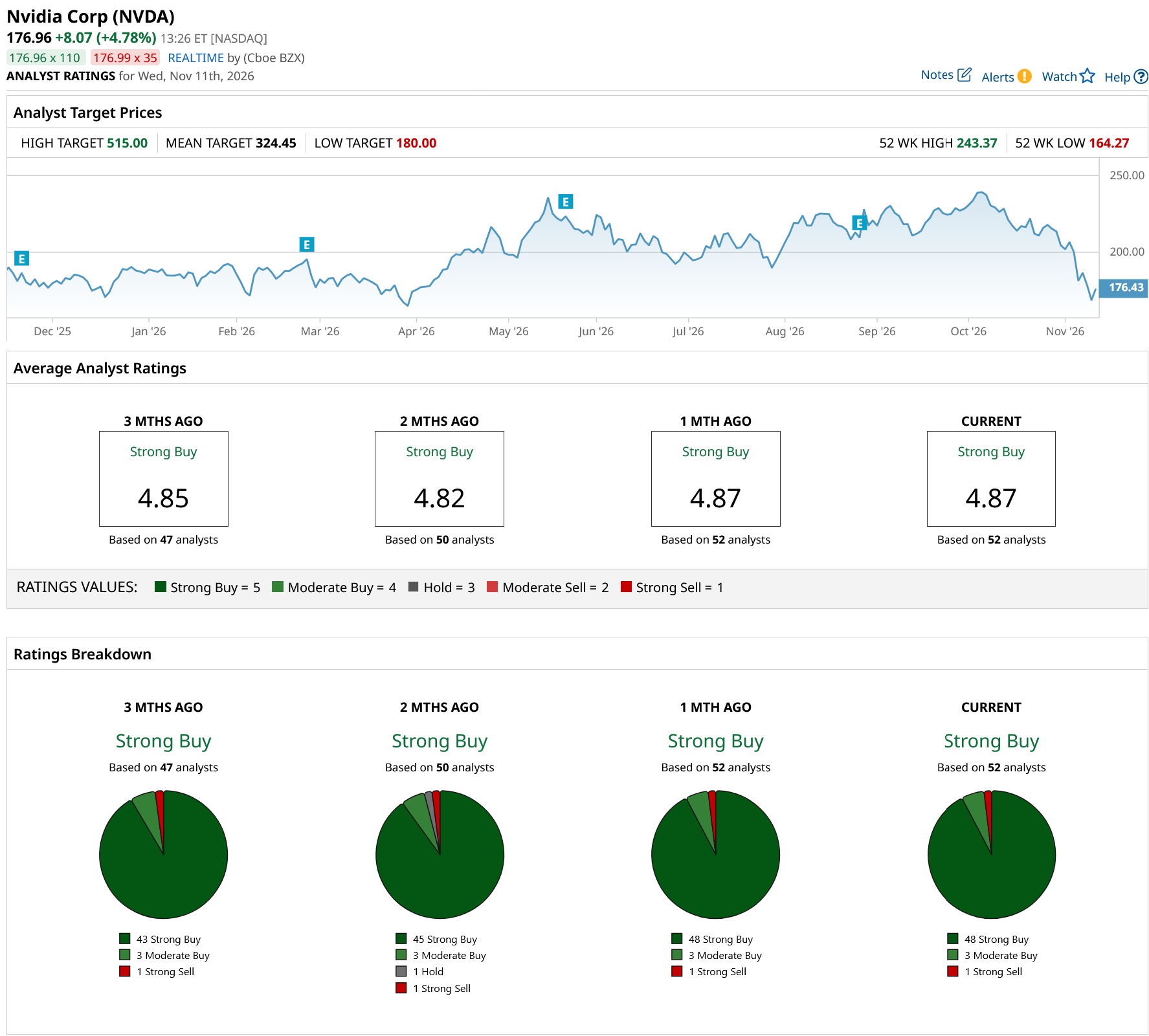
Overall, analysts are upbeat about NVDA’s growth potential, giving the stock a consensus rating of “Strong Buy.” Of the 52 analysts covering the stock, 48 advise a “Strong Buy,” three recommend a “Moderate Buy,” and only one is outright skeptical, suggesting a “Strong Sell.”
The average analyst price target for NVDA is $324.45, indicating potential upside of 83%. The Street-high target price of $515 suggests that the stock could rally as much as 191% from here.
On the date of publication, Sristi Suman Jayaswal did not directly have a position in any of the securities mentioned in this article. All information and data in this article is solely for informational purposes. For more information please view the Barchart Disclosure Policy here.