


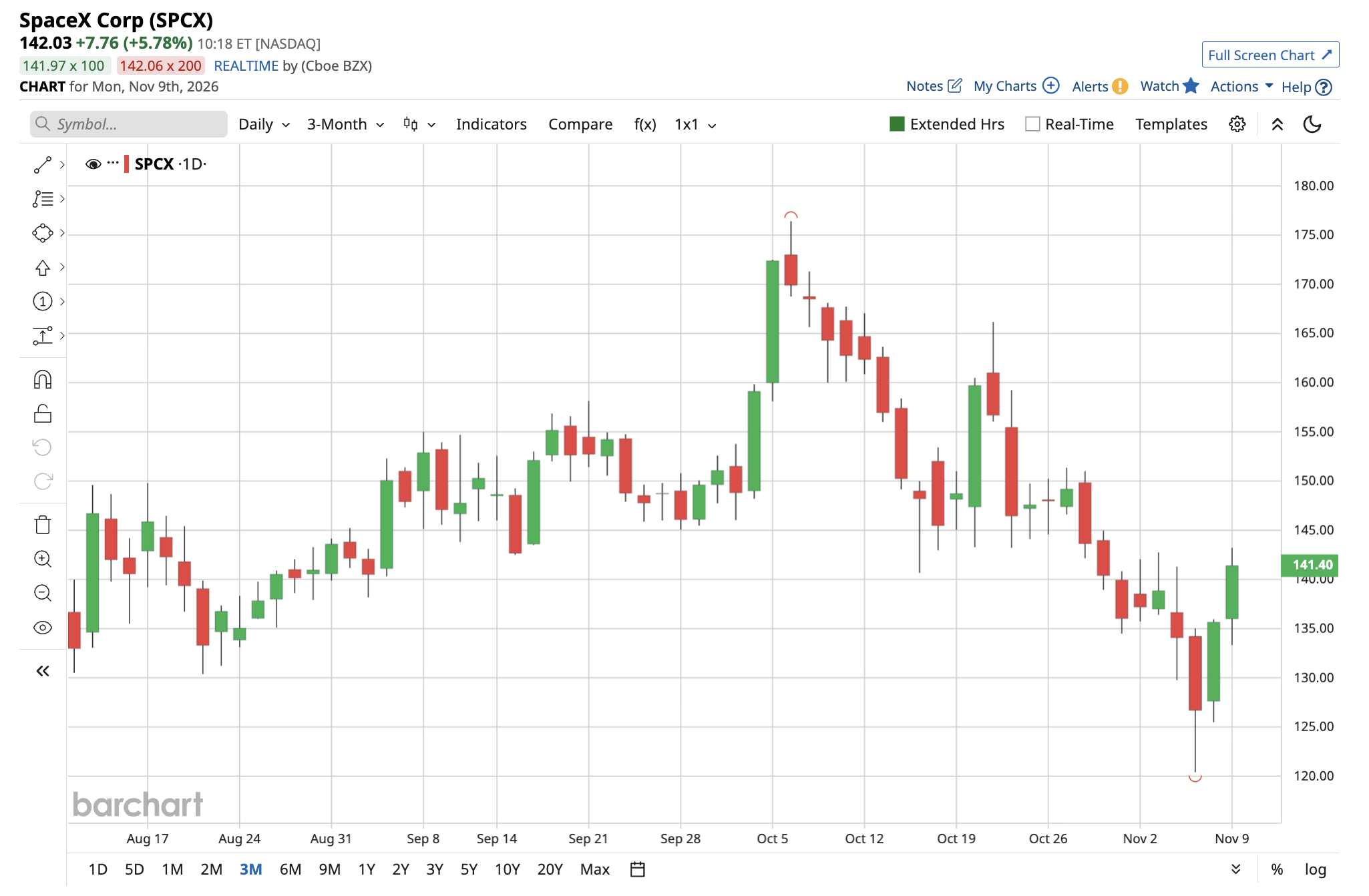
SpaceX (SPCX) stock dropped about 9% on Nov. 5 as post-midterm fears that a new Congress could slow data-center construction hit artificial intelligence (AI) stocks. On the same day, Cathie Wood's Ark Invest bought about $49 million worth of SPCX stock. Adding that purchase to its purchase on Nov. 4, Ark Invest recently bought a combined $96 million worth of shares.
Meanwhile, Jim Cramer recently said that he wants to buy SpaceX stock because its AI business is booming, but that he won't buy it yet. Cramer cautioned that "the company's projected costs are astronomical." Let's take a closer look.
Cramer's Case
Jim Cramer's argument that SpaceX's projected costs are "astronomical" makes sense given how heavily the company plans to spend. Management guided Q4 spending of $35 billion to $40 billion, nearly double Wall Street's roughly $20 billion estimate. As I wrote after the company's first public earnings report, CEO Elon Musk is asking investors to trust him about this spending paying off.
Another concern Cramer has is the supply of shares, which I think is the bigger issue. Only about a third of SpaceX's shares can be freely traded today, and more will unlock through mid-2027. The next big unlock is on Dec. 8, while Musk's own stake of roughly 6.4 billion shares will unlock next June. Once those shares unlock, early investors will be free to sell. "I think that supply short-term could overwhelm demand," Cramer said, meaning that more sellers than buyers could push the price down for a while.
Cathie's Case
On the other hand, Cathie Wood's decision to buy SPCX stock on the dip is defensible. The business is firing on all cylinders; SpaceX's AI revenue jumped about 830% year-over-year (YOY) to $7.56 billion last quarter, while Connectivity revenue grew 69% YOY to $5.25 billion. SemiAnalysis projects that the company could make $235 billion per year from AI compute alone, and that it is turning itself into an AI business first. Last quarter proved as much, with AI revenue making up 52% of total revenue. Because of this, Cramer also called SpaceX "primarily an AI hyperscaler" now.
So, the numbers are strong, and Ark Invest bought on a day the stock closed at about $123.62, below its initial public offering (IPO) price of $135 and the 52-week high of $225.64. That suggests Wood's timing might not be so bad. Still, I expect the December unlock to cause another dip, so Cramer's approach of waiting for an even better price holds weight, too.
About SpaceX Stock
SpaceX is best known for its rockets and Starlink satellite internet, but since absorbing xAI earlier this year, the company has also become one of the biggest AI compute providers in the world. That AI shift is why Cramer now calls it "primarily an AI hyperscaler," and it's also the main reason the company is spending so heavily. Founded in 2002, SpaceX is headquartered in Starbase, Texas, and led by founder and CEO Elon Musk.
Since closing its first day of trading at $160.95, SPCX stock has fallen roughly 12%, worse than the Invesco QQQ Trust’s (QQQ) 4% drop over the same period. After its IPO, the stock reached its 52-week high of $225.64 within a week. However, shares dropped soon after and haven’t come close to that high since.
AI Takes Over SpaceX's Results
SpaceX reported its third-quarter fiscal 2026 results on Oct. 20, and the numbers beat expectations on most key metrics. Revenue jumped 161% YOY to $14.6 billion, well above the $12.72 billion analysts expected. EPS of $0.35 was more than double the $0.15 estimate, as the company swung from a loss in the same period last year to a profit of $4.4 billion. AI was the standout, making up 52% of total sales, while the AI unit posted its first operating profit.
Looking ahead, SpaceX is planning to spend even more. It expects Q4 capital spending of $35 billion to $40 billion, nearly double Wall Street's consensus estimate. Musk wants to grow the company's computing capacity from 1.7 gigawatts at the end of September to about 3 GW by year-end and 13 GW by the end of 2027. The good thing is that SpaceX has about $90 billion in cash and investments, which should help cover a lot of that spending.
What Do Analysts Expect for SpaceX Stock?
Following the Q3 report, JPMorgan more than doubled its SpaceX price target from $240 to $500, while keeping an “Overweight” rating.
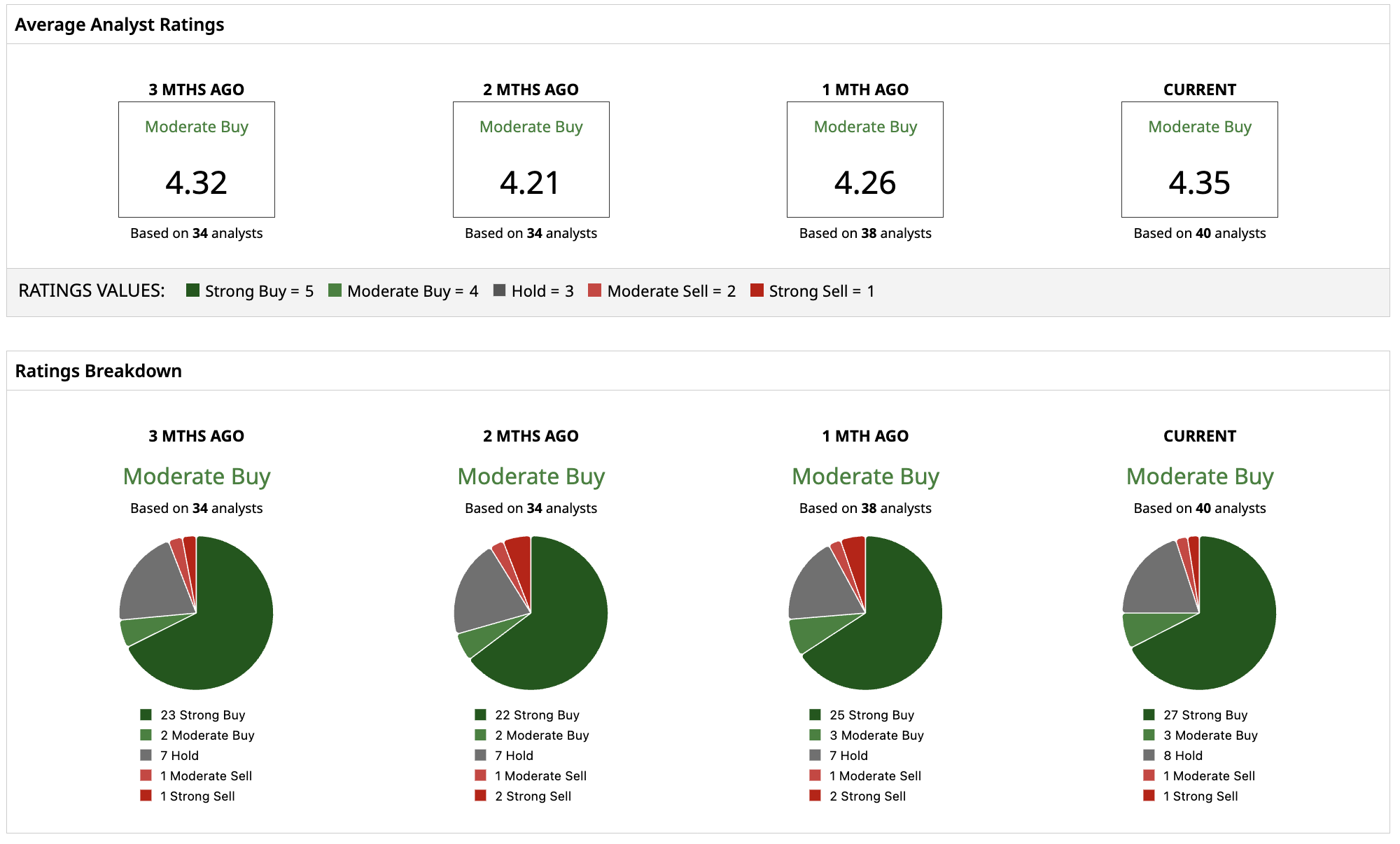
Overall, based on 40 Wall Street analysts with coverage, SPCX stock holds a consensus "Moderate Buy" rating. The mean price target of $252.05 suggests potential upside of 77% from current levels, while the Street-high target of $800 implies a possible 461% climb from here.
On the date of publication, Jabran Kundi did not directly have a position in any of the securities mentioned in this article. All information and data in this article is solely for informational purposes. For more information please view the Barchart Disclosure Policy here.