


Key Points
The Schwab U.S. Dividend Equity ETF's screening process helps it hold high-quality, shareholder-friendly stocks.
The Vanguard Dividend Appreciation ETF provides more tech exposure than many traditional dividend ETFs.
The S&P 500 has been one of the most rewarding and reliable investments in stock market history.
Exchange-traded funds (ETFs) are one of the best ways to invest in the stock market. They don't typically get as much attention as individual stocks, but they can be just as effective. They also generally carry less risk because performance isn't tied to one company.
As 2027 begins to creep up, it's time to start thinking about what investments could fit your portfolio. With higher-than-usual uncertainty around the stock market, it could be a good time to lean on ETFs. Plenty of quality options exist, but here are my top three heading into the new year.
Missed Nvidia in 2009? This Rare Signal Is Flashing Again. In 2009, a "Double Down" signal flashed for a little-known chipmaker called Nvidia. For the first time in years, that same "Total Conviction" signal is flashing for a company 1/100th the size of Nvidia. Continue »

Image source: Getty Images.
1. Schwab U.S. Dividend Equity ETF (SCHD)
The Schwab U.S. Dividend Equity ETF (NYSEMKT: SCHD) is a staple dividend ETF I own because it emphasizes quality. Unlike some dividend ETFs that focus solely on high-yield dividend stocks, SCHD has stricter criteria for the companies it includes. To be considered, a company must have 10 years of dividend payments with at least five consecutive years of dividend increases, and be in solid financial standing.
Of course, a high yield is much appreciated, but some high yields are due to a company's business and share price declining. By being more selective, SCHD holds quality companies and avoids yield traps. Even then, it offers one of the higher yields you'll find among dividend ETFs.
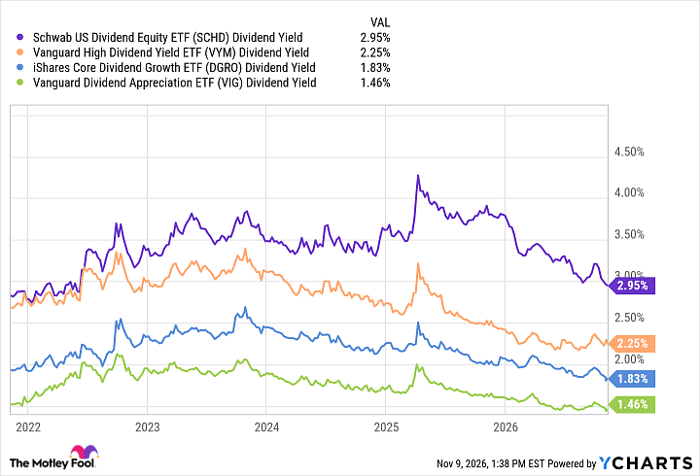
SCHD Dividend Yield data by YCharts
SCHD's average dividend yield has hovered near 3.5% over the past few years, but this year's 30% stock price surge has brought it down a bit. Still, a 3% yield is impressive for a broad ETF.
The stock market has a lot of question marks entering 2027, so an investment like SCHD is appealing because you'll be rewarded regardless of how stock prices move. I wouldn't expect SCHD's 2027 returns to mirror this year's so far, but I know you don't have to second-guess the dividend.
2. Vanguard Dividend Appreciation ETF (VIG)
Investing in the Vanguard Dividend Appreciation ETF (NYSEMKT: VIG) is me once again leaning on guaranteed dividend income for next year. As the name implies, VIG focuses on companies committed to increasing their annual dividends.
To be included, a company must have at least 10 consecutive years of dividend increases, which is a strong vetting hurdle, but it also leaves the door open for stocks not typically associated with dividends. VIG's top three holdings are Microsoft, Apple, and Broadcom, and 26.7% of its holdings are in tech.
VIG has a low dividend yield of 1.5%, but investing in it means playing the long game and benefiting from the compounding effect of its holdings routinely increasing their payouts. It's also more of a two-for-one than traditional dividend ETFs thanks to its tech holdings and the growth opportunities they offer.
VIG's stock price could lag if there's a tech-specific pullback, but most of its tech holdings are established leaders that have stood the test of time. If the current artificial intelligence boom continues through 2027, VIG could get a nice boost.
3. Vanguard S&P 500 ETF (VOO)
The Vanguard S&P 500 ETF (NYSEMKT: VOO) will likely always be one of my largest holdings because I don't have to overthink it. Investing in it is like investing in the U.S. economy because they have historically moved in tandem over time. Neither is foolproof, but it's one of the surer bets on Wall Street.
With a lot of its weight in megacap tech stocks like the Magnificent Seven and a few other AI giants, VOO's performance will depend on their momentum (or lack thereof). If the AI boom continues, it will definitely work in investors' favor. If it slows down, VOO's returns are likely to be far less than what we've seen since 2023.
VOO has only traded since September 2010, but the S&P 500 has historically been one of the most resilient investments anyone could make. It officially expanded to 500 companies in March 1957, and has since experienced 11 bear markets. Yet it has bounced back from every one and kept setting new all-time highs. Even if the S&P 500 lags a bit in 2027, I trust that it'll reward patience.
Stefon Walters has positions in Vanguard S&P 500 ETF. The Motley Fool has positions in and recommends Vanguard Dividend Appreciation ETF and Vanguard S&P 500 ETF. The Motley Fool has a disclosure policy.