


Did you ever try to catch a falling knife? Well, why not? I know people who do it all the time – and they’re not even magicians.
I’m obviously not talking about actual knives, but about the old Wall Street saying, “don’t catch a falling knife,” which roughly translates to not buying a stock when it’s falling sharply.
This adage seems a bit out of sorts with modern investor behavior, which leans so heavily on buying the dip, no matter the cost.
Looking across the tape right now, investors are having a field day. They see the Nasdaq-100 Index ($IUXX) slicing through intermediate support levels, speculative semiconductor names giving back months of gains in single sessions, and high-beta thematic funds in freefall. What’s the immediate, reflexive instinct?
Smash the buy button.
This looks like a Black Friday sale to some, and a trap to others.
For 15 years, zero-interest-rate policy (ZIRP) and relentless liquidity injections trained an entire generation of investors that every dip is an automatic buying opportunity. The muscle memory is so deeply ingrained that when prices tumble, people don’t ask why the market is selling. They simply celebrate the “discount.”
What has been particularly noteworthy to me lately is the force with which selloffs occur. Much of last week, the market could not catch a bid. Then Monday, it exploded upward.
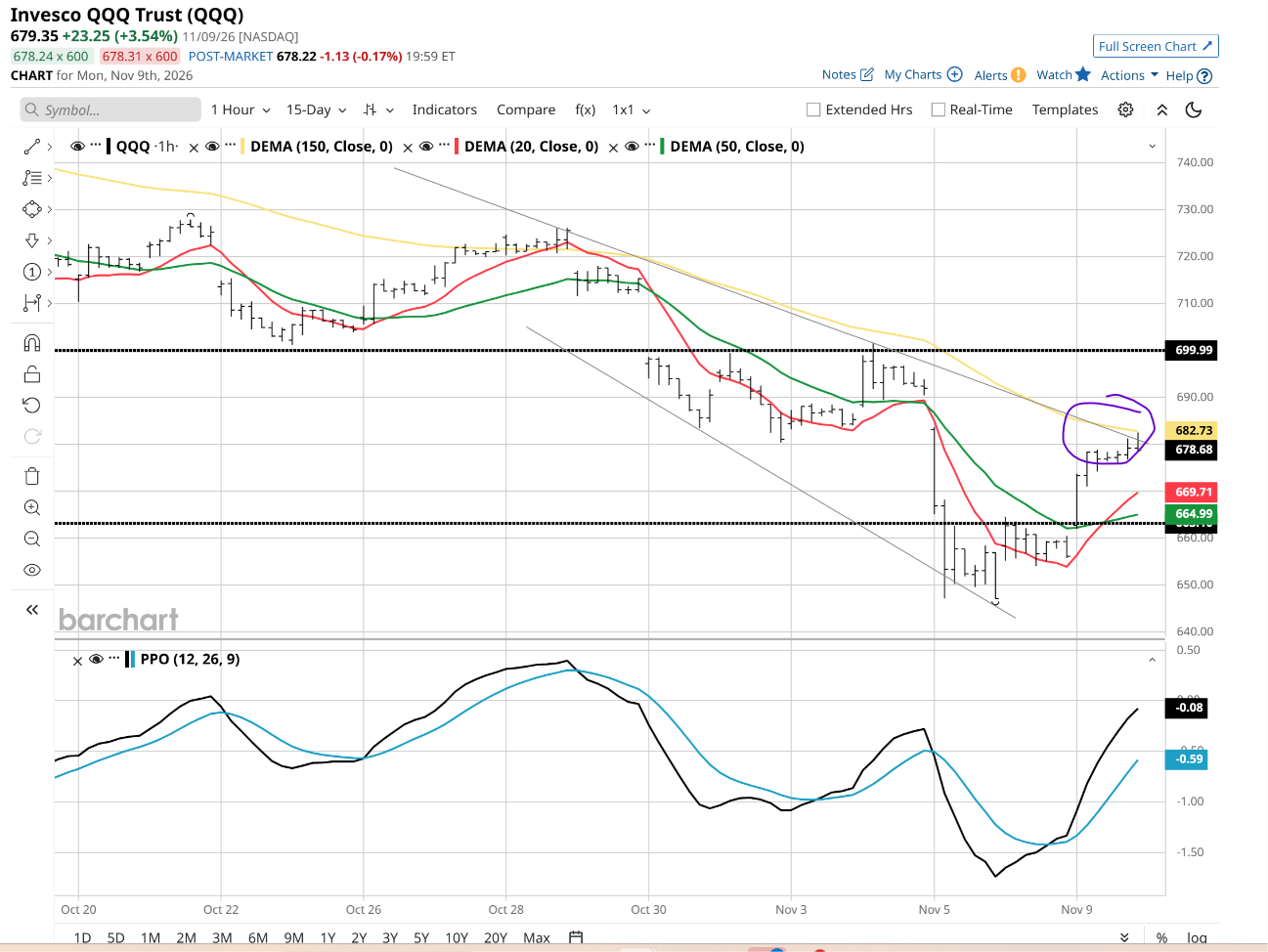
By the time you read this, the location on the one-hour chart of QQQ above might have been resolved. But as a technician, there are times where there simply is not much to say. When a downtrend like the one I outlined with those thin black lines rallies back to EXACTLY the spot it should… and then the market closes for the day, there’s nothing to say but “we’ll see.”
If we pull back just a bit, to the daily chart for QQQ, we see that the odds are stacked against this being a sustainable rally. The price broke down below the prior low, but Monday’s surge saved it.
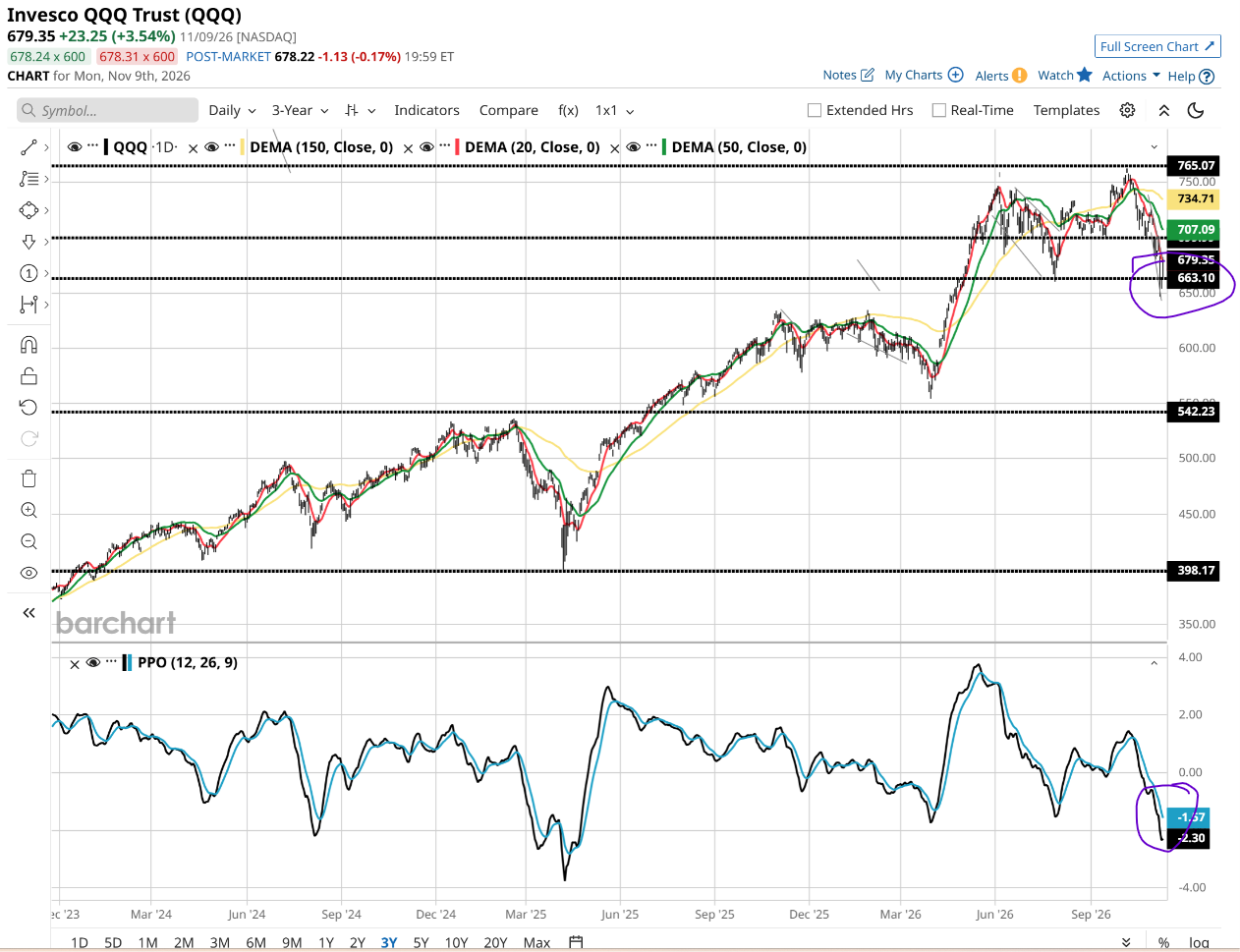
But the percentage price oscillator (PPO) in the lower part of the chart is still so weak, it will take more than a one-day wonder to reverse things. Not for a moment am I saying it can’t. I’m just saying the risk is abnormally high. In other words, you could cut the tension with a knife.
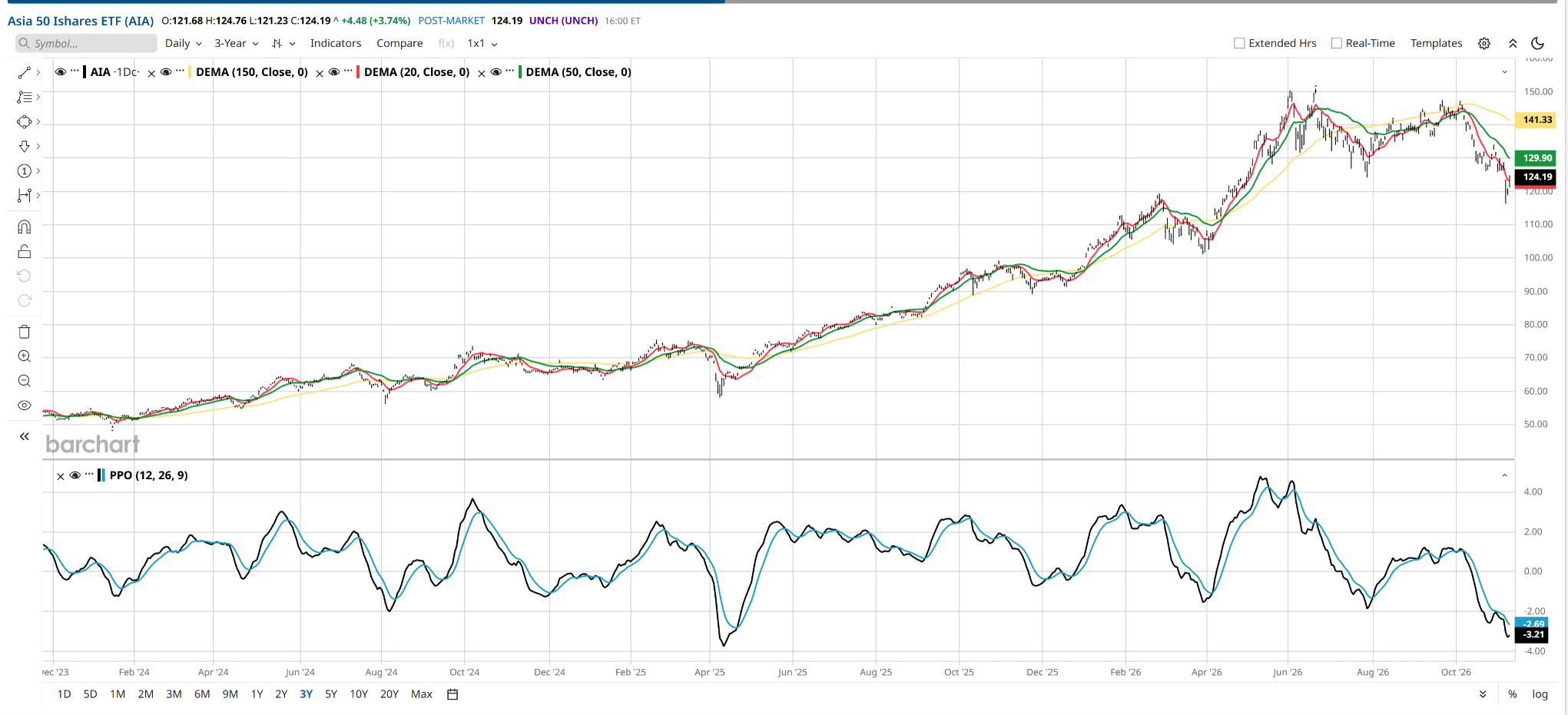
Complicating matters is the fact there are knives out everywhere. Here are a few of many others I’m tracking. Starting with Asia (AIA). That’s a falling knife.
Mortgage REITs? Also a falling knife. This is a go-to, high-yield equity industry. It started to look like it was bottoming, but now that’s very opaque to me.
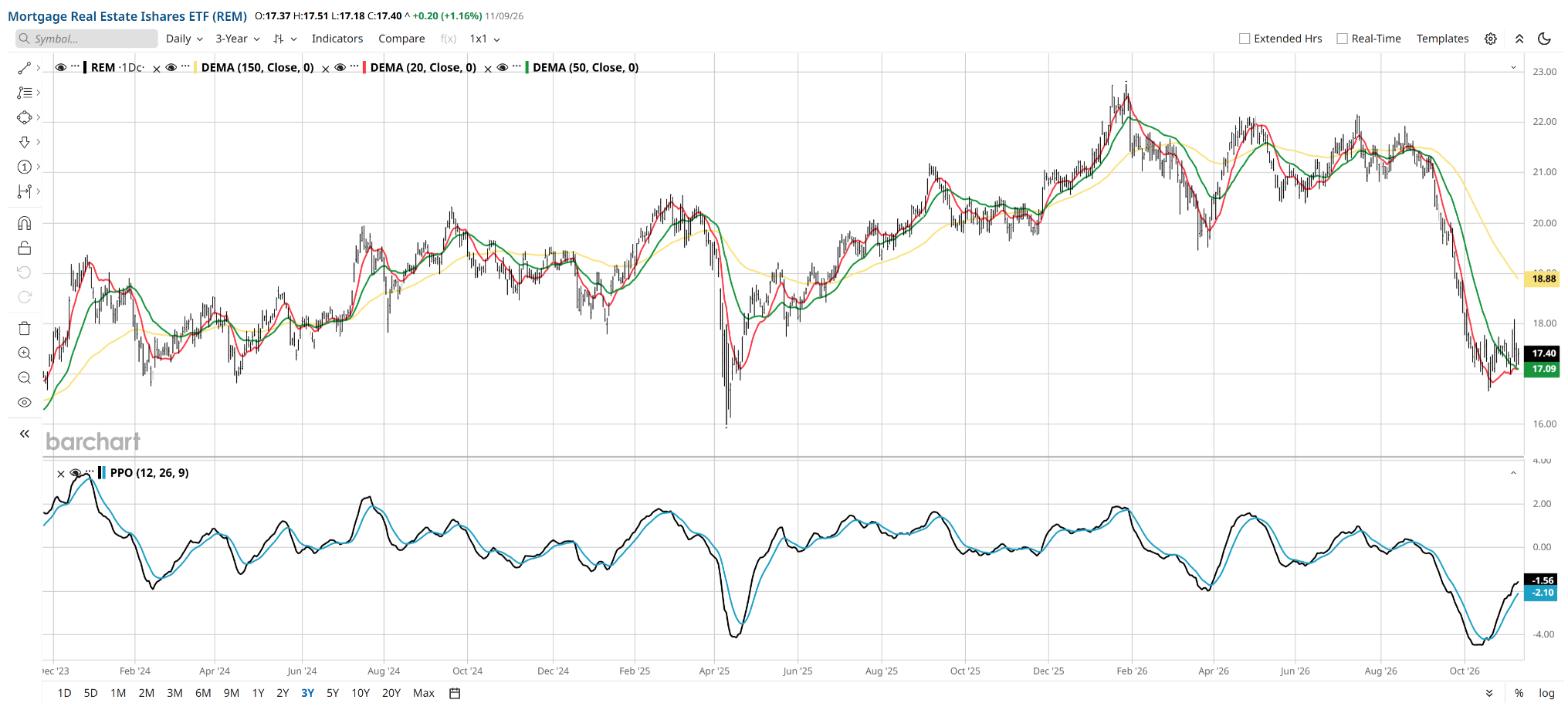
And if this is not bottoming, that means interest rates are less likely to roll over. Higher rates could stress the stock market. So that chain reaction makes me less likely to be aggressive here.
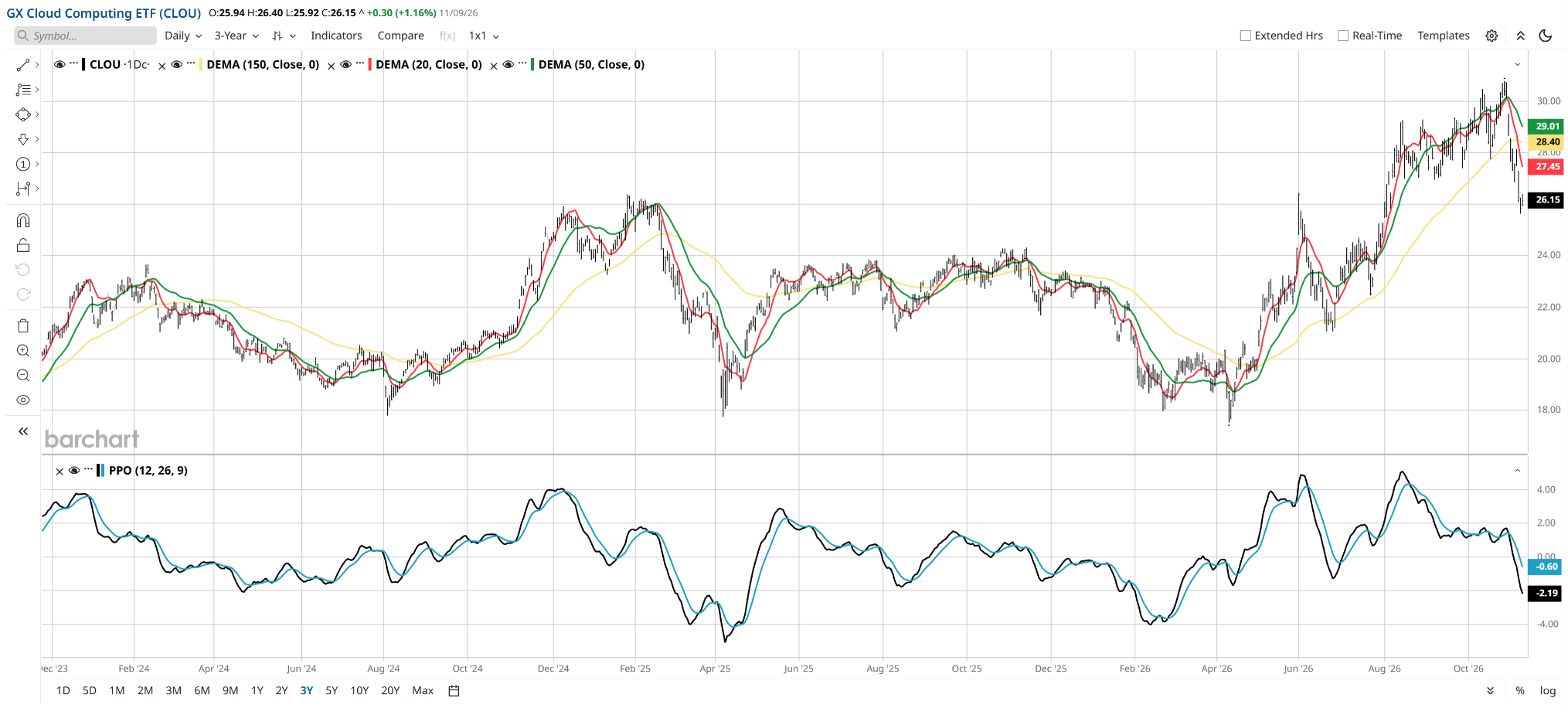
Finally, the GlobalX Cloud Computing ETF (CLOU) had a pedestrian day amid the tech rally Monday. It slid more than 15% in no time, then rallied just a tad. Verdict: still a falling knife. It will take a lot more to turn this one around.
How to Handle Falling Knives
You do not have to sit on your hands and do nothing. But this is a time when instead of dip-buying being a “no-brainer,” I use more proactive risk management.
When a falling knife plunges into a wooden floor, it vibrates violently before settling. In technical analysis, that settling process is called basing. Wait for an ETF to stop making lower lows, let its moving averages flatten out, and wait for some sustained buying pressure in the form of an upward price move. Not one manic up day. More like a series of ups and downs that starts to carve out a set of higher highs and higher lows. You don’t need to pick the exact bottom tick to make money.
Averaging down is the ultimate ego trade. It is an investor’s subconscious way of refusing to admit their initial entry was wrong. If a position breaks key technical support, think twice before throwing good money after bad.
Why Convexity Is King
If you believe a heavily oversold ETF or stock is primed for a violent counter-trend bounce, my go-to strategy is a combination of the underlying security plus a “married put,” as I’ve discussed here before.
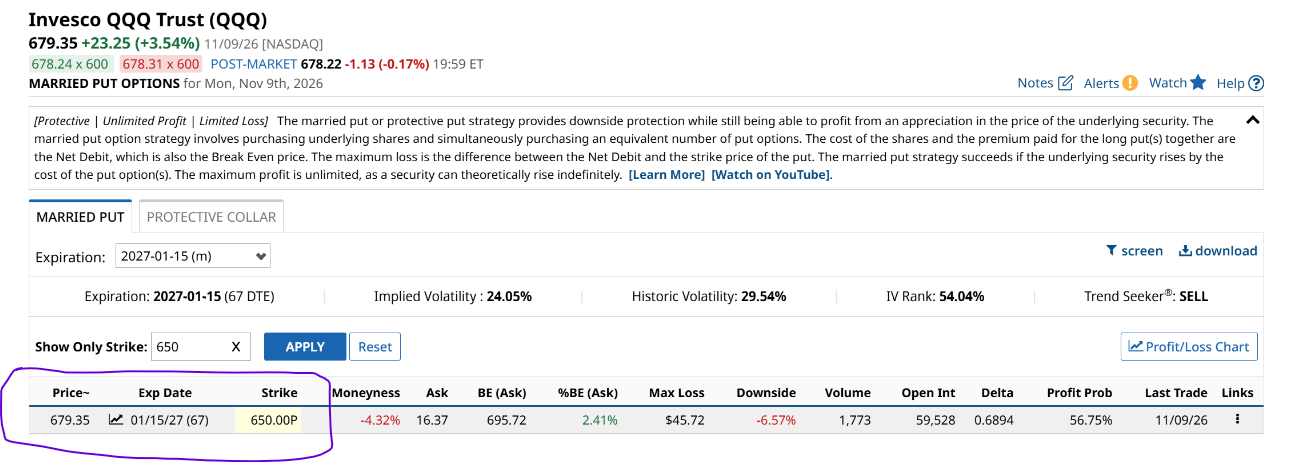
This quick example involves buying 100 shares of QQQ (or any ETF or stock with a liquid options market). Assuming you buy at the Monday close around $679, you could pay another $16 and lock in a worst-case scenario of $650, the strike price shown here. That is in effect until Jan. 15, 2027, so about 10 weeks from now.
Your effective net worst-case is $634 ($650-$16). That’s $45 off the $679 purchase price, or about a 7% loss. That is a bit steep for just 10 weeks’ time, but this is a fairly volatile market.
The key here is peace of mind. The other side of that 7% maximum downside is the upside. It is unlimited. If QQQ flies toward a new all-time high above $765, that’s about a 13% gain.
In a market like this, just as a huge loss is on the table over the next few months, so too is a potential parabolic move higher. So that upside could be 20% or more, who knows? There’s no cap on it. But the downside risk IS capped. That’s one of several ways to try to have your upside cake and eat it too.
When market leaders begin to break down, the crowd’s instinct is to treat the drop like a clearance sale. But in a shifting macro environment where gravity has returned to valuations, those “bargains” frequently turn into multi-year capital traps.
Step away from the knife rack. Keep your primary wealth protected, demand that the market prove its footing before deploying risk capital, and let the knife-catchers do the financial bleeding. That’s the red you see on your screen on days like this past Thursday.
Rob Isbitts is a semi-retired CIO, former fiduciary investment advisor, Barchart columnist, and straight-talker. Download his new free e-book on hedged bond investing for retirement at ETFYourself.com. His research and model portfolios are at ROAR.PiTrade.com.
On the date of publication, Rob Isbitts did not directly have a position in any of the securities mentioned in this article. All information and data in this article is solely for informational purposes. For more information please view the Barchart Disclosure Policy here.