


- Ross Stores is drawing attention ahead of its November 19, 2026 earnings release, with recent reports highlighting 13.3% revenue growth, a 70.5% rise in earnings per share, and low net debt that together point to solid operating momentum and balance sheet flexibility.
- An unusual split has opened up between strong fundamentals at Ross Stores and sharply different valuation views. Some analysts cite room for continued market share gains and store expansion, while others argue the stock price sits well above estimated intrinsic value based on discounted cash flow work.
- Next, the focus turns to how Ross Stores' anticipated earnings strength and operational execution might influence the longer term investment narrative around its off price model.
Compare Ross Stores' setup with a hand picked group of retailers showing resilient balance sheets and solid fundamentals in our list of solid balance sheet and fundamentals (24 results) for context on where quality is clustering.
Ross Stores Investment Narrative Recap
To own Ross Stores, you need to be comfortable with a simple idea. The retailer converts excess branded inventory into value-focused apparel and home goods, and according to Esteban, an investor in the Simply Wall St Community, it has historically done this most reliably when conditions are tough and shoppers trade down. Recent revenue and EPS gains, plus firm margins, keep that operating story intact.
The key near term catalyst is the November 19 earnings release, where investors are watching comparable-store trends and merchandise margins after a period of solid growth. The biggest risk right now is the premium valuation colliding with any disappointment in traffic, closeout availability, or margin quality. Recent updates have not changed that risk reward skew in a material way.
The most relevant recent update for this setup is the expectation for higher EPS and revenue in the upcoming report, tied to stronger customer traffic, better comparable performance, and firmer merchandise margins. That sits on top of longer term context where earnings grew 28.9% over the past year and Ross Stores has been growing profit or revenue more broadly.
That earnings momentum, alongside high quality past earnings and rising net profit margins from 9.6% to 10.8%, makes execution on November 19 a real swing factor. Any slip in the off price model, such as weaker supply of attractive closeout goods or pressure on margins, could matter more than usual because the stock trades on a richer P/E than many peers.
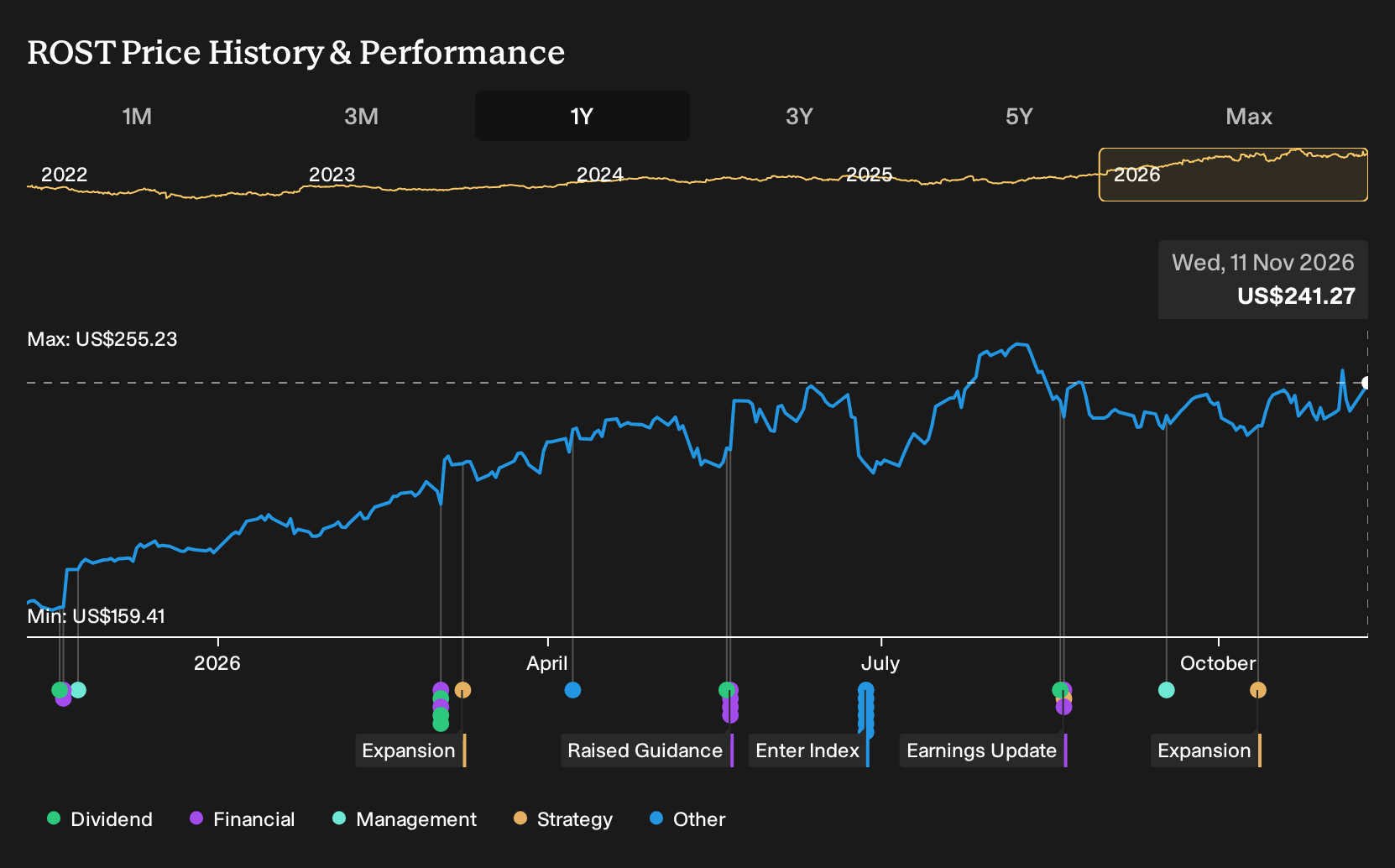
Esteban sets the Ross Stores fair value at $74.69 using a model that assumes revenue will decline 15.0% a year and profit margins will settle at 9.7%, which together describe a conservative earnings path that still supports that valuation under his assumptions.
Uncover why Ross Stores' fair value indicates a 69% potential downside to its current price, leaving little room for error.
Exploring Other Perspectives
One point the lowest analysts focus on is margin pressure at Ross Stores. You can see it in their assumptions. They were modeling profit margins easing from 10.8% to 10.1% and only 7.2% annual revenue growth, yet still forecasting earnings of US$3.1b by 2029. That more cautious stance may shift once the latest earnings land.
Explore 3 other Ross Stores fair value estimates, including one that suggests as much as 69% downside from the current price.
The Verdict Is Yours
Disagree with existing narratives? Extraordinary investment returns rarely come from following the herd, so trust your own analysis and judgment.
- A great starting point for your Ross Stores research is our analysis highlighting 2 key rewards and 1 important warning sign that could impact your investment decision.
- See our latest analysis for Ross Stores. The report includes a comprehensive fundamental analysis summarized in a single visual, the Snowflake, which helps you evaluate Ross Stores' overall financial health at a glance.
Looking for more investment ideas beyond Ross Stores?
Once you have formed a view on Ross Stores, it can help to compare that thesis with other businesses that share similar financial strengths or offer very different return profiles. The Simply Wall St Screener gives you a quick way to scan the market for specific traits that match your own risk tolerance and income or growth goals.
- If you want potential mispricing combined with balance sheet resilience, check out a curated group of quality stocks through our 32 high quality undervalued stocks.
- For investors who care most about reliable income, focus on companies with stronger yields and payout histories through our 6 dividend fortresses.
- When capital preservation matters and you prefer steadier profiles, narrow your search using our 30 resilient stocks with low risk scores.
Have feedback on this article? Concerned about the content? Get in touch with us directly. Alternatively, email editorial-team@simplywallst.com