


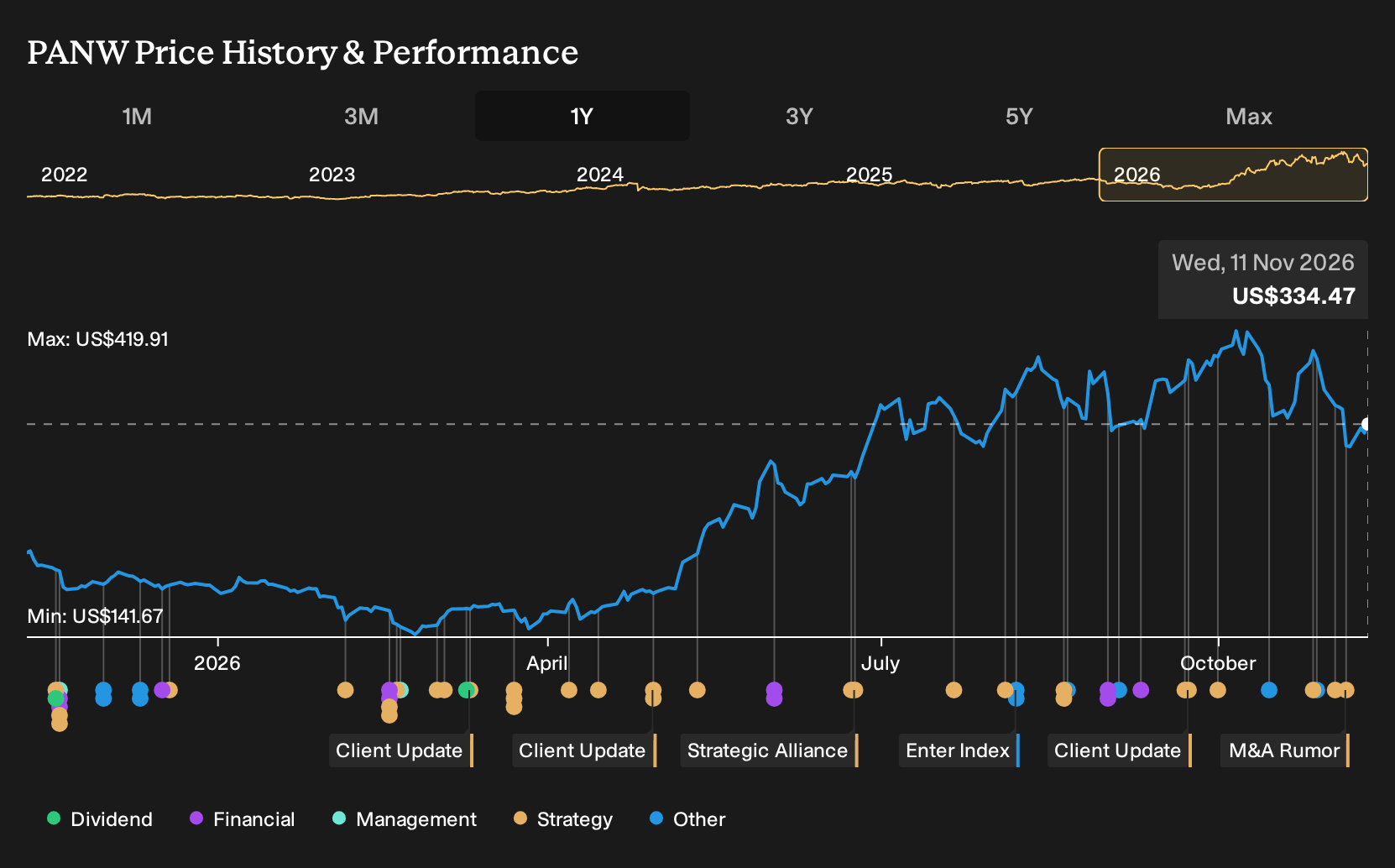
- Palo Alto Networks is reportedly in talks to buy Clutch Security for about US$500 million, aiming to add a digital application that manages cybersecurity services and digital assets to its platform.
- Guardz recently announced it is integrating Palo Alto Networks’ Prisma Browser for Business to link browser, email, identity and endpoint protection for small businesses and managed service providers, underscoring rising demand for unified, AI-aware security workflows.
- Next, the focus turns to how Palo Alto Networks’ rumored Clutch Security acquisition could influence the existing investment narrative around AI led security.
Palo Alto Networks Investment Narrative Recap
To own Palo Alto Networks, you need to buy into the analyst consensus Narrative on Simply Wall St that AI led security platforms, identity tools and observability can turn into multi billion dollar recurring lines while holding margins together. The rumored US$500 million Clutch Security deal would lean into that idea but also adds yet another product to integrate.
In the near term, the key swing factor is execution on platform consolidation and Next Generation Security subscription growth as cyber budgets shift toward AI aware defenses. The biggest current risk sits in margin pressure and dilution, with gross margin already at 75.8% and stock based compensation running at about 17% of revenue.
The Guardz integration of Prisma Browser for Business looks tightly linked to this story. It shows Palo Alto Networks pushing its AI infused browser security into smaller enterprises and managed service providers, tying together email, identity, endpoint and data signals into one incident view rather than isolated alerts.
For catalysts, that kind of real world deployment is what can support higher Next Generation Security ARR and deepen wallet share if customers see value in unified AI workflows. Execution risk is that broader rollouts increase cloud hosting and support costs faster than related subscription revenue, which could add further pressure to already tight margins.
How Palo Alto Networks' AI Story Stacks Up Against Other Security Infrastructure Plays
Palo Alto Networks' narrative projects US$18.5b revenue and US$2.6b earnings by 2029. That profile assumes 17.3% yearly revenue growth and an earnings increase of about US$2.3b from US$307.0m today.
Set Palo Alto Networks alongside a broad AI security infrastructure peer such as 53 AI infrastructure stocks and you are really comparing two routes to the same budget line. One path runs through full stack security suites that fuse network, cloud, identity and observability into a single workflow. The other often leans into the underlying compute, data plumbing and tooling that AI security teams use to build their own detection and response layers.
For investors, that difference matters when thinking about where cyber budgets might migrate next. CISOs that want fewer vendors and one console for policy, telemetry and response are more likely to skew toward platformized security like Palo Alto Networks. Teams that prefer to assemble their own best of breed stack, tying together SIEM, data lakes and model pipelines, may allocate more to the kind of infrastructure and tooling that sits inside the 53 AI infrastructure stocks bucket.
Palo Alto Networks is leaning into AI as an integrated feature across its offerings, from Prisma AIRS to Unit 42 Frontier AI Defense and now a possible Clutch Security style digital service manager. That approach tries to turn AI into a multiplier on existing products, so the value pitch is tighter incident workflows and fewer blind spots. By contrast, companies grouped under 53 AI infrastructure stocks can often monetise AI security spend earlier in the stack, for example when enterprises expand data pipelines, logging, or inference infrastructure to support heavier detection and monitoring workloads.
Risk profiles diverge as well. Palo Alto Networks is working with very high current valuation multiples, including a P/E of 1,055.8x today and an implied 198.3x on the US$2.6b 2029 earnings assumption. That leaves less room if gross margin compression, dilution from roughly 7% yearly share count growth or integration issues around Idira, Chronosphere and any Clutch Security type deal cause earnings to lag analyst expectations. Peers in the 53 AI infrastructure stocks group may face their own concerns around capital intensity, pricing for compute and storage, and customer concentration, even if headline valuation looks different.
Budget timing is another angle to watch. Platform wide AI upgrades at Palo Alto Networks typically show up when contracts renew or when large enterprises standardise more workloads on its stack. Infrastructure projects in the 53 AI infrastructure stocks category can sometimes see spend earlier, for instance when a security team needs more scalable logging or model infrastructure before it commits to a new detection console. That can influence how recurring revenue lines build over time for each side of the AI security arms race.
There is also the question of who owns the key data exhaust. Palo Alto Networks wants telemetry from firewalls, endpoints, identities and SaaS apps to feed models inside its own products. Many AI infrastructure platforms that might sit inside 53 AI infrastructure stocks instead aim to be the neutral data and compute layer underneath a range of security tools. If those platforms succeed in aggregating the richest datasets, they could gain more leverage over how AI driven detection is actually trained and operated, even when the final alert surfaces in a security vendor console.
For a portfolio, that means Palo Alto Networks and 53 AI infrastructure stocks type stocks can express different parts of the same thesis. One leans into security specific workflows and large multi module contracts with enterprises. The other can give exposure to the core AI infrastructure that multiple security vendors and in house teams might depend on. How you weight each side depends on whether you think the real value tilts more toward the security control plane or the underlying AI plumbing that makes those controls possible.
Uncover how Palo Alto Networks' fair value indicates an 18% potential upside to its current price that could close faster than many investors expect.
Exploring Other Perspectives
Some of the most optimistic analysts lean on remaining performance obligations of US$21.2b and a path to US$3.7b in earnings by 2029, which paints a very upbeat story on Palo Alto Networks long term AI security demand. You might see those forecasts differently, especially now that the Clutch Security talks and Guardz integration could push both narratives to evolve.
Explore 5 other Palo Alto Networks fair value estimates, including one that suggests there may be as much as 20% upside from the current price.
Decide For Yourself
Don't just follow the ticker. Dig into the data and build a conviction that's truly your own.
- A great starting point for your Palo Alto Networks research is our analysis highlighting 2 key rewards and 3 important warning signs that could impact your investment decision.
- See our latest analysis for Palo Alto Networks. The report includes a comprehensive fundamental analysis summarized in a single visual, the Snowflake, making it easy to evaluate Palo Alto Networks' overall financial health at a glance.
Looking for more investment ideas beyond Palo Alto Networks?
If Palo Alto Networks has sharpened your interest in AI led security, it can help to widen the lens and compare it with other opportunities that line up with your risk tolerance, income needs and preference for balance sheet strength. The Simply Wall St Screener can surface different sets of stocks that fit those angles, so you can weigh Palo Alto Networks against a mix of alternatives rather than viewing it in isolation.
- Seek potential mispriced opportunities by scanning a 32 high quality undervalued stocks that combine solid fundamentals with more modest expectations baked into their current prices.
- If capital preservation is a priority, focus on stability first and run a screen for 30 resilient stocks with low risk scores that may offer smoother return profiles and fewer financial red flags.
- For investors who want resilience on the balance sheet, start with a list of solid balance sheet and fundamentals (24 results) and use it to compare how other companies manage debt, liquidity and overall financial strength.
Have feedback on this article? Concerned about the content? Get in touch with us directly. Alternatively, email editorial-team@simplywallst.com