


The Zhitong Finance App learned that when the artificial intelligence company Anthropic (ANT.US) starts trading after the expected listing next week, its stock price performance in the first few weeks will mainly depend on who has to buy it, not who wants to buy it. Investors are studying SpaceX's successful listing process in June this year to find clues.
Elon Musk's SpaceX (SPCX.US) rewrites the old approach to listing shares of giant companies: major US index providers such as NASDAQ have rewritten inclusion rules to ensure that a large pool of passive capital buys stocks within the first 15 days after listing. Investors expect Anthropic to see the same dynamic. The developer of this Claude chatbot plans to issue 825 million shares at $70 to $78 each, raising a maximum capital of $644 billion, and a maximum valuation of the company of $1.4 trillion.
In the past, major index vendors usually didn't include the company in the benchmark index until weeks or months after the company went public. But like SpaceX, Anthropic will be included in at least six major indices within 5 to 15 days of listing, including the FTSE US Index, the S&P All Markets Index, and the Nasdaq 100.
“Anthropic is a mirror image of SpaceX's IPO. As far as this is concerned, it had the same index-related drive as SpaceX during the first 15 days of listing and trading.” Carsten Hesse (Carsten Hesse), head of London's Berenberg Index events, said.
Intropic, a London-based index rebalance analysis company, estimates that passive demand from index-tracking funds will account for about 28% of Anthropic's shares issued, or about $19 billion. Funds that rebalance indices and hedge funds bid to open positions ahead of time before this anticipated passive demand occurs.
SpaceX left one-fifth of its $75 billion offering to retail investors, more than double the regular level, and valued at nearly $1.75 trillion. Anthropic is doing the same thing.
Index funds and retail investors together took nearly half of SpaceX's shares sold, and other fund managers opened positions ahead of schedule to meet this demand. This created upward momentum for the small portion of tradable shares that were initially publicly sold. Similarly, Anthropic's shares in this IPO account for only about 6% of its total outstanding share capital.
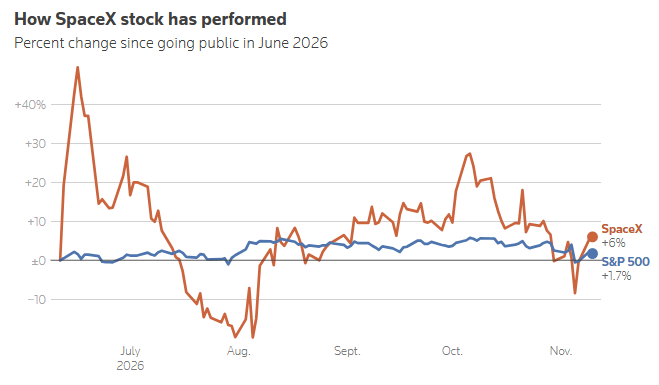
SpaceX and SK Hynix, a South Korean company listed on the NASDAQ in July of this year, both experienced a sharp jump in stock prices on the third day of listing — the day options trading began, and speculators hedged their derivatives positions by buying underlying shares. Anthropic's stock will also see similar early buys, analysts say.
“You won't wait until day 5, day 10, or day 15 to see the index upgraded or included in the actual implementation.” Hesse said, “As we saw with SpaceX, people bought ahead of time.”
A game-changer for index trading
By the third day, SpaceX's stock price had cumulatively increased 50% from the opening price of $150 on the first day of listing, and remained well above the issue price of $135 for the first 15 days. Since then, the stock price declined as investors began preparing for the first batch of lockdown periods to expire — at which time employees and other pre-listing shareholders were allowed to sell.
Intropic stock analyst Ruben Pathmanathan (Ruben Pathmanathan) said that buying with very low price elasticity has driven this round of the market. “The reason SpaceX is likely to be a blueprint is that several market forces revolve around the listing simultaneously: index inclusion, passive demand, and a highly concentrated circulation market. Together, they determined how the stock was priced and how it was traded for the first few days.”
Anthropic's path may be slightly different: it allows employees who hold approximately 15% of the company's shares to sell part of their shares on the first day of listing.
Anthropic is also raising $26 billion from cornerstone investors through an independent private placement. Investors include Google (GOOGL.US), NVDA.US (NVDA.US), and AMD (AMD.US). There is no lock-up period for these shares.
New index rules and huge capital flows have become game changers for those funds that profit from index rebalancing transactions. “It's an evolution of the market.” Brian Hartigan (Brian Hartigan), head of global ETF and index investing at Invesco, said he was referring to the novelty of this large-scale issuance, which accumulated huge amounts of private shares before listing.
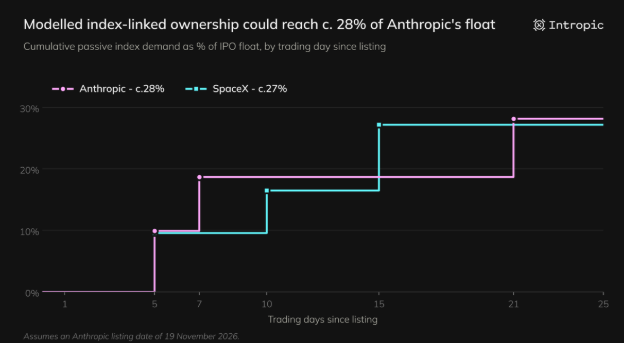
Traditionally, index rebalancing deals are limited by the size of IPOs — too many funds are trying to get away with limited passive demand. For giant IPOs, this issue is less prominent.
“This is the type of opportunity the arbitrage community likes because the risk of crowding is relatively limited.” Celia Fseil (Celia Fseil), head of gender strategy for the stock market at Candriam, said.
According to reports, Millennium Management's two teams engaged in index movement trading made $3.7 billion in June. Millennium has not been confirmed.
“If you do exponential rebalancing, these are probably events you'll only encounter a few times in a lifetime.” Bill Park (Bill Park), chief investment officer at Altisma Capital Management in Connecticut, said.