


The Zhitong Finance App learned that as the promotion and application of artificial intelligence (AI) continues to drive growth in corporate and consumer spending, and the economy still shows resilience under the energy shock caused by the Iran war, the British economy has achieved the fastest growth rate in two and a half years. According to data released by the UK Office for National Statistics (ONS) on Thursday, the gross domestic product (GDP) grew by 0.7% in the third quarter, higher than the 0.5% increase in the second quarter, and the growth rate accelerated. This figure is in line with economists' median expectations.
Among them, in September alone, the UK GDP grew by 0.2%, better than the zero growth expected by the market. In September, all major sectors of the UK economy grew, with manufacturing growing by 0.7% and construction expanding by 0.8%.
Since the outbreak of the war in Iran, the UK economy has shown resilience beyond expectations, and spending on AI applications has contributed to economic growth. UK Chancellor of the Exchequer John Healy said on Wednesday that his goal is to once again exceed economic growth forecasts in 2027. Economists have also raised their forecasts for the UK's economic growth this year. However, the Bank of England expects the quarterly economic growth rate to slow to 0.3% in the fourth quarter and remain at 0.2% throughout 2027.
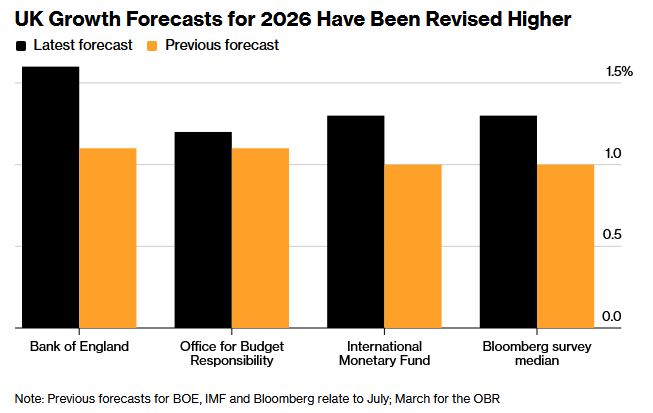
The UK economic growth forecast for 2026 continues to rise
According to the UK Office for National Statistics, the business-oriented service sector boosted economic growth in the third quarter. Among them, the promotion and application of AI led to a 2.1% increase in output in the information and communication industry. Overall, the services sector grew by 0.9%. At the same time, the manufacturing industry also showed signs of AI-driven growth, which also expanded by 0.9%. Within the manufacturing industry, production of computers, electronics and optical products increased 4.6%. Corporate investment increased 3% over the same period last year. Faced with another round of inflationary shocks, British households also showed little sign of tightening spending — consumer spending rose 0.6%, higher than economists' expectations.
Jack Finney, senior economist at PricewaterhouseCoopers, said, “It is important to note that economic growth is currently still concentrated in a relatively limited number of industries related to AI infrastructure construction. But as AI applications continue to spread across the economy, we have every reason to believe that the benefits of AI may begin to expand to other industries by 2027.”
British Prime Minister Andy Burnham welcomed this set of data. In a statement, he said: “Despite events around the world over the past year driving up domestic costs in the UK, our economy continues to grow and gives hope for the future.”
A series of previously released data also showed the resilience of the British economy. The UK labour market is also showing signs of stabilization — in the three months ending August, the unemployment rate fell to 4.7% from 4.9% previously, and the number of salaried workers increased by 13,000 in September. The Composite Purchasing Managers' Index (PMI) rose to 52.9 in October, hitting an eight-month high, and both manufacturing and service activity improved.
Since this year, the UK's economic growth has been mainly driven by the technology industry and business services. In the face of rising energy costs and borrowing costs, consumer spending also performed better than many people were worried, and households used savings to cushion the impact.
The British government has so far announced only limited aid measures to help families withstand this shock. Although the recent drop in oil prices may give consumers some relief at gas stations, it is expected that the next time the UK adjusts the upper limit of energy prices in January next year, gas and electricity bills will rise by about a quarter.
The acceleration of economic growth has also increased the pressure on the Bank of England to raise interest rates again. The Bank of England announced on November 5 that it would raise the benchmark interest rate by 25 basis points to 4%. The Monetary Policy Committee passed this decision with an 8-1 vote. The Bank of England pointed out that the UK consumer price index (CPI) rose 3.5% year on year in September. Against the backdrop of continued high energy prices, inflation is expected to rise to about 5% in mid-2027. Meanwhile, recent economic activity has performed better than expected, and the labor market is showing signs of stability, increasing the risk that rising energy prices will spread to wider inflation. Investors currently tend to think that the bank will raise interest rates further in December.