


The Zhitong Finance App learned that Cui Dongshu, Secretary General of the Passenger Federation Branch, published an article stating that in 2026, the average price of passenger cars was 172,000 yuan, an increase of 50,000 yuan over the same period. Due to Tesla's abnormally low price, the average price of passenger cars was 162,000 yuan in October, down 10,000 yuan from the same period. In October, the penetration rate of new energy in all levels of the market exceeded 50%. The highest penetration rate of new energy vehicles is a small car. In October, the new energy penetration rate for mini cars was 100%, A0 class cars reached 91% of new energy, the penetration rate of C-class cars of new energy was 73%, and the penetration rate of B-class new energy was 69%. The penetration rate of A-class new energy increased relatively well, and the penetration rate reached 50% in October.
The average price of luxury cars in 2026 was 330,000 yuan, down 30,000 yuan from 2025; in October 2026, the average price of luxury cars was 330,000 yuan, up 20,000 yuan over the same period. The 2026 joint venture brand was 171,000 yuan, which is basically the same as in 2025; the average price of 167,000 yuan in October 2026 decreased by 20,000 yuan compared to the same period. The new forces in 2026 were 230,000 yuan, down 10,000 yuan from 2025; in October 2026, the average price was 216,000 yuan, down 16,000 yuan from the same period. In 2026, the average price of independent brands was 128,000 yuan, an increase of 60,000 yuan over the same period; in October 2026, the average price of independent brands was 125,000 yuan, an increase of 50,000 yuan over the same period.
1. Passenger car prices increased slightly
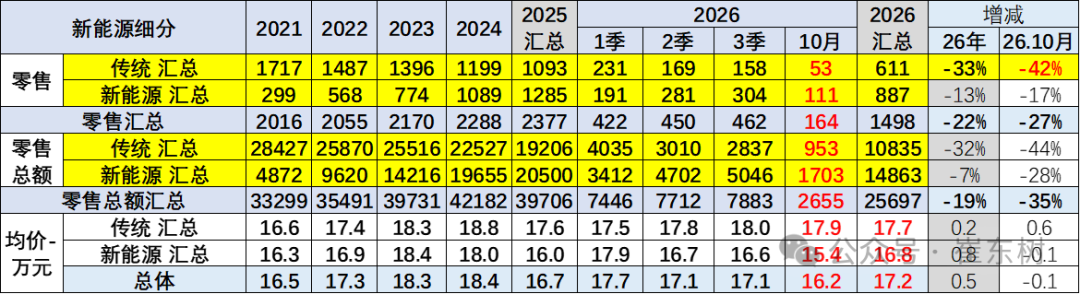
Price changes are mainly affected by structural changes and changes in sales volume. The volume-price relationship is the opposite; price increases fall, and low prices increase. As sales grew slowly, the average price in the car market continued to rise. The average retail price of passenger cars was 165,000 yuan in 2021; the average price rose to 184,000 yuan in 2024; the average price of passenger cars in 2025 was 167,000 yuan, down 17,000 yuan from the average price in 2024; the average price of passenger cars was 172,000 yuan in 2026, an increase of 50,000 yuan over the same period. Due to Tesla's abnormally low price, the average price of passenger cars was 162,000 yuan in October, down 10,000 yuan from the same period.
The price of conventional fuel vehicles continues to rise. The market contraction is obvious in the middle and low end, while the high-end shrinks slowly, so it has risen from 166,000 yuan in 2021 to 188,000 yuan in 2024. In 2025, with the rapid contraction of high-end fuel vehicles, the average price in 2025 dropped to 176,000 yuan. The average price of conventional fuel vehicles was 179,000 yuan in October 2026, and fuel vehicle buyers contracted across the board.
Recently, the average price of new energy vehicles has gradually declined, from the average price of 184,000 yuan in 2023 to 180,000 yuan in 2024, and the average price of new energy vehicles is 160,000 yuan in 2025. The price drop is significant. October 2026 was 154,000 yuan, down 10,000 yuan from the same period. Excluding Tesla interference, the volume was still falling and prices rising, reflecting structural changes in NEV consumption.
2024-2025 was promoted by end-of-life renewal and trade-in subsidy policies, and sales in the middle and lower end increased significantly, so average prices declined and the market picked up. Since the popularity of private cars in China is relatively backward, the reduction in average prices promotes all-round development of the market, which is conducive to the popularization and increase in the scale of the car market.
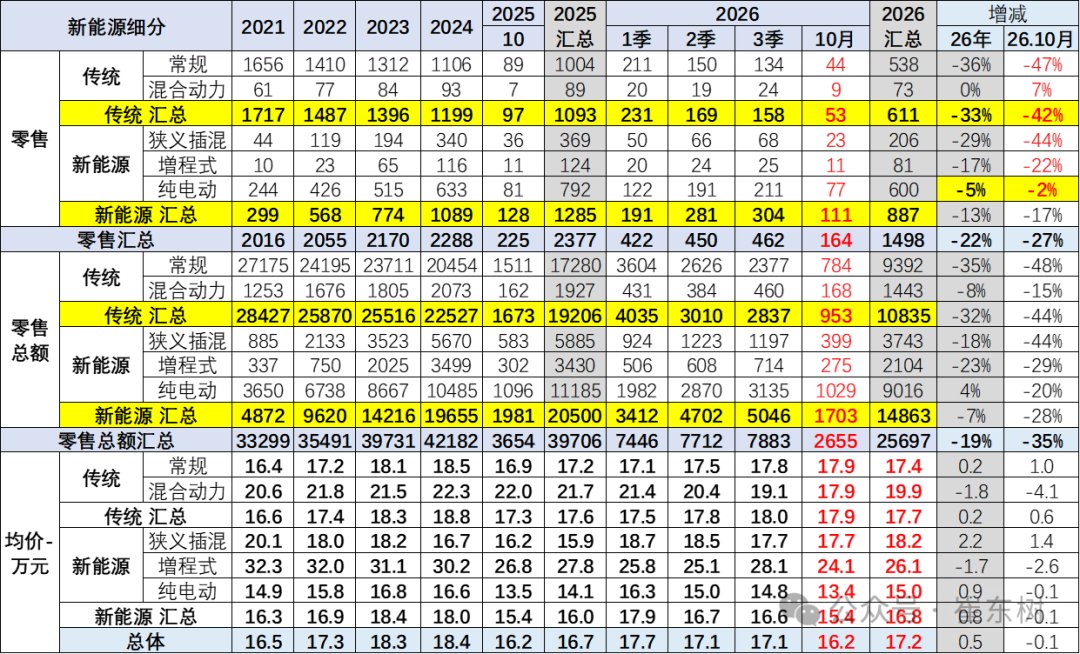
The highest average price in the car market is for extended-range and hybrid vehicles, and the lowest is for pure electric vehicles. The structural reason for the recent decline in average price is the increase in the share of A0 grade pure electric power, and the decline in the share of higher-cost extensions and hybrid power, creating structural impetus. The growth rate of new energy sources declined in October 2026, and Tesla's retail sales were low at the beginning of the quarter. The shrinkage of fuel vehicles led to a huge drop in the prices of plug-in hybrid and pure electric vehicles. As a result, the overall average price in October was 162,000 yuan, a relative drop of 10,000 yuan.
In an objective reality where the popularity of the Chinese car market is low, the long-term decline in average prices in the car market reflects an increase in purchases by middle- and low-end people. It should be a good thing to have an increase. However, retail sales declined in October 2026, and the high-end fuel vehicle market was under great pressure, and the overall market was sluggish.
2. Low-end contraction of the passenger car market price segment sales structure
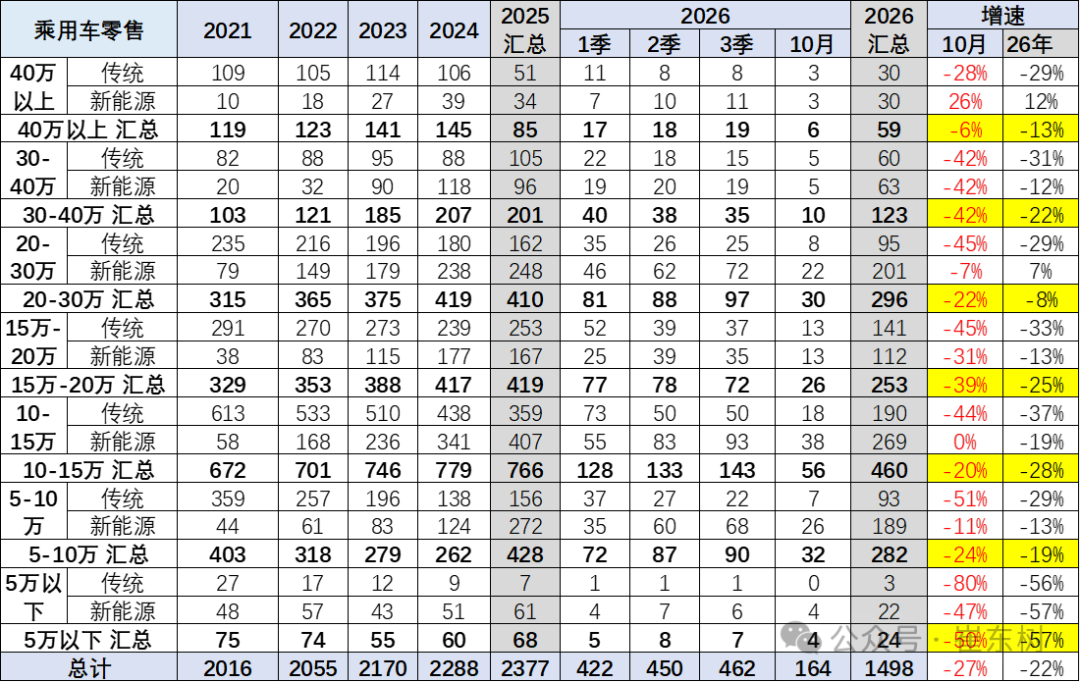
According to Passenger Link data, the price segment structure trend in the national retail market continued to rise in previous years. Sales of high-end new energy models increased markedly, while sales of medium- and low-priced models declined. In 2025, with the promotion of the end-of-life renewal policy, the middle- and low-end car market picked up, and medium- to low-end consumption rebounded. In 2026, along with the high-quality development of policies, the A00 declined sharply. Among them, the drop was 50%, which was drastic, while sales of traditional major models also declined sharply, causing poor entry-level consumption pressure. Fuel vehicles were sluggish and mixed were poor, which together curtailed the growth of the car market.
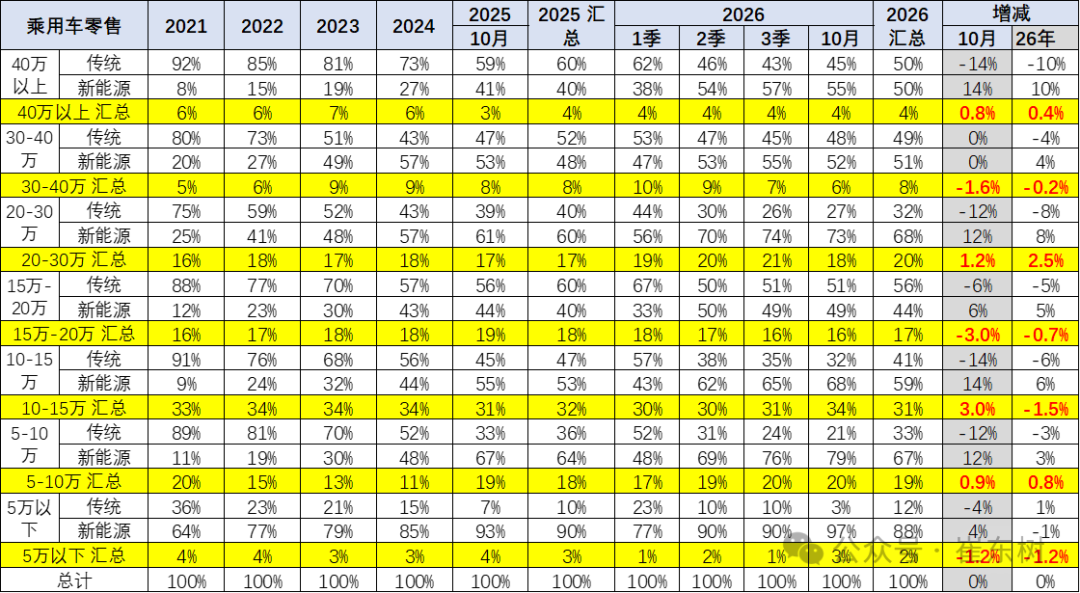
Currently, new energy in most price segments has exceeded 50%, and only 150,000 to 200,000 fuel vehicles are still highly competitive.
Autonomous high-end breakthroughs reflect the obvious trend of high-end development brought about by the growth of new energy sources for passenger cars, but the breakthrough was based on stability at the low end. Currently, the downward trend in entry-level new energy sources is quite severe. High-end consumption is reflected in the fact that ordinary consumption is not strong. People's consumption is fundamental. Although high-end consumption is strong, it actually shows that the car market is generally weak.
3. Passenger car grade market sales structure
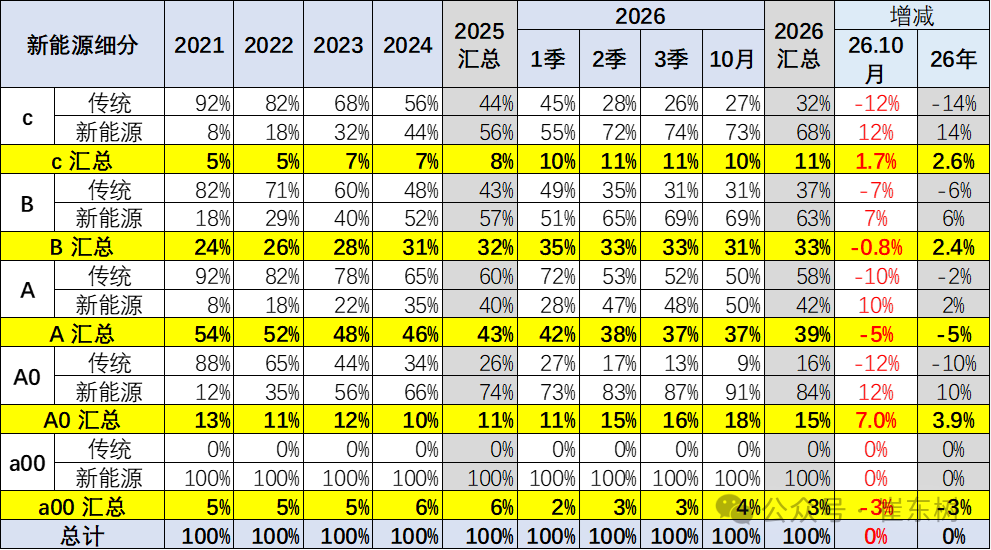
The penetration rate of new energy sources is highest at both high and low levels, and Class A is the lowest. In October, the penetration rate of new energy in all levels of the market exceeded 50%. Recently, the highest penetration rate of new energy vehicles is a small car. In October, the new energy penetration rate for mini cars was 100%, A0 class cars reached 91%, C-class cars had a new energy penetration rate of 73%, and B-class new energy penetration rate was 69%. Class A new energy had increased relatively well, and the penetration rate reached 50% in October.
The new energy penetration rate of B-class cars continues to increase, and the performance of extended-range models has improved. The new energy penetration rate of C-class cars has increased dramatically, reflecting the obvious advantages of high-end electrification.
4. New energy line structure for passenger cars
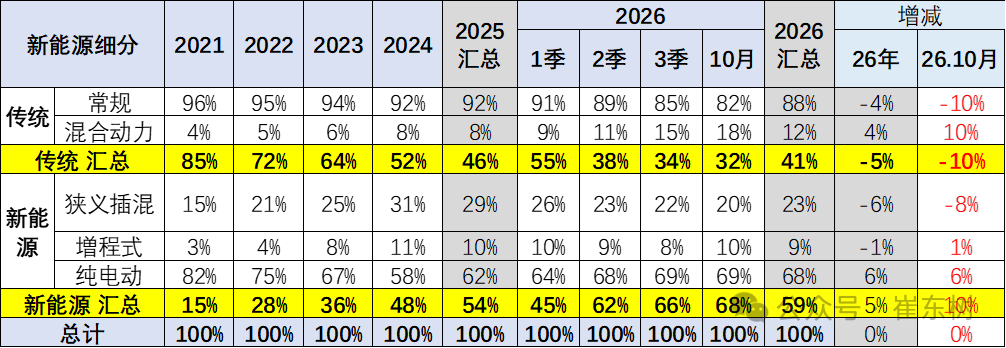
Domestic retail sales of pure electric new energy vehicles continue to grow at a high rate. Among them, plug-in hybrid performance was outstanding in previous years, but recently plug-in hybrids have had less short battery life, and demand for long-life plug-in hybrids has clearly been replaced by pure electric ones. Due to too many new products, the growth rate continued to increase slightly in October this year. Sales of traditional passenger cars are under continuous downward pressure.
The share of new energy vehicles reached 59% in 2026, and the penetration rate of new energy vehicles reached 68% in October 2026, and the contribution of new energy vehicles driven by high fuel prices increased significantly.
5. Sales structure of internal dynamics in each price segment in October 2026
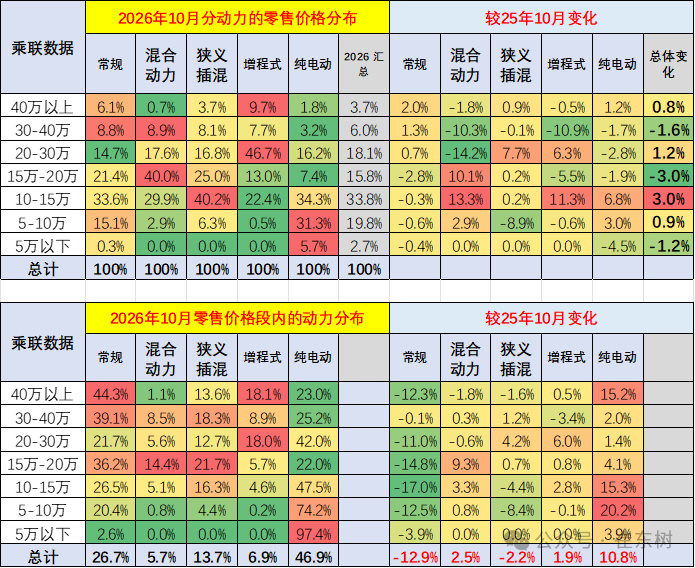
Retail data for October 2026 showed that the share of pure fuel vehicles fell 12.9% year on year, pure electricity increased 10.8%, and new energy continued to squeeze the fuel market. The market shows clear price stratification: under 100,000 yuan is dominated by pure electricity; 100,000 to 150,000 yuan is the Red Sea of competition for fuel, plug-in blends, and pure electricity; 150,000 to 200,000 yuan fuel shrinks drastically, and hybrid and narrow plug-and-mix quickly seize share; 200,000 to 300,000 yuan of pure electricity accounts for more than 40% of the home market; fuel above 300,000 yuan still holds volume, hybrid, and pure electricity compete. The expansion program has begun to penetrate downward into the 100,000 to 150,000 yuan range. The original high-end market share has shrunk, and the price bands for various power categories are being restructured.
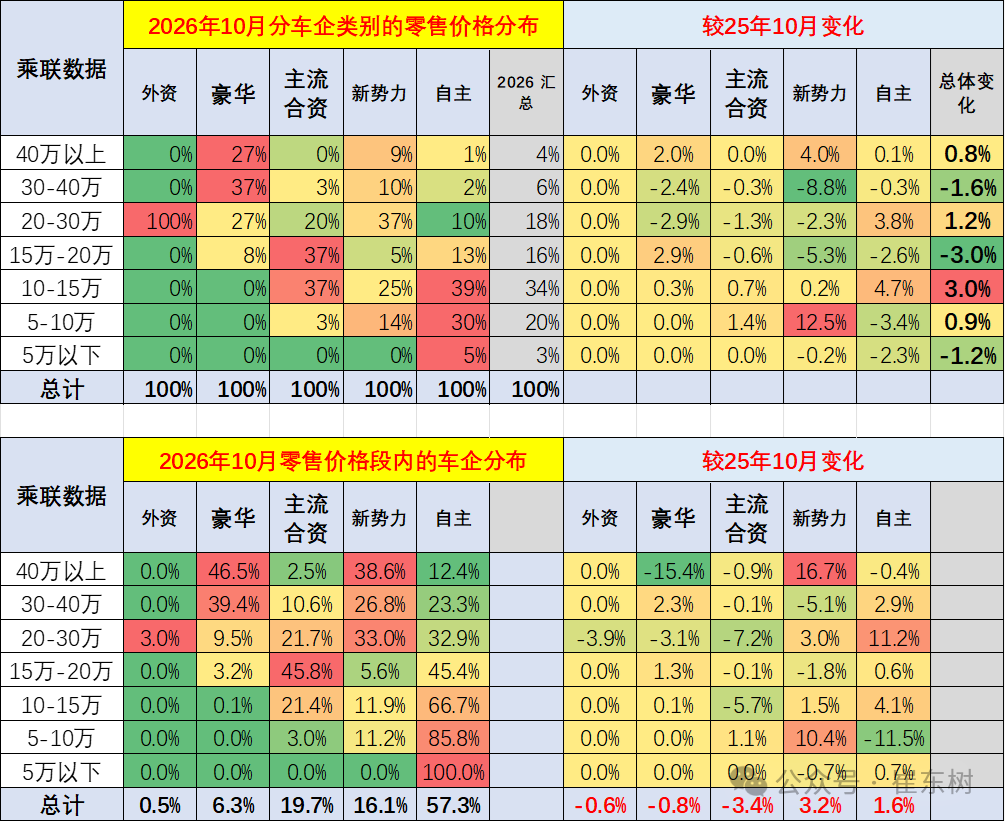
Retail data for October 2026 showed that the overall share of new forces surged by 3.2%, while mainstream joint ventures declined by 3.4%. Market price differentiation is remarkable: 5-10 million yuan is being diverted by new low-price forces, and under 50,000 yuan is almost monopolized by independent brands; 10,000 to 150,000 yuan has an absolute advantage; 150,000 to 200,000 yuan is the core battleground for autonomous and mainstream joint ventures; 200,000 to 300,000 yuan new forces have become the main force to seize the middle and high-end; the share of luxury brands above 400,000 yuan is under pressure, and new forces and independent high-end continue to encroach on the high-end market. The price band of the new forces continues to fall, breaking through upward on their own, and joint ventures and luxury are being squeezed in both directions.
6. Changes in market average prices for various brands
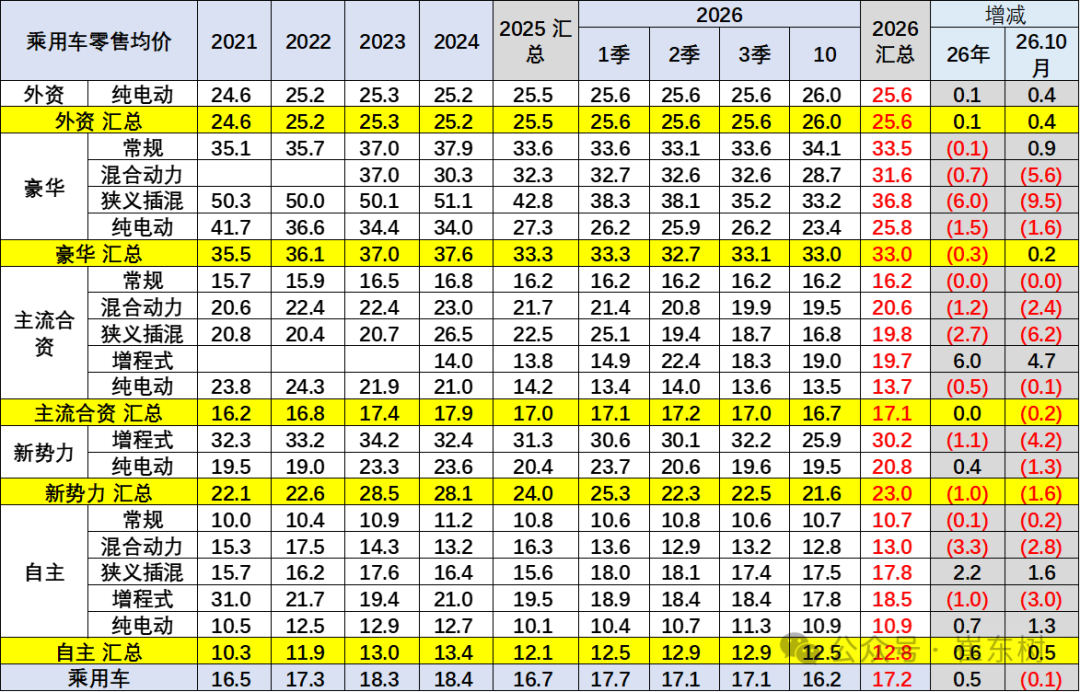
The average price of luxury cars in 2026 was 330,000 yuan, down 30,000 yuan from 2025; in October 2026, the average price of luxury cars was 330,000 yuan, up 20,000 yuan over the same period. The 2026 joint venture brand was 171,000 yuan, which is basically the same as in 2025; the average price of 167,000 yuan in October 2026 decreased by 20,000 yuan compared to the same period. The new forces in 2026 were 230,000 yuan, down 10,000 yuan from 2025; in October 2026, the average price was 216,000 yuan, down 16,000 yuan from the same period. In 2026, the average price of independent brands was 128,000 yuan, an increase of 60,000 yuan over the same period; in October 2026, the average price of independent brands was 125,000 yuan, an increase of 50,000 yuan over the same period.
Independent brand new energy sources are at full strength. Both pure electric and hybrid performance are under high pressure, and hybrid performance is strong. Overall, the price competitiveness of high-end new energy sources has increased. The structure of new forces has fluctuated greatly, and the pure electric market has clearly weakened. In October 2026, the average price of autonomous fuel vehicles was 107,000 yuan, down 20,000 yuan from the same period; in October, autonomous pure electric vehicles were 109,000 yuan, an increase of 13,000 yuan over the same period, and the car purchase threshold was seriously raised.