


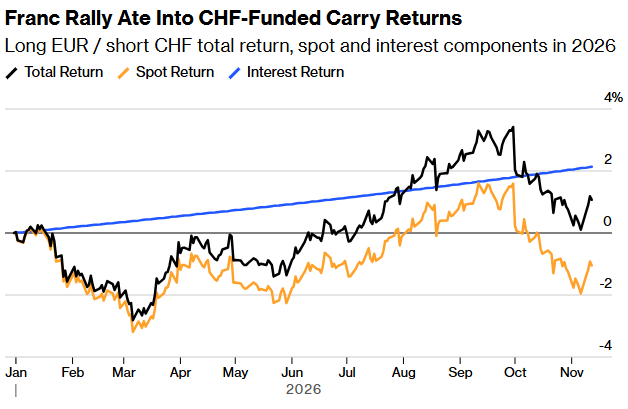
The Zhitong Finance App learned that a popular bet around the Swiss franc is declining. This has added fuel to the Swiss franc's rise, and has also caused the market to speculate on the extent to which the Swiss central bank will tolerate the appreciation of the local currency. The Swiss franc is a safe haven currency for investors when the situation in Europe is uncertain. It strengthened in October amid violent protests and political turmoil in France. This round of increases eroded the return on so-called arbitrage transactions: investors took advantage of Switzerland's low borrowing costs to invest their capital in currencies with higher interest rates.
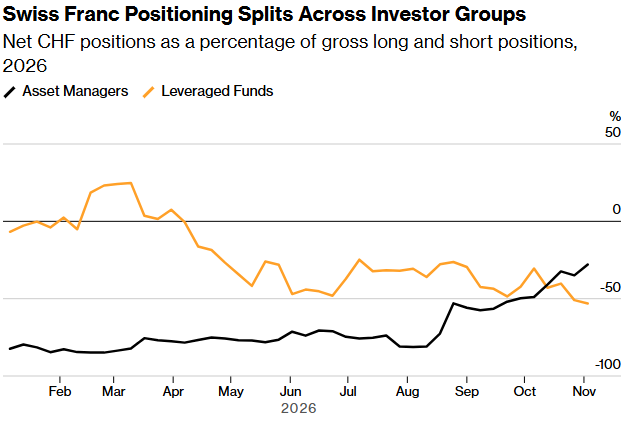
The annual return on selling the Swiss franc and buying the euro narrowed to 0.1% last week, and was still 3.4% at the end of September. According to data from the US Commodity Futures Trading Commission (CFTC), asset management companies have cut their bearish positions on the Swiss franc as the attractiveness of this transaction has declined; however, leveraged funds still hold large amounts of net short positions. Once positions are reversed, they may further boost the Swiss franc.
“If risk aversion continues, this remaining position is a potential source of additional demand for the Swiss franc,” said Gregor Hirt, multi-asset global chief investment officer at Allianz Global Investors (Allianz Global Investors).
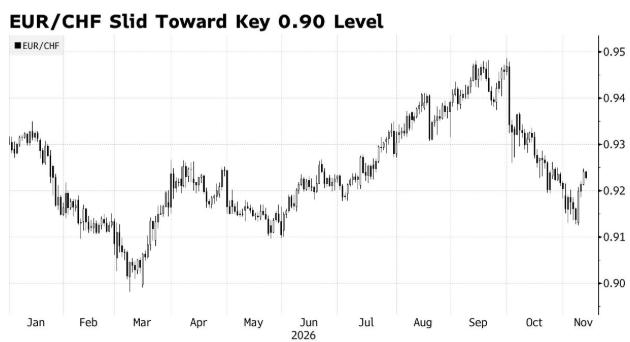
Over the weekend, the Swiss franc rose to 0.91,376 CHF to 1 euro, the strongest level since May, and has weakened slightly since then. Shaun Osborne, chief foreign exchange strategist at Scotiabank (Scotiabank) of Canada, said that any trend falling below 0.90 “will make policymakers feel uncomfortable, especially when the Swiss franc appreciates rapidly.” He predicts a return to 0.93 by the end of the year.
SNB officials told the government at a meeting on Wednesday that the agency is ready to intervene in the foreign exchange market if necessary. J.P. Morgan strategists expect the SNB to calm sharp fluctuations rather than “completely stop or reverse the appreciation of the Swiss franc.”
In addition to speculative demand, Florian Ielpo, macro director at Lombard Odier Investment Managers (Lombard Odier Investment Managers), believes that the strong Swiss economy and low level of government debt mean that investors have a “structural demand” for the Swiss franc, especially when the European political situation is difficult.
Osborne also pointed out that after Switzerland's inflation rate accelerated from 1% a month ago to 1.5% in October, the Swiss central bank may be more tolerant of the strengthening of the Swiss franc.
Van Luu, head of currency and fixed income strategy at Russell Investments (Russell Investments), said he would prefer to short the Swiss franc against the yen rather than the euro. Since the yen is also considered a safe-haven currency, there is less risk of exchange rate fluctuations caused by political turmoil. He also said that the yen is about 50% cheaper than it should be against the US dollar, while the Swiss franc seems to be overvalued by about 20% against the US dollar.
Hirt said that in a situation where European political risks persist and French budget discussions are still ongoing, it is difficult for real money investors to substantially return to bearish bets on the Swiss franc.
“Especially for target assets in Europe, currently using Swiss franc financing is tantamount to shorting regional safe-haven currencies to bear regional risks,” he said. “We will be cautious about this at a time when interest spreads in France are high.”