


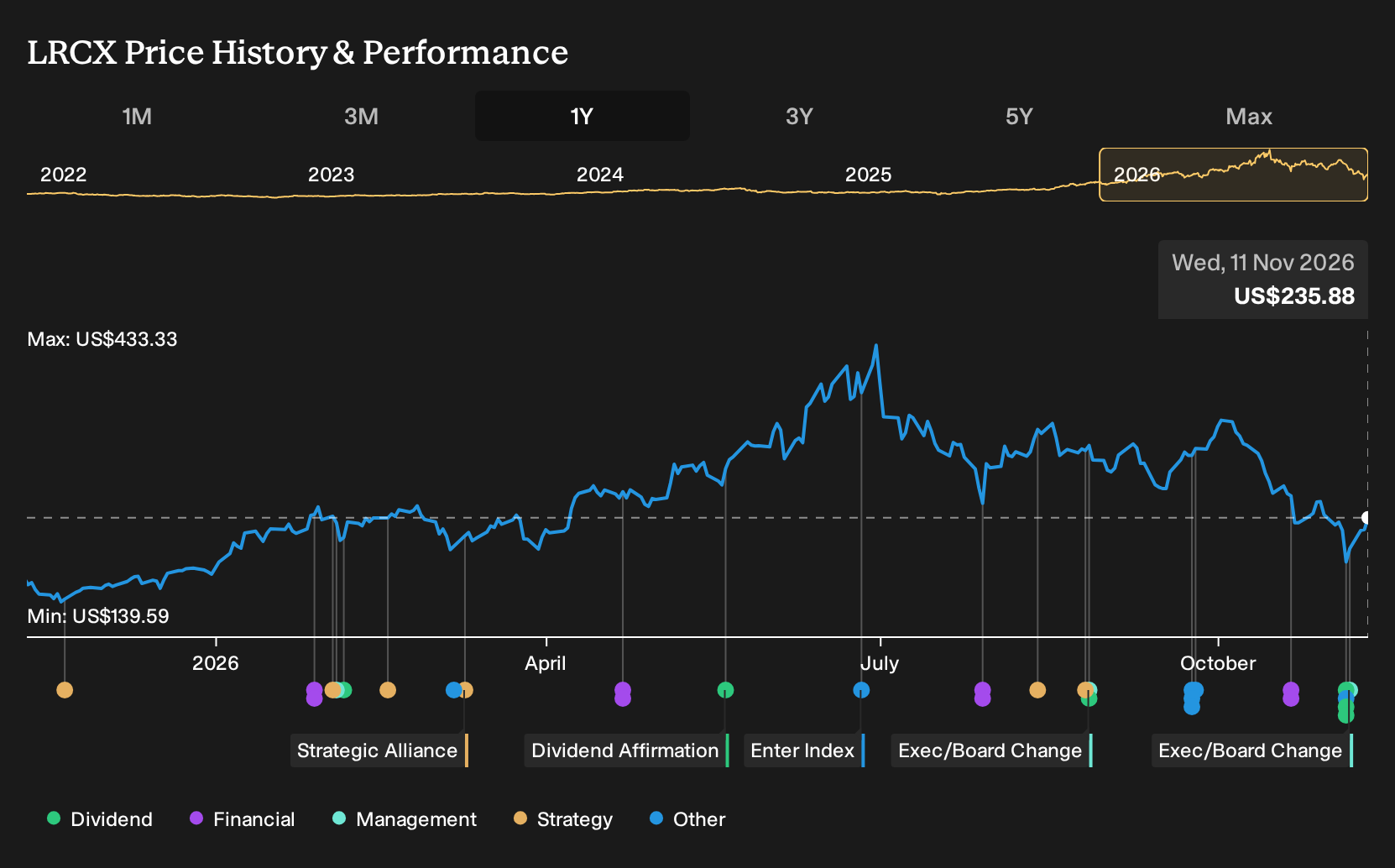
- Lam Research approved a US$25b share repurchase program with no termination date and reaffirmed its quarterly dividend of US$0.33 per share, following a quarter of record revenue and record gross margin driven by stronger demand and a supportive business mix.
- The combination of a very large buyback authorization and sustained profitability signals management’s focus on long-term capital returns, while memory makers weigh future equipment spending and policy risks tied to China.
- The focus now shifts to how Lam Research’s large, open-ended buyback shapes the existing thesis around AI-driven memory equipment demand.
Lam Research Investment Narrative Recap
To own Lam Research, you need to believe the AI driven memory capacity buildout keeps requiring heavy spending on etch and deposition tools that only a few players can supply at scale. According to isidrohg, an investor in the Simply Wall St Community, Lam earns when memory is tight and when manufacturers rush to add or upgrade capacity. The central near term catalyst is how quickly that NAND conversion cycle and broader wafer fab equipment spending translate into new orders. Recent headlines around the US$25b buyback and dividend affirmation do not materially change that operating story.
The biggest current swing factor is still memory maker capex and export policy toward China, not capital returns. Risks that spending slows or is deferred would likely show up first in Lam Research’s order book, deferred revenue and customer deposits, even if reported results stay strong for a while because of long lead times. Investors also need to watch significant recent insider selling and the high level of non cash earnings flagged in the risk checks, since both can complicate how you read headline profit quality in the short run.
The US$25b share repurchase authorization with no end date is the announcement that matters most for this discussion. It sits on top of a quarterly dividend of US$0.33 per share, record revenue, a 52.4% non GAAP gross margin in Q1 FY2027 and management’s guidance around mid US$150b wafer fab equipment spending in 2026 and above US$200b in 2027. That combination underlines how Lam Research is leaning into returning cash while the AI driven memory upgrade cycle plays through the system.
For catalysts, the interesting angle is how this buyback interacts with any future volatility in orders tied to AI spending, China rules or a possible pause in memory capex. The authorization gives Lam room to absorb some share price swings without touching the core operating plan that is anchored in high aspect ratio etch, 3D NAND conversions and customer support on a large installed base, which is what isidrohg focuses on. Execution in Korea under the new country head also matters, given Korea’s role as a key memory hub feeding the same AI demand narrative.
On those inputs, isidrohg’s narrative arrives at a fair value of US$423.85 by applying 16.7% annual revenue growth and a 31.3% future profit margin, then using a P/E no higher than Lam Research’s typical range so the appraisal leans on earnings power rather than multiple expansion.
Uncover how Lam Research's fair value indicates a potential 80% upside to its current price that could narrow quickly as sentiment catches up.
Exploring Other Perspectives
One alternate angle you should weigh is China risk. The most cautious analysts worry export controls could bite much harder than Lam Research’s buyback implies, despite their own forecasts already baking in revenue of about US$46.5b and earnings of roughly US$16.6b by 2029. That is a far more pessimistic story on access to Chinese demand, and it shows how sharply opinions can differ before this week’s repurchase news and Korea leadership change are fully reflected. It is worth comparing several such viewpoints before you decide what this new capital return plan might mean for you.
Explore 8 other Lam Research fair value estimates, including one that suggests as much as 25% downside from the current price.
The Verdict Is Yours
Disagree with existing narratives? Extraordinary investment returns rarely come from following the herd, so consider trusting your own analysis and judgment.
- A great starting point for your Lam Research research is our analysis highlighting 4 key rewards and 2 important warning signs that could impact your investment decision.
- See our latest analysis for Lam Research. The report includes a comprehensive fundamental analysis summarized in a single visual, the Snowflake, making it easy to evaluate Lam Research's overall financial health at a glance.
Looking For More Ideas Beyond Lam Research?
Once you have a view on Lam Research, it can help to compare that thesis with other opportunities that match your risk tolerance and income needs. The Simply Wall St Screener gives you a structured way to scan for businesses that fit specific financial traits rather than relying only on headlines or hunches.
- If you want stability and prefer companies that aim to protect capital during rough patches, consider starting with 30 resilient stocks with low risk scores that already clear strict resilience checks.
- For investors who care most about quality at a reasonable price, you can widen your watchlist with a 32 high quality undervalued stocks that combine strong fundamentals with attractive pricing signals.
- If you are trying to avoid weak balance sheets, narrow your search to a list of solid balance sheet and fundamentals (23 results) so you are focusing on businesses with healthier financial foundations.
Have feedback on this article? Concerned about the content? Get in touch with us directly. Alternatively, email editorial-team@simplywallst.com