


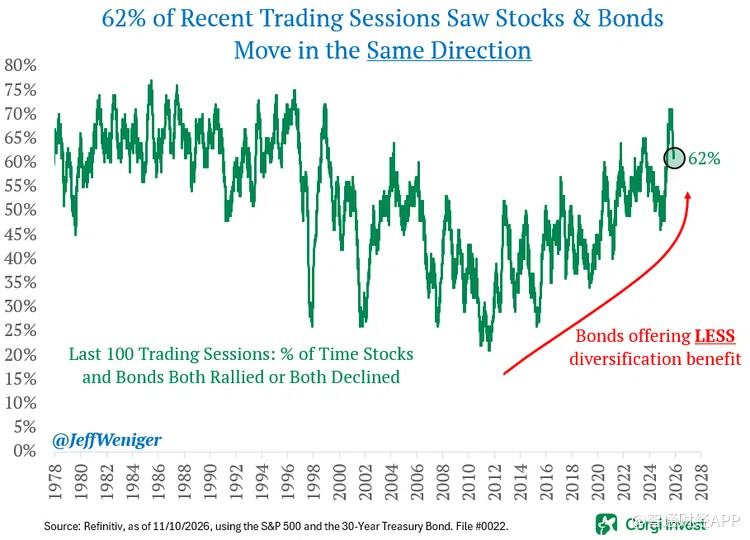
The Zhitong Finance App learned that Jeff Weniger, chief investment strategist at Corgi Invest, posted on the social networking platform X that out of 100 trading days up to November 10, the S&P 500 index and 30-year US Treasury bonds had the same rise and fall for 62 trading days. This data shows that the hedging effect of US stocks and long-term bonds has been greatly weakened, and investors have relied on these two types of assets in the past to cushion portfolio fluctuations.
The data shows that the S&P 500 index and the 30-year US Treasury bond index recently reached about 70%, then fell back to 62%. The indicator tracks the proportion of two types of assets rising or falling at the same time over the past 100 trading days.
Historical data dating back to 1978 shows that this relationship has changed significantly over time. The indicator fell to early 20% around 2011, and remained at 30% to 40% for most of the mid-2010s, during which time it fell to the middle of 20%.
For most of the period from 2017 to 2019, the indicator was roughly between 35% and 55%; in the earlier decades, there was also a period where stocks and bonds fluctuated frequently in the same direction.
Weniger said the current model is similar to the 1980s and 1990s, when investors experienced a long period of simultaneous rise or fall in stocks and bonds. In practice, when stocks and long-term treasury bonds fall at the same time, the hedging effect of bonds on stock losses weakens, thereby reducing diversified returns.
It is worth noting that the safe-haven function of US bonds has recently returned in a phased manner. At the beginning of November, US technology stocks were sold off, and safe-haven funds poured into the bond market at an accelerated pace, driving back US bond yields. However, the basis for this round of safe-haven purchases is not strong: investors are highly sensitive to the path of interest rate hikes. Currently, the market generally expects that the Fed's interest rate hike in December is almost a foregone conclusion; after October's CPI completely exceeded expectations, US bond yields rose. Industry insiders believe that inflation is still the core variable that determines the direction of US bond yields, and US fiscal expansion will continue to disrupt the market in the medium to long term.