


Recently, another astonishing sub-IPO appeared in the Hong Kong stock market.
On November 11, the insurance technology company White Pigeon Online (02672) staged a high-ranking flash crash. Previously, the company's stock price continued to rebound from a low of HK$31.48 on September 9, hitting an intraday high of HK$150 on November 11, rising more than 350% in just two months. However, in the afternoon of the same day, only about an hour before the market closed, the stock price suddenly plummeted and finally closed at HK$40.90, which plummeted 72.08% in a single day.
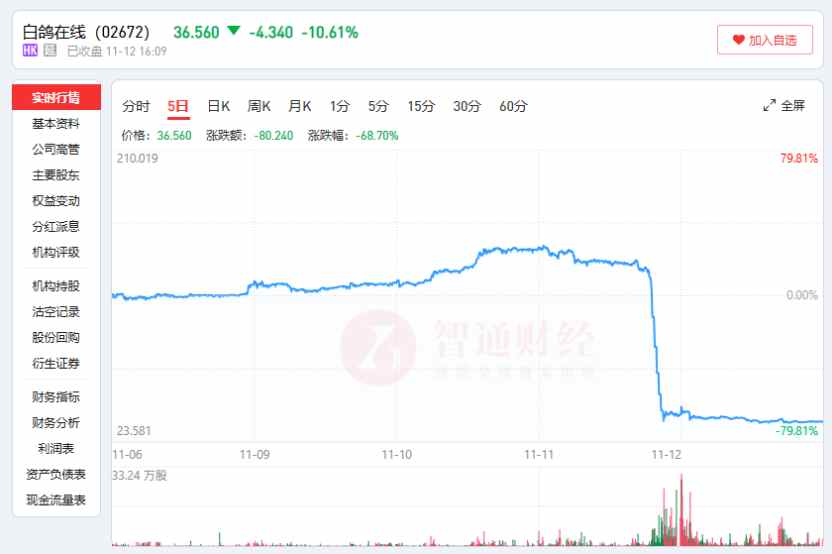
What is even more intriguing is that what was waiting late at night was not an explanation of the cause of the sharp drop, but an urgent rumor refutation announcement. On the evening of the 11th, the company issued an announcement stating that an unauthorized entity fraudulently used its name, brand logo, stock code, or even the name of Chairman Tu Jinbo in connection with an unauthorized financing platform. The company had reported related matters to the relevant departments and emphasized the normal and stable operation of the group's business.
A sharp drop where no “killer” could be found, and a late-night statement that dissociated the relationship formed the most absurd page in the four months since this stock was listed. Why was the stock price able to soar by 350% in just two months, and why almost crashed within a day? The trigger behind this sharp fluctuation may have laid the groundwork from the first day of the company's listing.
After four and a half months of listing, how did a small-circulation IPO get out of the crazy market?
The stock price story of White Pigeon Online laid the groundwork from the first day of listing.
The Zhitong Finance App learned that on June 29, 2026, the company officially landed on the main board of the Hong Kong Stock Exchange. The issue price was HK$15.60, and 333.444 million H shares were sold globally, accounting for about 10.4% of the total share capital after listing.
On the first day of listing, White Pigeon surged 291.67% when it opened, then continued to rise. Finally, it closed at HK$73, up 367.95% from the issue price. At one point, the total market value reached about HK$23.4 billion. For the winning investors, it is certainly a very lucrative IPO market.
However, compared to the impressive first-day increase, what is more noteworthy is the company's distribution structure. After deducting a total of 1.282 million shares subscribed by the two cornerstone investors, it is estimated that the actual tradable shares of the company at the beginning of its listing were about 32.06 million shares, accounting for only about 10% of the total share capital. Based on the issue price, the corresponding initial tradable shares have a market value of approximately HK$500 million.
This means that in the early days of White Pigeon's online listing, it was not a stock with a huge free circulation market. Under a relatively limited number of tradable shares, as long as there is continuous buying in the market, it may have a far greater driving effect on stock prices than ordinary large-cap stocks.
After the crazy rise on the first day of listing, White Pigeon Online experienced a round of high level fluctuations and showed significant adjustments in early September. On September 7, the company's stock price fell by 34.97% in a single day, and fell further to around HK$31.48 on September 9.
The turning point came on September 10th. Starting with the closing price of HK$32.98 on the same day, White Pigeon Online re-entered an upward channel, which accelerated markedly in late October. On October 26, the company's stock price closed at HK$97.90, breaking the intraday high of HK$101. After entering November, the stock price continued to reach new highs, hitting an intraday high of HK$150 on November 11.
Based on the closing price on September 10, up to the intraday high on November 11, White Pigeon Online had a cumulative increase of about 354.8%, and the stock price rose 4.55 times the original in less than two months.
From insurtech to AI concept stocks, why did White Pigeon Online receive tens of billions of HKD valuations?
In addition to the stock price elasticity brought about by the small circulation market, this round of rise in White Pigeon Online was also driven by three factors:
The first is the market's revaluation of the company's MaaS business. The Zhitong Finance App learned that White Pigeon Online itself is not an artificial intelligence model company in the traditional sense, but rather an insurance technology company that empowers insurance transactions through digital technology based on scenario insurance. Its core business includes insurance transaction services, precision marketing and digital solutions, and third party management services (TPA).
Simply put, through cooperation with financial institutions, enterprises and various scenario partners, the company embeds insurance products into scenarios such as travel, health, and public services, and then completes product design, risk identification, marketing, and claims processing through technical systems.
This type of business is characterized by scattered scenarios, but a wide range of applications. For insurance companies, White Pigeon Online provides not only sales channels, but also technical support for scene recognition, digital marketing, and risk management.
The emergence of the MaaS business, on the other hand, has provided a new valuation logic for the market. The company disclosed that as of the end of August 2026, MaaS business revenue was about RMB 47.4 million, up 579.8% year on year; revenue in the first three quarters further reached about RMB 62.1 million, up 730.4% year on year.
In a context where the AI industry chain continues to receive attention from the capital market, White Pigeon Online combines artificial intelligence technology with insurance scenarios and is beginning to receive additional attention from the market. Investors are also no longer simply pricing it according to the logic of traditional insurance intermediaries, but are trying to give it a valuation premium on the service attributes of AI technology.
Second, there are financial concerns brought about by the expected and actual inclusion of the Hong Kong Stock Connect. On September 7, 2026, White Pigeon Online was officially transferred to the Hong Kong Stock Exchange Securities List under the Shanghai-Shenzhen-Hong Kong Stock Connect. This means that eligible mainland investors can participate in this stock transaction through the Hong Kong Stock Connect channel, and the scope of investors has been expanded.
For a sub-IPO that has not been listed for a long time, has a relatively limited circulation market, and has an AI theme, entering Hong Kong Stock Connect will undoubtedly increase market attention and provide a new trading channel for potential capital.
However, it is worth noting that on the day the Hong Kong Stock Connect was included, the company's stock price plummeted by 34.97%, and then continued to adjust to the low level on September 9. This also shows that the inclusion of the Hong Kong Stock Connect does not mean that southbound capital will inevitably continue to be bought, and that some of the funds laid out in advance may also choose to be sold when favorable is realized.
Third, it is the market's expectation for the full circulation of the company's H shares. On September 29, White Pigeon announced online that it plans to convert about 169.66 million unlisted shares held by five domestic shareholders into H shares, accounting for about 52.91% of the company's total issued shares. The bill was then passed at the Extraordinary General Meeting of Shareholders held on October 16.
As far as the market is concerned, this arrangement means that the company may have more shares in circulation in the Hong Kong market in the future, and the shareholding structure and transaction structure are expected to change. However, it should be emphasized that approval by the shareholders' meeting does not mean that the shares have been converted and approved for listing; the relevant procedures must still be carried out in the future.
In the market environment at the time, the rapid growth of the AI business, the inclusion of Hong Kong Stock Connect, and full circulation expectations were superimposed on each other, forming a favorable trading story for White Pigeon Online.
At the same time, there has also been some improvement in the company's fundamentals. In the first half of 2026, White Pigeon Online achieved revenue of about 789 million yuan, a year-on-year increase of 39.2%; net loss was about 12.161 million yuan, a year-on-year decrease of 43.6%. Among them, revenue from the precision marketing and digital solutions business increased by 130.4% year on year, and revenue from insurance transaction services also increased.
Judging from this, the increase from September to November was not completely unsupported by fundamentals, but was the result of a combination of factors such as MaaS business growth, operational improvement, inclusion of Hong Kong Stock Connect, and full circulation expectations.
However, when the market begins to price an insurance technology company that is still losing money according to the valuation logic of AI technology companies, the distance between stock prices and actual operating performance is becoming more and more worth wary of.
Overnight dreams were shattered at a high of HK$150, and the chip game behind the 72% sharp drop
On November 11, White Pigeon Online opened at HK$146.50, hitting an intraday high of HK$150. However, the stock price suddenly took a sharp turn in the afternoon. Starting with a rapid decline of HK$125.80 at around 14:59, it had dropped to HK$54 at 15:18, a drop of more than 57% in less than 20 minutes. Since then, the sell-off continued, falling to an intraday low of HK$35.28 and finally closing at HK$40.90, a single-day decrease of 72.08%.
The day's turnover was about HK$440 million, and the number of shares traded was about 5.462 million shares. The turnover rate was about 3.62% based on the H shares already issued, all indicating that market trading was extremely active. The total market value of the company also shrunk from about HK$46.97 billion on November 10 to about HK$13.1 billion, evaporating about HK$33.9 billion a day. The huge gains accumulated over the previous two months were drastically repulsed by this flash crash.
What is more interesting is how funding has actually changed. According to the latest position records disclosed on November 11, White Pigeon Online Southbound Capital holds about 1.067 million shares, an increase of about 11,400 shares over the previous disclosure date. Despite a slight increase in the number of positions held, due to the sharp drop in stock prices, its book market value has shrunk markedly. It should be noted that Hong Kong Stock Connect implements T+2 settlement. This change in position does not directly represent the trading direction on the day of the sharp decline; it still needs to be judged based on subsequent position data.
However, if you look at CCASS brokerage seats, the chip differentiation is even more obvious. In the past 60 days (as of November 11), Huasheng Securities and Huatai Financial Holdings had net sales of about 3.552 million shares and 1,859,600 shares respectively, totaling about 5.41 million shares, accounting for about 17% of the actual tradable market at the beginning of the listing.
It is worth noting that the international placement ratio of this IPO was as high as 90%. The subscription ratio for the international placement was about 2.44 times, while the subscription ratio for the Hong Kong public offering was about 242.05 times, which ultimately did not trigger the callback mechanism. Combined with the net sales of 3.552 million shares and 1,859,600 shares of Huasheng Securities and Huatai Financial Holdings in the past 60 days, it is not ruled out that the two brokerage seats managed some of the early international placement shares and gradually realized them as stock prices rose. That is, it is suspected that state-owned chips have reduced their holdings in stages. However, CCASS was unable to identify the ultimate beneficiaries, nor was it possible to confirm whether the relevant shares came directly from an international placement, so this judgment is still speculative.
In terms of phased acceptance, Futu Securities made net purchases of about 3.276 million shares in the past 60 days, and the total net purchase of about 1.067 million shares from Hong Kong Stock Connect Shanghai and Shenzhen. At the same time, Hong Kong International, which had accumulated net purchases of about 1.882,600 shares in the previous 60 days, turned into a net sale of about 182,200 shares in the past 1 day, making it the seat with the highest net sales on that settlement day. It is worth noting that in the past 1 day, Huasheng bought a net purchase of 0.56 million shares, and Huatai only net sold 0.06,000 shares, indicating that the reduction in their holdings mainly occurred during the previous period, not on this settlement date.
Of course, net brokerage seat trading is not equal to brokers' own trading, and Futu Net Buying does not mean that all retail investors take over; moreover, CCASS has the same T+2 settlement caliber. The data for the past 1 day cannot directly correspond to the sell-off in the November 11 session, and the specific seller still needs to confirm the subsequent settlement data. However, the fragmentation of positions among different seats at least reflects that during the rise of White Pigeon online, some early chips may have already been transferred to other trading channels.
Furthermore, at the message level, there has always been a lack of direct explanations. During the trading period, the company did not issue new performance announcements or stock price changes announcements. It is worth noting that White Pigeon Online was previously involved in an incident where the “Whale App” was unable to withdraw funds. According to media reports, Chairman Tu Jinbo's name appeared in relevant documents, triggering speculation about the relationship between the two parties. However, the company also issued a clarification notice later, saying that unauthorized entities fraudulently used the company, brand logo, and chairman's name, making people mistakenly believe that they are linked to related financing platforms.
On the other hand, the ban period for shareholders before the IPO will not expire until around late June 2027. The 169.66 million domestic shares to be converted to H shares had not yet completed the relevant procedures at the time, and are not additional tradable shares that have already entered the market.
Therefore, there is no sufficient evidence to directly attribute this sharp decline to the lifting of the ban, selling pressure, short selling snipers, or explosions in performance. Judging from the changes in CCASS seats, some brokerage seats did show phased net sales, while other trading channels showed net purchases, but it is not yet possible to confirm the identity of the final trader and the source of shares.
A more reasonable judgment is that this sharp decline may be related to factors such as the fulfillment of previous profit orders, market valuation revisions, and insufficient liquidity acceptance. For a sub-IPO with limited initial circulation and a short-term cumulative increase of more than 350%, once concentrated sales occur at a high level, the stock price is prone to sharp fluctuations.
The Zhitong Finance App learned that at the beginning of the company's listing, the actual tradable shares were about 3.06 million, accounting for only about 10% of the total share capital. When stock prices rise, limited chips can easily amplify the driving effect of buying; when the stock price has risen from HK$32.98 to HK$150, and a large amount of floating profit has accumulated, once concentrated sales occur, limited market carrying capacity may further amplify the decline.
Furthermore, the potential future supply of shares is also a risk that cannot be ignored. The 169.66 million domestic shares that the company plans to convert are equivalent to about 5.3 times the estimated tradable shares during the IPO stage. Although these shares are not actually in circulation, the potential supply brought about by full circulation in the future and the expiration of the ban period has become a factor that cannot be ignored by the market.
The gap between fundamentals and valuations has further amplified the intensity of market adjustments. On November 10, the market value of White Pigeon Online was about HK$46.97 billion, and the company was still at a loss. From 2023 to 2025, the company's revenue increased from 660 million yuan to 1,227 million yuan, but the net loss also increased from 17.18 million yuan to 46.67 million yuan, and the gross margin was 7.9% to 9.1% for a long time.
Although the company's losses narrowed in the first half of 2026, and MaaS business revenue reached 62.1 million yuan in the first three quarters, compared to the overall business scale, this new business is still in the development stage. As for the market's forecast for an increase in MaaS revenue share and gross margin in 2028, it is still a long-term expectation, rather than a realized performance.
Therefore, this sharp decline does not mean that the company's fundamentals have suddenly deteriorated, nor does it prove that the AI business growth logic has failed. What has actually been corrected is how much of a valuation premium the market is willing to pay for a sub-IPO that is still losing money, is only about 10% in circulation, and faces full circulation supply — when low-cost chips are chosen to be fulfilled, the gap between valuation and performance is quickly priced.
November 11 was certainly an important turning point for White Pigeon Online. At the end of the day, revenue growth is not equal to profit growth, nor is the AI concept meant to support any valuation. What White Pigeon Online really needs to prove is not that the MaaS business has achieved too high a growth rate, nor how much Hong Kong dollars the stock price has reached, but whether business growth can be converted into continuous profits, and whether new shares can be sufficiently accepted after entering the market in the future.