



3D printing company Stratasys (NASDAQ:SSYS) reported Q3 2026 results exceeding the market’s revenue expectations, with revenue up 4.1% year on year to $142.6 million. On the other hand, the company’s full-year revenue guidance of $558.5 million at the midpoint came in 1.2% below analysts’ consensus estimates. Its non-GAAP profit of $0.04 per share was $0.02 above analysts’ consensus estimates.
For more on Stratasys, read our free full research report.
Stratasys Q3 2026 highlights:
- Revenue $142.6 million vs S&P consensus estimates of $141.4 million (4.1% year-on-year growth, 0.9% beat)
- Adjusted EPS $0.04 vs S&P consensus estimates of $0.02 ($0.02 beat)
- Adjusted EBITDA $8.05 million vs analysts’ consensus estimates of $6.90 million (5.6% margin, 16.7% beat)
- Revenue guidance The company dropped its revenue guidance for the full year to $558.5 million at the midpoint from $570 million, a 2% decrease
- Adjusted EPS guidance Management lowered its full-year adjusted EPS guidance to $0.11 at the midpoint, a 4.3% decrease
- EBITDA guidance $25 million at the midpoint for the full year, below analysts’ consensus estimates of $25.3 million
- Operating margin -7.7%, up from -16.6% in the same quarter last year
- Market capitalization $572.8 million
“Our third quarter results reflect the successful ongoing shift from rapid prototyping to manufacturing, as reflected in the 4.1% growth year over year, supported by disciplined expense management,” said Dr. Yoav Zeif, CEO of Stratasys. “Our largest business, aerospace and defense, grew more than 35% year-over-year, in addition to growth in our automotive, dental and Stratasys Direct businesses. We continue to experience robust customer engagement across our pipeline as we navigate longer and more variable timelines for large, production-focused awards, which we have factored into our updated outlook. Demand for industrial additive manufacturing is increasingly structural, driven by megatrends such as onshoring, speed, cost and the need for resilient supply chains. With our debt-free balance sheet and strong cash position, we are poised to keep investing in our strategy to create long-term value for all stakeholders.”
Revenue growth
A company’s long-term revenue performance is one signal of its overall quality. Any business can deliver a good quarter or two, but many enduring ones grow for years. Stratasys struggled to consistently generate demand over the last five years as its revenue dropped at a 1% annual rate. This fell short of our standards and points to poor business quality.
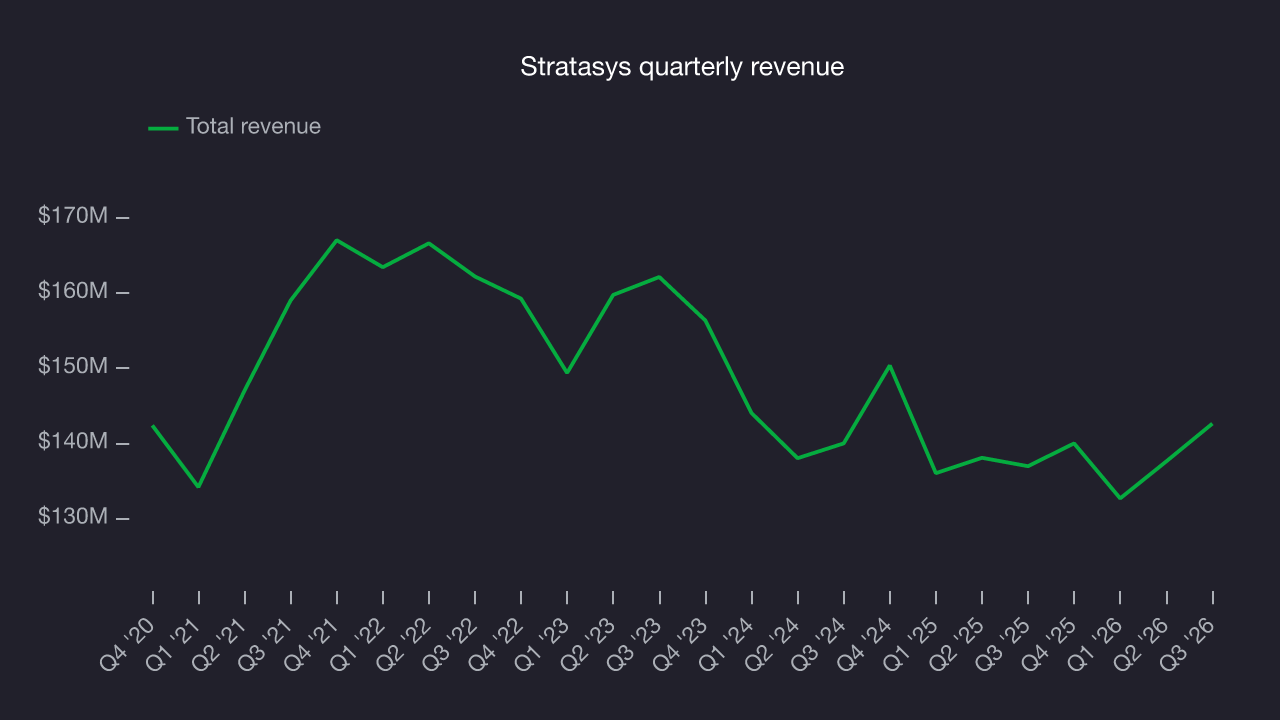
Long-term growth matters most, but within industrials, a half-decade historical view may miss cycles, industry trends or a company capitalizing on catalysts such as a new contract win or a successful product line. Stratasys’s recent performance shows its demand remained suppressed as its revenue has declined by 2.2% annually over the last two years. 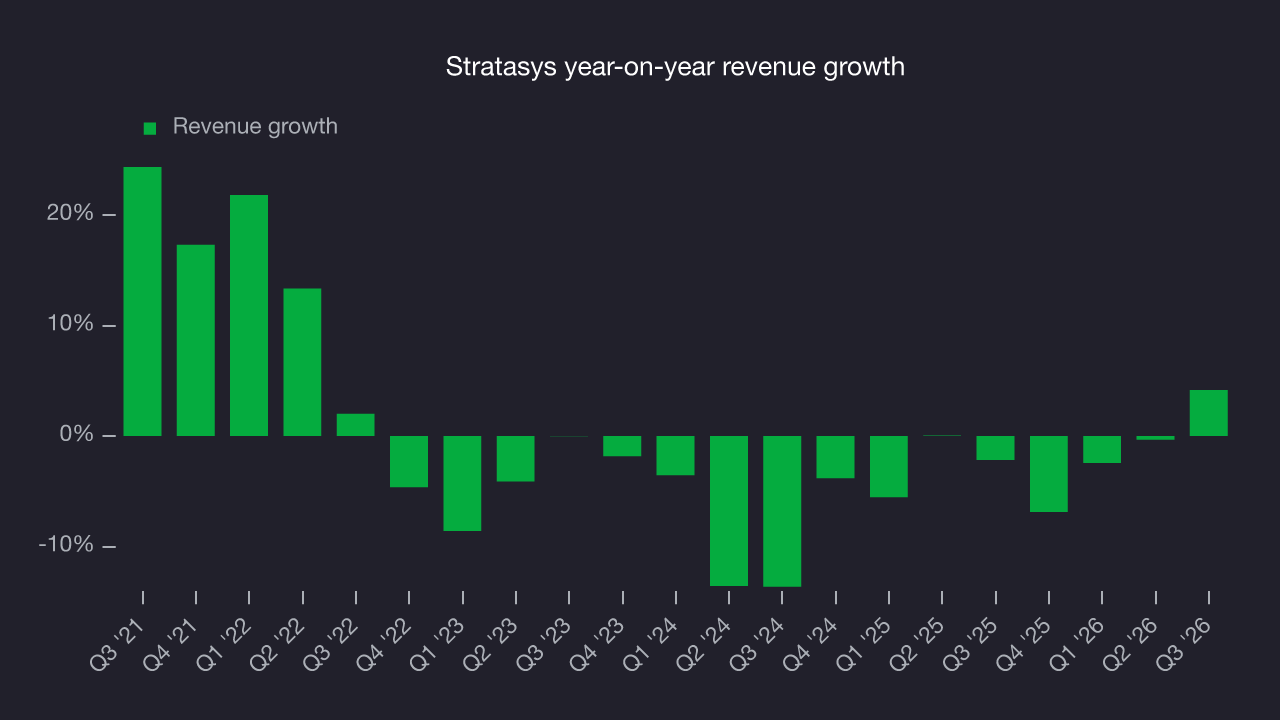
This quarter, Stratasys reported modest year-on-year revenue growth of 4.1% but beat Wall Street’s consensus estimates by 0.9%.
Looking ahead, sell-side analysts expect revenue to grow 5.7% over the next 12 months, according to S&P, an improvement versus the last two years. This projection is above average for the sector and implies its newer products and services will catalyze better top-line performance.
Operating margin
Over the last five years, Stratasys’s operating margin fell by 1.6 percentage points. This deterioration shows its costs grew relative to revenue, putting pressure on profitability. Its trailing 12-month operating margin was negative 13%.
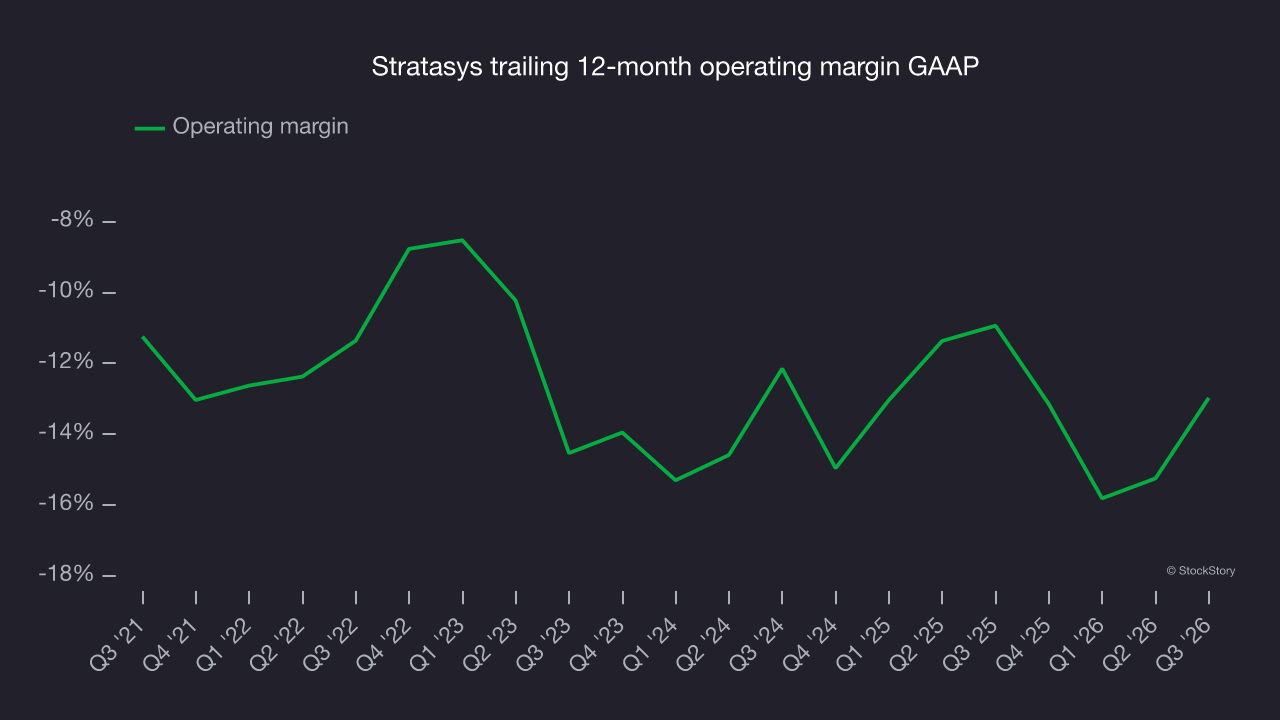
Stratasys’s operating margin was negative 7.7% this quarter. The company’s persistent lack of profits is a concern.
Earnings per share
We track the long-term change in earnings per share, or EPS, for the same reason as long-term revenue growth. Compared to revenue, however, EPS highlights whether a company’s growth is profitable.
Stratasys’s EPS grew at a 16.7% compounded annual growth rate over the last five years, higher than its 1% annualized revenue declines. However, that growth warrants caution because its operating margin didn’t improve and it didn’t repurchase its shares, meaning the difference came from reduced interest expenses or taxes.
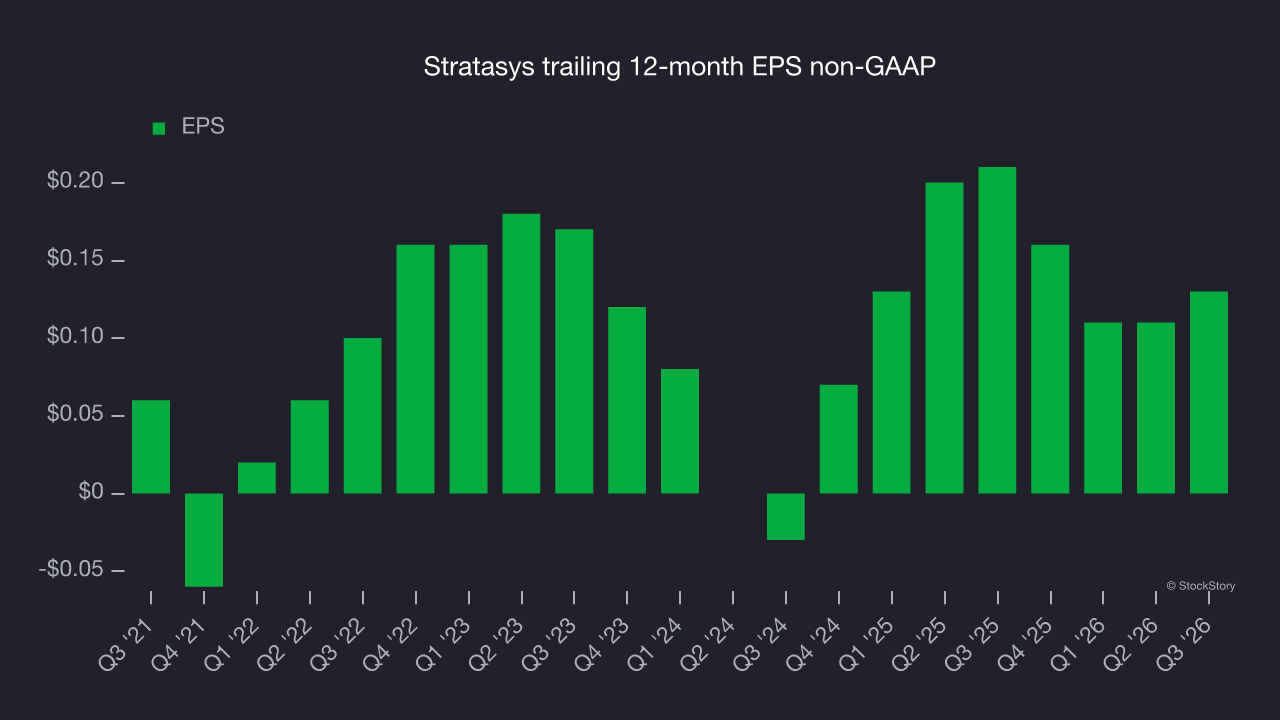
Like with revenue, we analyze EPS over a more recent period because it can provide insight into an emerging theme or development for the business.
For Stratasys, its two-year annual EPS growth of 152% was higher than its five-year trend. That acceleration is a positive sign, particularly given the already high base.
In Q3, Stratasys reported adjusted EPS of $0.04, up from $0.02 in the same quarter last year. This result easily cleared analysts’ consensus estimates, a positive outcome for shareholders. Over the next 12 months, Wall Street expects Stratasys’s full-year EPS to grow 21.2% from $0.13 to $0.16, according to S&P.
Key takeaways from Stratasys’s Q3 results
Stratasys delivered a mixed quarter with some key positives: EPS beat analysts’ consensus estimates and EBITDA topped Wall Street’s consensus by a wide margin, but the full-year outlook fell a little short. Both EBITDA and revenue guidance slightly missed Wall Street’s consensus estimates. Shares rose 3.5% to $6.77 immediately after the results.
Stratasys may have had a good quarter, but that alone doesn’t make it a buy. When making that decision, it’s important to consider its valuation, business quality and latest quarterly results. For more on Stratasys, read the full research report here (it’s free).