



Outdoor lifestyle products brand (NYSE:YETI) fell short of the market’s revenue expectations in Q3 2026 as revenue rose 4.4% year on year to $509.4 million. Its non-GAAP profit of $0.91 per share was 8.1% above analysts’ consensus estimates.
For more on YETI, read our free full research report.
YETI Q3 2026 highlights:
- Revenue $509.4 million vs S&P analyst consensus of $522.2 million (4.4% year-on-year growth, 2.4% miss)
- Adjusted EPS $0.91 vs S&P analyst consensus of $0.84 (8.1% beat)
- Adjusted EPS guidance Management lowered its full-year adjusted EPS guidance to $2.93 at the midpoint, a 1.5% decrease
- Operating margin 12%, in line with the same quarter last year
- Free cash flow margin 14.1%, down from 18.3% in the same quarter last year
- Market capitalization $3.12 billion
This performance demonstrates continued progress against our Investor Day “Built for the Wild” strategy. It reflects the dedication of our teams and partners, and the multi-year investments we have made across brand, innovation, and global capabilities. Together, these results reinforce the strength of the financial model we outlined. While demand was uneven at times during the quarter, particularly in the US and Canadian markets, the expanding diversity of our products, channels, and geographies strongly supported our overall performance. Looking ahead, we anticipate the consumer environment will remain cautious and put pressure on demand in Q4. Although we are mindful of these near-term dynamics, the strength of our strategy, the durability of our brand, our innovation cadence, and our business model position us well to navigate the short-term market, create value and continue building for the long term.”
Revenue growth
A company’s long-term revenue performance is one signal of its overall quality. Any business can experience short-term success, but top-performing ones sustain growth for years. YETI’s revenue grew at a weak 7.8% compounded annual growth rate over the last five years, falling short of the consumer discretionary sector benchmark.
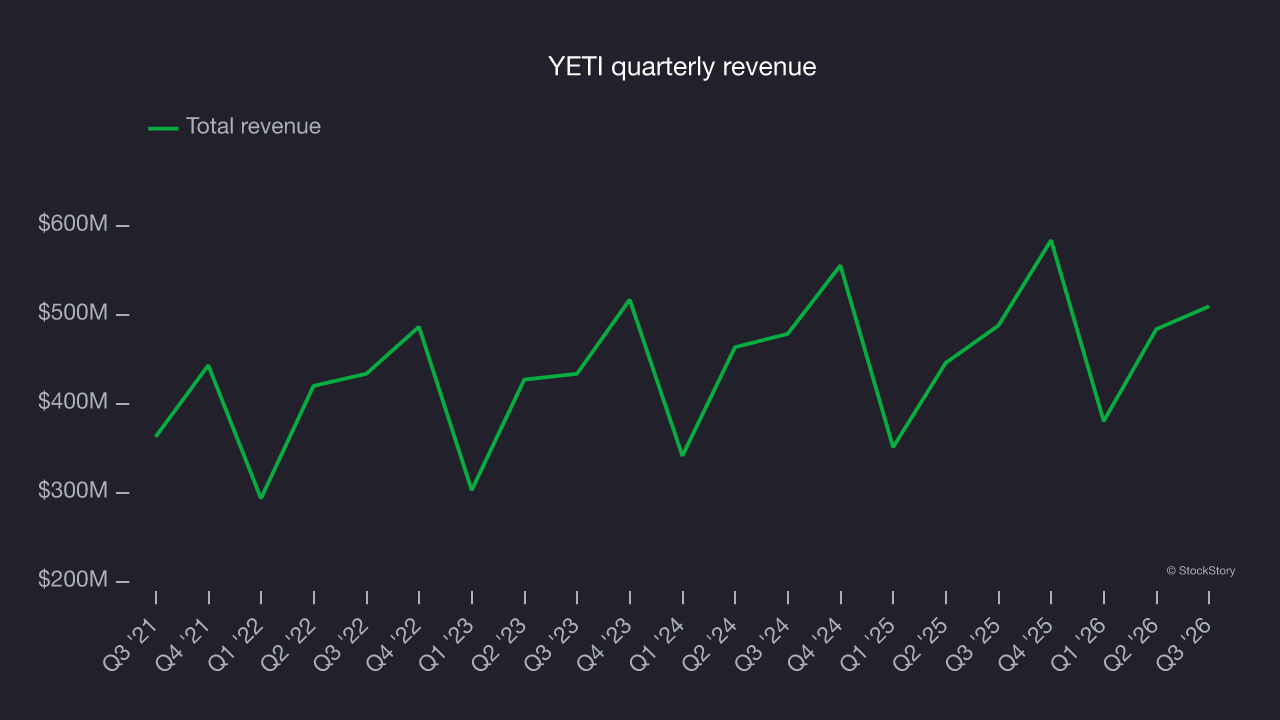
Long-term growth is the most important, but within consumer discretionary, product cycles are short and revenue can be hit-driven due to rapidly changing trends and consumer preferences. YETI’s recent performance shows its demand has slowed as its annualized revenue growth of 4.3% over the last two years was below its five-year trend. Decelerating revenue growth in the sector is a concern, as it could signal changing consumer tastes given low switching costs. 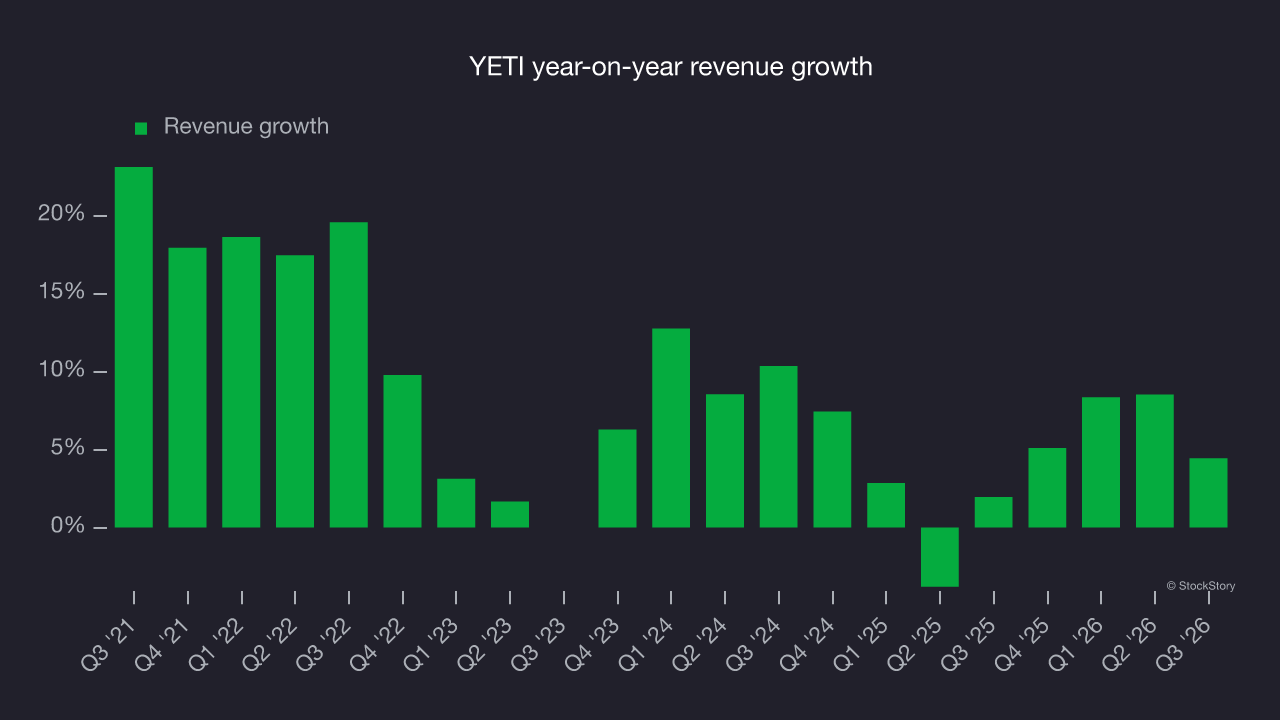
The company’s most important segments, Retail and Wholesale, account for 42.3% and 55.8% of revenue. Over the last two years, YETI’s Retail revenue (direct sales to customers) was flat while its Wholesale revenue (sales to retailers) averaged 10.3% year-on-year growth. 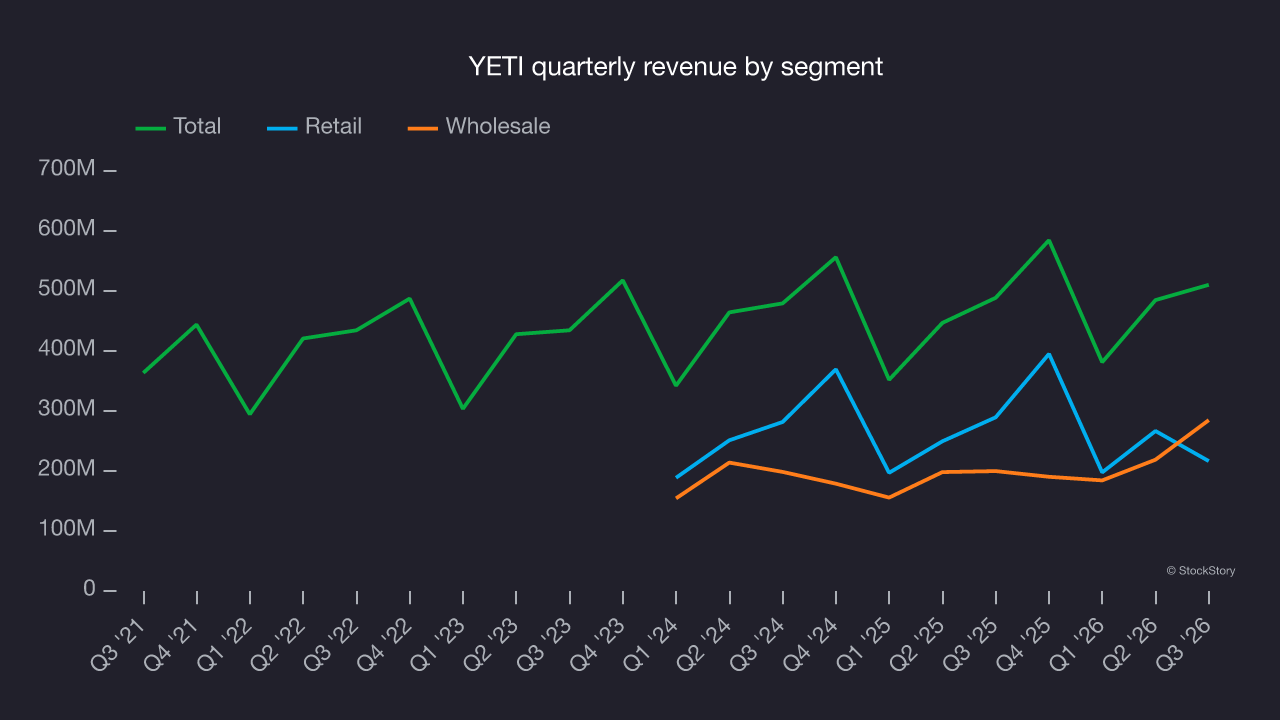
This quarter, YETI’s revenue grew by 4.4% year on year to $509.4 million, falling short of Wall Street’s consensus estimates.
Looking ahead, sell-side analysts expect revenue to grow 7.8% over the next 12 months, according to S&P. While this projection implies its newer products and services will fuel better top-line performance, it is still below average for the sector.
Operating margin
Operating margin is an important measure of profitability as it shows the portion of revenue left after accounting for all core expenses, everything from the cost of goods sold to advertising and wages. It’s also useful for comparing profitability across companies with different levels of debt and tax rates because it excludes interest and taxes.
YETI’s operating margin has been largely unchanged over the last 12 months, but rising margins from economies of scale and cost efficiency would be a better outcome over time.
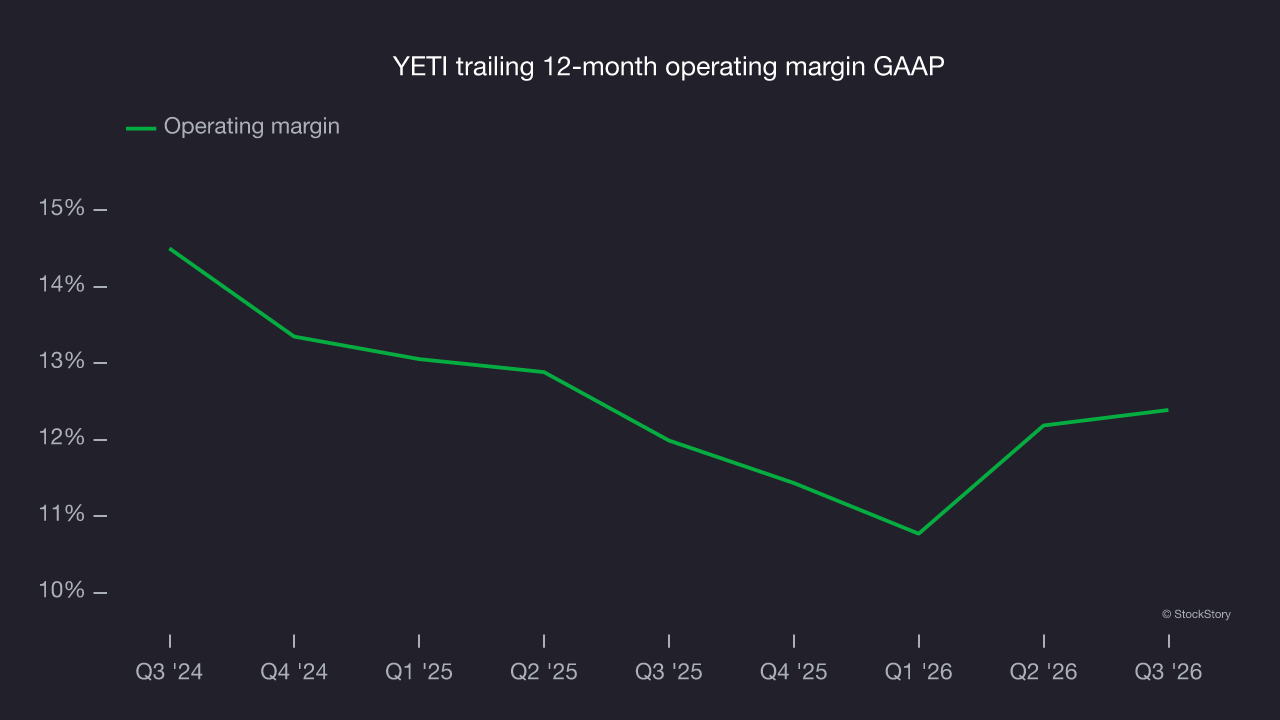
In Q3, YETI generated an operating profit margin of 12%, in line with the same quarter last year. This indicates the company’s overall cost structure has been relatively stable.
Earnings per share
Long-term changes in earnings per share, or EPS, matter for the same reason as long-term revenue growth. Compared to revenue, however, EPS highlights whether a company’s growth is profitable.
YETI’s EPS grew at a weak 2.5% compounded annual growth rate over the last five years, lower than its 7.8% annualized revenue growth. This indicates that the company became less profitable on a per-share basis as it expanded due to non-fundamental factors such as interest expenses and taxes.
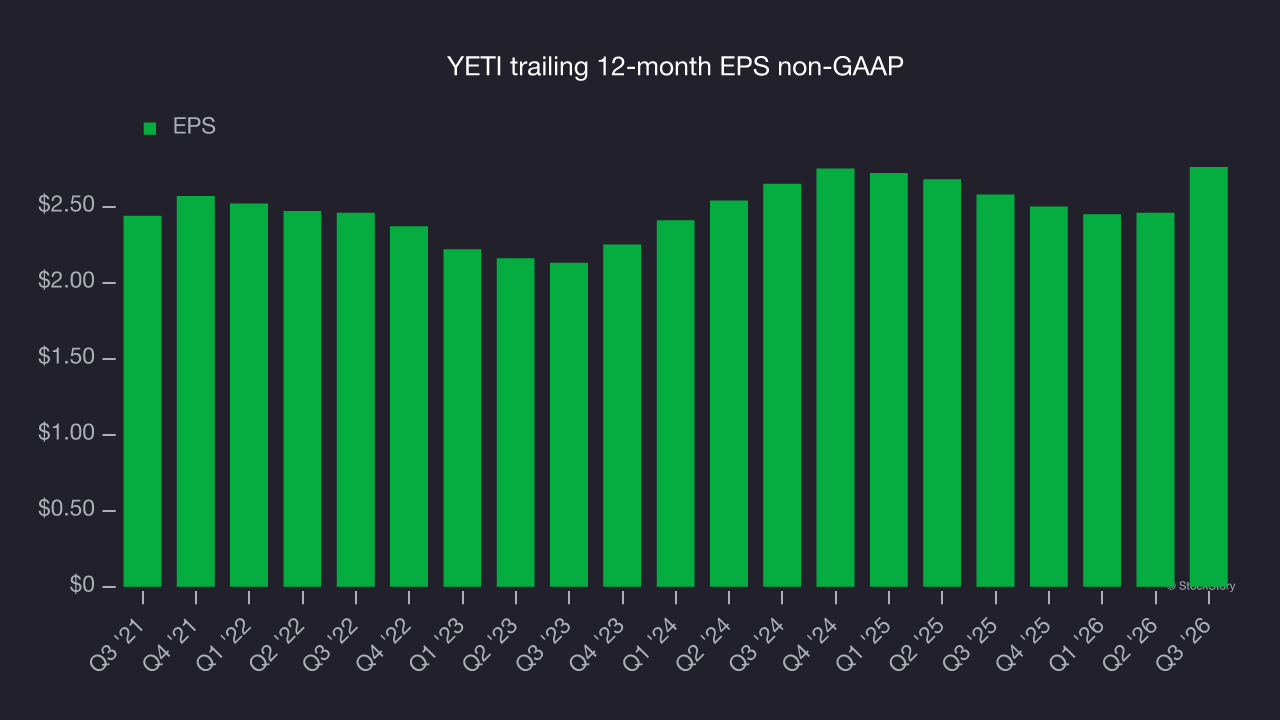
In Q3, YETI reported adjusted EPS of $0.91, up from $0.61 in the same quarter last year. This result beat analysts’ consensus estimates by 8.1%. Over the next 12 months, Wall Street expects YETI’s full-year EPS to grow 17.9% from $2.76 to $3.25, according to S&P.
Key takeaways from YETI’s Q3 results
An EPS beat was the bright spot in a YETI quarter that could have been better: Revenue missed analysts’ consensus estimates, and full-year EPS guidance fell short of Wall Street’s consensus. Shares tumbled 7.3% to $39.67 immediately after the release.
YETI may have had a tough quarter, but does that create an investment opportunity? The latest quarter matters, but not nearly as much as longer-term fundamentals and valuation when deciding if the stock is a buy. For more on YETI, read the full research report here (it’s free).