


Universal tariff refunds are suddenly back on the table, and that potential US$166b swing in cash puts import dependent businesses in a very different position from just a few years ago. Balance sheets could look cleaner, pricing room could widen, and investors who ignore this shift may miss where value quietly builds. This article breaks down three stocks directly exposed to the news and how that exposure might matter for your portfolio thinking.
The stocks covered below are a sample of this tariff sensitive corner of retail, while the full screen surfaced 7 more U.S. import dependent value and off price companies with equally compelling narratives that are not unpacked here. To identify and analyze the highest conviction ideas straight away, head into the U.S. Import-Dependent Value and Off-Price Retailers screener.
Superior Group of Companies (SGC)
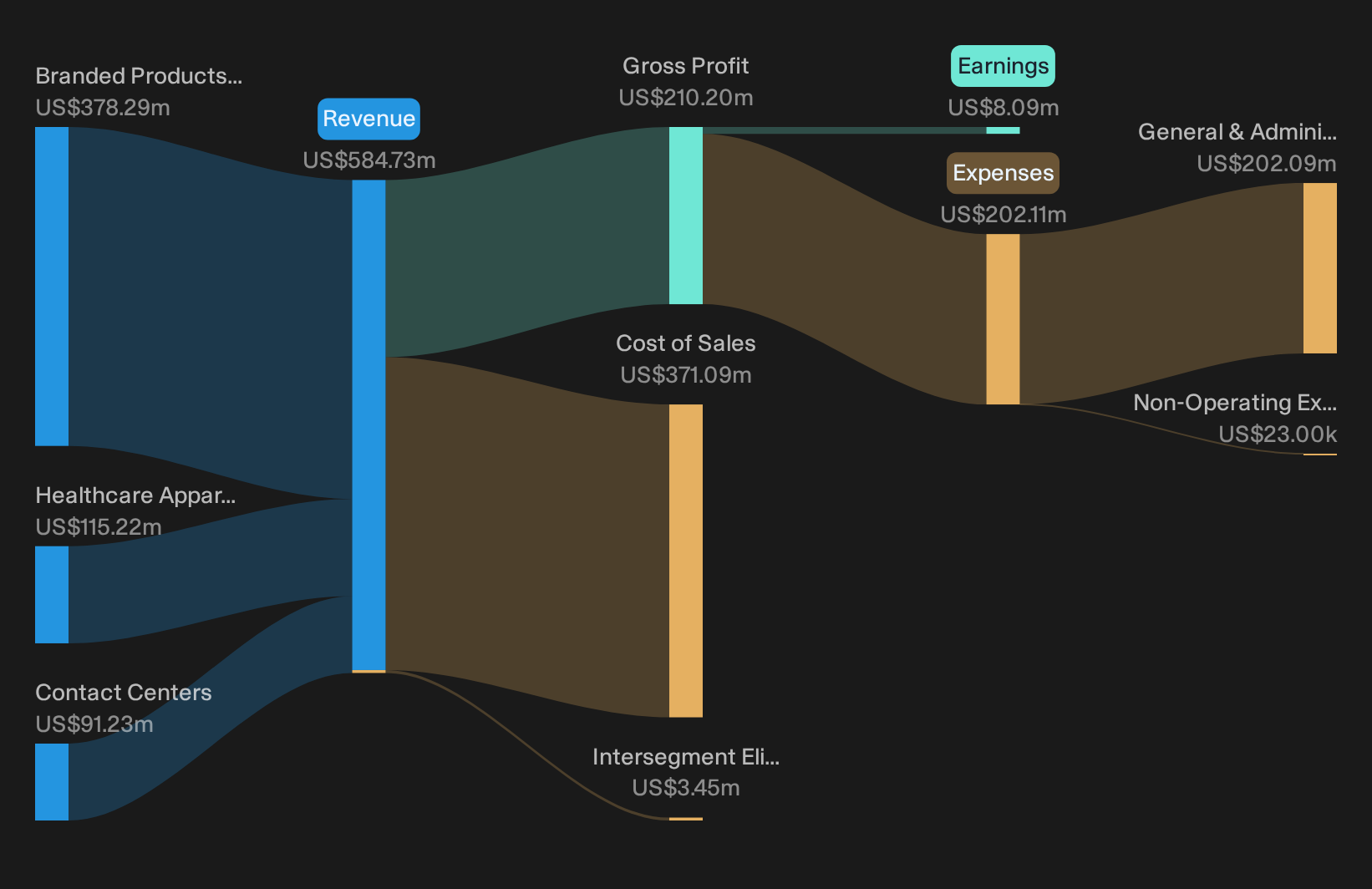
Overview: Superior Group of Companies supplies imported branded uniforms, promotional merchandise and healthcare apparel, alongside a smaller outsourced contact-center operation.
Operations: The business generates most revenue from Branded Products at about US$378 million, with Healthcare Apparel at roughly US$115 million and Contact Centers near US$91 million.
Market Cap: US$212 million
Superior Group of Companies is a direct expression of this screener’s theme, where imported textiles, value focused customers and tariff policy all converge. Even the bearish analyst Narrative on Simply Wall St highlights how operational choices around import heavy lines and service capacity could shift the risk reward balance.
"Although the Contact Centers business is applying AI to reduce SG&A and improve EBITDA margins, the same customer hesitancy that is delaying new conversions and contributed to weaker recent revenue creates a catalyst where subdued client demand offsets efficiency gains."
What happens to Superior Group of Companies’ margin story if one unresolved cost side pressure moves sharply in the opposite direction investors expect?
If that tariff pressure flips, read the full narrative for Superior Group of Companies to see how Superior Group of Companies’ import mix and margins could be quietly decoupling from consensus views.
Steven Madden (SHOO)
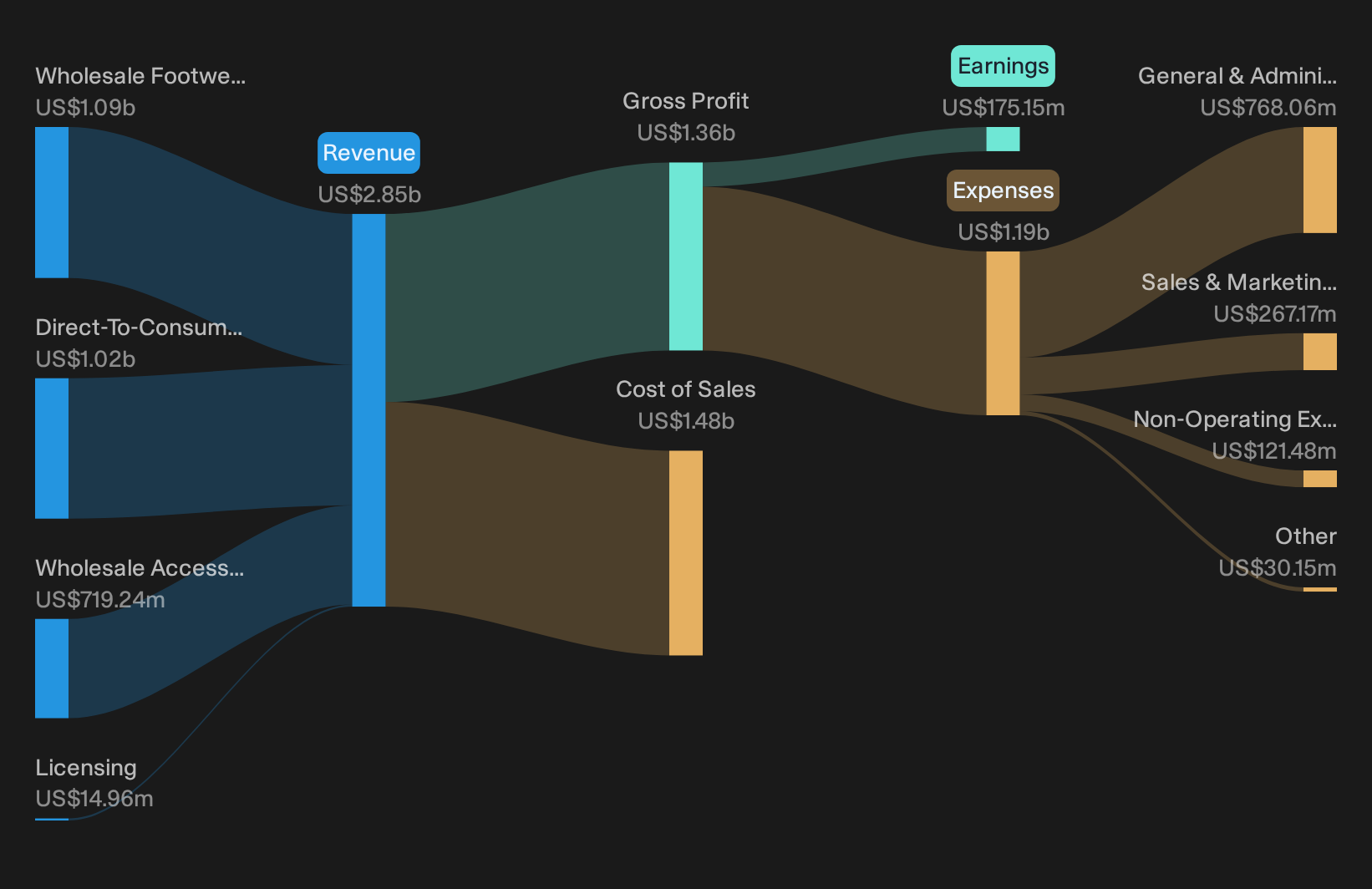
Overview: Steven Madden designs and imports fashion footwear, handbags and accessories for value focused shoppers, selling through wholesale partners and its own stores.
Operations: Steven Madden generates about US$1.09b from Wholesale Footwear, US$1.02b from Direct-To-Consumer, and US$719 million from Wholesale Accessories/Apparel, with revenue roughly US$1.80b in the United States and US$1.04b internationally.
Market Cap: US$3.11b
For a screen built around import dependent value retailers, Steven Madden is almost the textbook example. The analyst consensus Narrative on Simply Wall St frames how its import heavy sourcing and off price channels turn tariff refunds into a direct test of earnings power.
"Strong double digit digital growth in direct to consumer for Steve Madden and Kurt Geiger, with global DTC revenue rising 30.6% in the latest quarter and continued increases in marketing spend to about 5.3% to 5.4% of revenue, supports a mix shift toward higher margin channels that can lift gross margin and earnings."
The open question is how far that improving mix can carry profitability if one stubborn cost headwind suddenly starts to ease.
If that cost tailwind really starts to bite, read the full narrative for Steven Madden to see whether tariff relief is masking a much bigger earnings reset or acceleration.
Kontoor Brands (KTB)
Overview: Kontoor Brands owns Wrangler and Lee jeanswear, sourcing imported apparel and selling value focused denim and outdoor clothing through global retail channels.
Operations: Kontoor Brands generates about US$2.0b from Wrangler, US$711 million from Helly Hansen and US$40 million from Other, with additional segment adjustments.
Market Cap: US$4.52b
Kontoor Brands matters for this import heavy value retail screen because its Wrangler and Helly Hansen lines sit at the intersection of tariff sensitive sourcing, sharp price points and denim demand, which is exactly what the bearish analyst Narrative on Simply Wall St focuses on.
"Although Helly Hansen is running ahead of internal plans with low double digit revenue growth in the first half of 2026 and operating margin at 7%, the required step up to more than $1.1b of revenue and roughly $165 million of operating profit by 2030 depends heavily on scaling in underpenetrated regions like the U.S. and China where current brand awareness is low."
The real swing factor for Kontoor Brands is what happens to margin progress if a single key assumption about import costs or demand shifts.
If that swing factor matters to your thesis, read the full narrative for Kontoor Brands to see whether tariff relief is quietly accelerating Kontoor Brands’ next chapter or masking it.

Seeking Alternatives Before The Crowd
Fresh ideas move first, and the best breakouts often fly once momentum catches on. Scan these under-the-radar opportunities while it matters and get in early.
- Target resilient compounding by tracking companies screened for strong cash generation and balance sheets using the 32 high quality undervalued stocks before the market fully catches on.
- Ride structural demand shifts by reviewing the curated 42 power grid technology and infrastructure stocks while grid upgrades and electrification themes are still being priced in gradually.
- Position ahead of the AI infrastructure surge by scanning the hand picked 53 AI infrastructure stocks while many investors remain focused only on headline chip designers.
Have feedback on this article? Concerned about the content? Get in touch with us directly. Alternatively, email editorial-team@simplywallst.com