


The Zhitong Finance App learned that concerns about the Nvidia (NVDA.US) corporate governance crisis have spread from the stock market. As CEO (CEO) Hwang In-hoon's retention issue became a key variable affecting the chip giant, as of press release, Nvidia's US stock fell more than 8% before the market on Thursday, and its debt default protection costs also rose. According to ICE Data Services, the five-year default protection cost of Nvidia debt once rose by 3.25 basis points to 1.445 percentage points, slightly lower than the intraday high set on November 3. Although this cost has more than tripled since mid-year, Nvidia Credit Default Swap (CDS) is still only about half of the cost of lower-rated SpaceX (SPCX.US) and Oracle (ORCL.US).
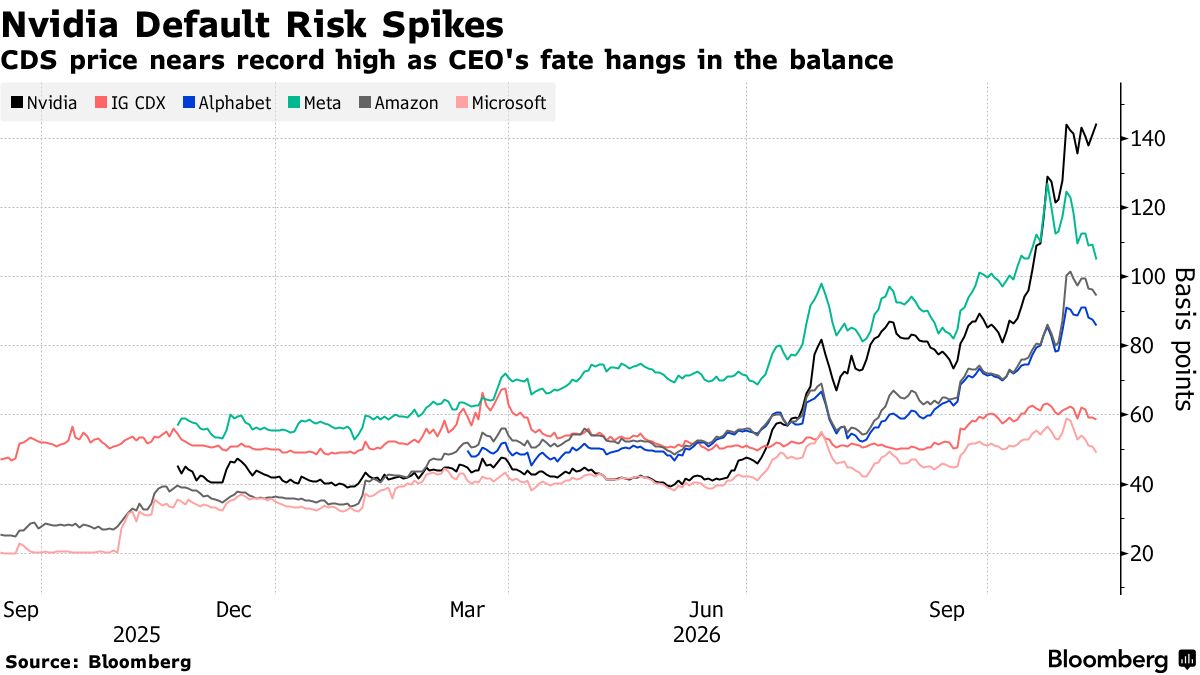
The rising cost of debt default protection means that bond investors will need to pay higher premiums to buy protection to prevent Nvidia from defaulting within the next five years. Credit default swaps are generally regarded as an important market indicator for measuring a company's credit risk. Price changes not only reflect investors' judgments about a company's solvency, but are also affected by market liquidity, risk appetite, and expectations of future uncertainty.
It should be noted that the rising cost of debt default protection does not mean that Nvidia has experienced difficulties in repaying its debts, nor can it simply be equated with a simultaneous rise in the probability of default. It more directly reflects the market's demand for higher risk compensation to bear Nvidia-related credit risks. This rise in debt default protection costs indicates that creditors are beginning to include factors such as corporate governance crises, potential regulatory investigations, and leadership changes in credit risk pricing.
On November 8, Huang Renxun sent an internal letter to all employees admitting being unfaithful to his wife and apologizing to his family, employees, board of directors, partners and shareholders. Nvidia's board of directors announced on the same day that a special committee composed of independent directors has been set up to launch an independent investigation with the assistance of external independent legal advisers to find out whether Hwang In-hoon has become the target of foreign intelligence agencies' actions.
However, just three days later, it was revealed that Hwang In-hoon had a second extramarital relationship. The woman was Nvidia's vice president who reported her work directly to her. Meanwhile, according to media reports, citing people familiar with the matter, Nvidia's board of directors is intensively preparing to dismiss Wong In-hoon. The board of directors will be held on November 12 as soon as possible to decide where to stay, and has cooperated with external headhunters to find a successor and consider appointing an interim CEO to transition first.
For bond investors, the risk posed by Hwang In-hoon's possible departure is not just a change in the company's senior personnel, but rather how much impact this change may have on Nvidia's future business strategy, customer relationships, capital allocation, and industrial chain financing arrangements.
Wong In-hoon is not only the founder and long-time leader of Nvidia, but also an important driver of the company's technology route, product planning, and customer relationships. Over the past three decades, he has led Nvidia's development from a graphics processor manufacturer to a core supplier of global AI infrastructure. As the scale of the company's business continues to expand, Hwang In-hoon's influence in strategic decisions and external communication has also become more prominent.
Therefore, if Nvidia's board of directors finally decides to remove Hwang In-hoon, the company may face a leadership transition period. The new CEO needs to re-establish communication mechanisms with large cloud computing companies, AI model developers, chip makers, and other industry chain partners, while ensuring that product roadmaps and long-term capacity plans such as Blackwell and Vera Rubin are not affected.
Meanwhile, there is currently no clear successor for Hwang In-hoon. The company's chief financial officer, Colette Kress, was identified as one of the potential candidates for the interim CEO, while Ian Buck, an executive responsible for the data center business, was also mentioned as a potential successor. However, there is still uncertainty about whether the interim management can quickly stabilize the company's operations and whether the board of directors can find a long-term leader who can continue the current technology strategy and maintain customer trust.
This uncertainty may first be reflected in the bond market. Creditors usually pay more attention to the stability of a company's future cash flow, capital structure, and solvency rather than simply the personal reputation of management. However, for a company like Nvidia where the founder is deeply involved in strategic decisions, technology routes, and customer relationships, changes in core leadership may affect the market's judgment on future business continuity.
What is particularly noteworthy is that Nvidia's business model has surpassed traditional chip sales. The company is deeply involved in the upstream and downstream development of the AI industry chain through investment, strategic cooperation and financing support. If Wong In-hoon leaves office, the board of directors may need to re-examine some investment projects, cooperation agreements, and related risk exposures. Even if these arrangements do not change immediately, investors may require the company to further disclose relevant commitments and their potential financial impact.
In addition to the CEO retention issue, another important risk Nvidia faces is related to potential government investigations and possible export control and regulatory measures. If the investigation eventually triggers stricter chip export restrictions, or if the government asks Nvidia to adjust some commercial cooperation arrangements, the company's overseas sales, customer structure, and supply chain layout may all be affected. For creditors, such policy risks are of particular concern, as their impact may not be limited to short-term income, but may also alter the long-term market entry conditions and capital expenditure plans of the enterprise.
Although Nvidia's debt default protection costs have more than tripled since mid-year, it's still only about half that of SpaceX and Oracle. This gap reflects that although the bond market is increasing risk pricing on Nvidia, it still believes that its credit status is relatively stable. Unlike companies that partially rely on external financing to drive data center expansion, Nvidia has strong profitability, huge cash reserves, and a high market share. Even if Hwang In-hoon eventually leaves office, the company's current chip products, CUDA software ecosystem, R&D system, and partnerships with large customers will not disappear in a short time as a result.
For creditors, what really needs to be observed is whether changes in leadership will further affect the company's operating strategy and capital allocation, whether government investigations will evolve into substantial regulatory restrictions, and whether Nvidia will need to adjust investment and financing support for AI industry chain partners.
Looking back, the board's decision on Hwang In-hoon's stay, the progress of the independent investigation, and Nvidia's upcoming financial report and business outlook may all be important catalysts affecting the price of its CDS. If the board of directors can quickly clarify succession arrangements and prove that the company's technical routes, customer cooperation, and operating decisions are not affected, market concerns about governance risks may gradually ease; conversely, if leadership transitions fall into a long-term impasse or investigations trigger new regulatory and commercial risks, Nvidia's debt default protection costs may rise further.