


Alphabet (GOOGL) recently disclosed a $548 million stake in semiconductor company Qualcomm (QCOM), marking its first investment in the company and adding to a list of investees, including the likes of SpaceX (SPCX), Arm (ARM), and UiPath (PATH). Of those, SpaceX is easily the biggest holding at roughly $83.7 billion.
Thus, in comparison, Alphabet's investment in Qualcomm is quite modest. Yet the possibilities and rationale behind the stake are anything but.
About Qualcomm Stock
Founded in 1985, Qualcomm's historical significance comes from its role in developing and commercializing CDMA technology. Its innovations helped establish the foundations of 3G mobile networks and contributed to the evolution of 4G LTE and 5G. Currently, its principal operations are divided into three segments: Qualcomm CDMA Technologies (QCT), Qualcomm Technology Licensing (QTL), and Qualcomm Strategic Initiatives (QSI).
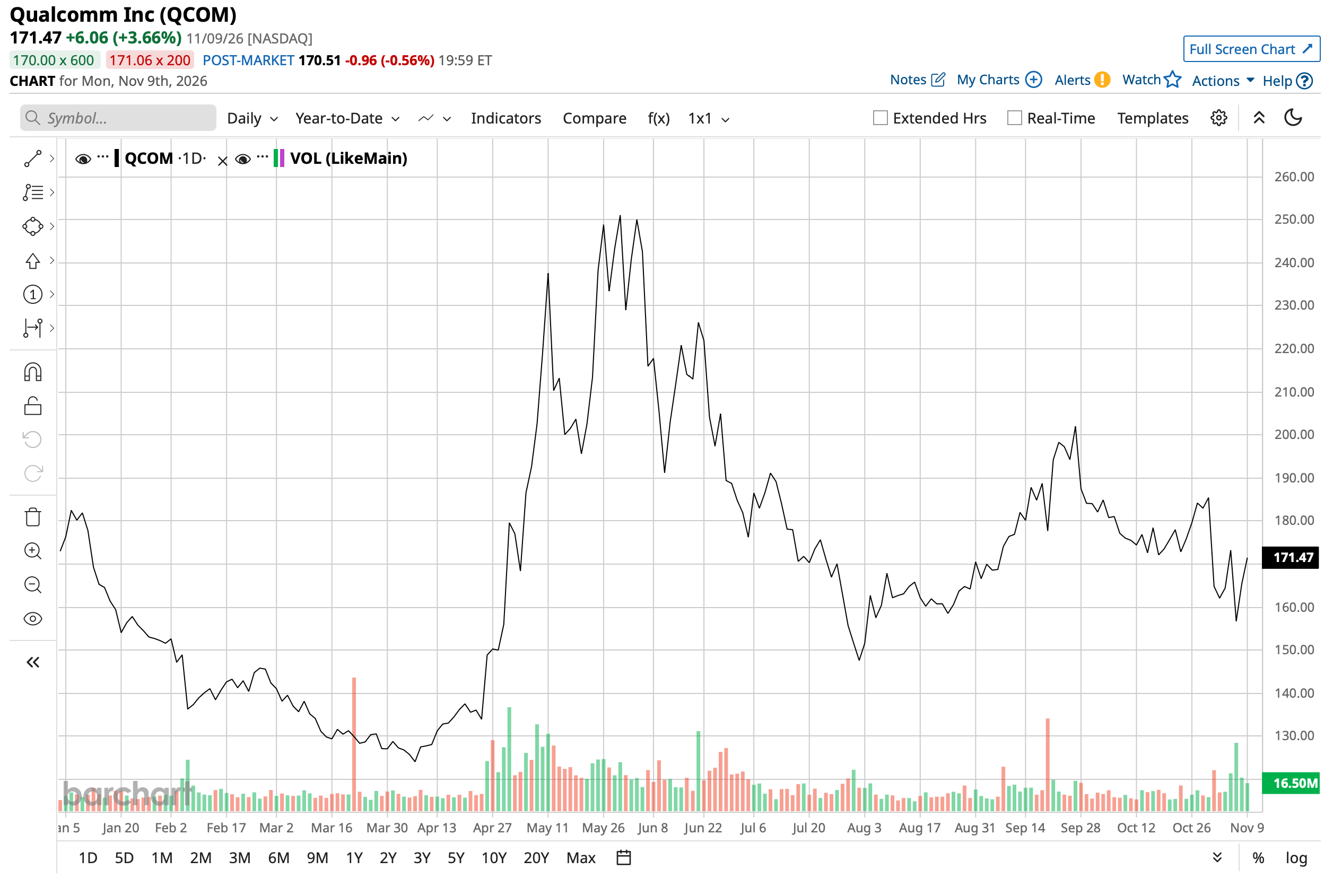
Valued at a market capitalization of $185 billion, QCOM stock is up about 3% year-to-date (YTD). Notably, the stock offers a dividend yield of 2.15%. Further, the company has raised its dividend consecutively for the past 22 years and returned close to $2 billion to shareholders in the most recent quarter.
But dividends and share repurchases were certainly not the reasons behind Alphabet's investment in Qualcomm. Let's take a closer look.
Solidifying a Long Relationship
To start, we should note that Alphabet's recent investment in Qualcomm is likely a consequence of the latter acquiring Modular for $3.9 billion in July 2026. Modular develops an AI-native software platform that enables AI applications to run efficiently across different hardware architectures. Google Ventures was already an investor in Modular and thus received nearly 3 million Qualcomm shares as a consequence of the acquisition.
Having said that, this investment can bring mutual benefits. For Qualcomm, its Snapdragon processors power a large proportion of premium Android smartphones, and Google controls the Android operating system and several of the most widely used AI services on those devices. Deeper collaboration would allow Qualcomm to demonstrate that its hardware is optimized for Google's latest software and AI workloads. This is commercially valuable when smartphone manufacturers decide which processors to use in their premium devices. Additionally, it would help Qualcomm defend its position against competitors such as MediaTek and Apple (AAPL), which are developing increasingly sophisticated on-device AI capabilities.
The second potential benefit is access to Google's AI models and cloud infrastructure for automotive and other enterprise applications. Qualcomm can sell more than a processor when it offers automakers an integrated solution combining computing hardware, software, connectivity, and AI services. Google's Gemini models and Google Cloud capabilities would make Qualcomm's automotive platforms more compelling to manufacturers seeking to develop intelligent vehicles. In turn, Qualcomm could provide Google with a hardware platform and established industry relationships through which its AI services can be deployed.
Lastly, Qualcomm's fledgling data-center business can receive a serious thrust, as it seeks to clock $15 billion in revenue by fiscal 2029 from the segment. While its $60 billion commitment from Amazon (AMZN) is substantial, the company is also targeting other major hyperscalers like Google, Microsoft (MSFT), and Meta Platforms (META).
Qualcomm's Q4 Report Showed Hiccups
Qualcomm's most recent results for the fourth quarter of 2026 had some undeniable issues, chief among them being the decline in core handset revenues. However, Q1 earnings guidance that missed Wall Street's expectations led to a 9.5% nosedive in QCOM stock. In my view, that decline was unwarranted for a company boasting some solid fundamentals.
Revenue fell 7% year-over-year (YOY) to $10.4 billion. Handset revenue fell 26% YOY to $5.1 billion, as management attributed the slowdown to high memory prices affecting smartphone demand. On the flip side, automotive revenue jumped 89% on a YOY basis to $1.99 billion. Licensing revenue moved 7% lower to $1.3 billion.
Meanwhile, earnings eased by 28% YOY to $2.17 per share, yet that was just enough to beat the consensus estimate of $2.16 per share. Out of the past nine quarters, Qualcomm's earnings have surpassed Street expectations on eight occasions.
For Q1 fiscal 2027, Qualcomm expects revenue between $10.4 billion and $11.2 billion. At the midpoint, this comfortably surpasses the consensus estimate of $10.55 billion. However, earnings guidance led to the recent share price decline, with the company forecasting a range of $2.15 to $2.35 per share. The midpoint of $2.25 comes in lower than the consensus estimate of $2.32 per share.
What should be slightly more concerning is the roughly 20% YOY fall in net cash provided by operating activities for fiscal 2026 to $11.1 billion, as inventories grew significantly YOY to $2.05 billion, reflecting poorly on the company's demand situation. Overall, Qualcomm closed the quarter with a cash balance of $4.6 billion and capital expenditures of just $2.5 billion for the year. The cash balance was also higher than its short-term debt level of $2.5 billion.
Qualcomm stock trades at relatively reasonable levels, though. While its price-to-cash flow (P/CF) ratio of 18.4 times is just below the sector median of 18.7 times, the forward price-to-earnings (P/E) ratio of 23.9 times and price-to-sales (P/S) multiple of 4.2 times are above the respective sector medians.
What Do Analysts Think of QCOM Stock?
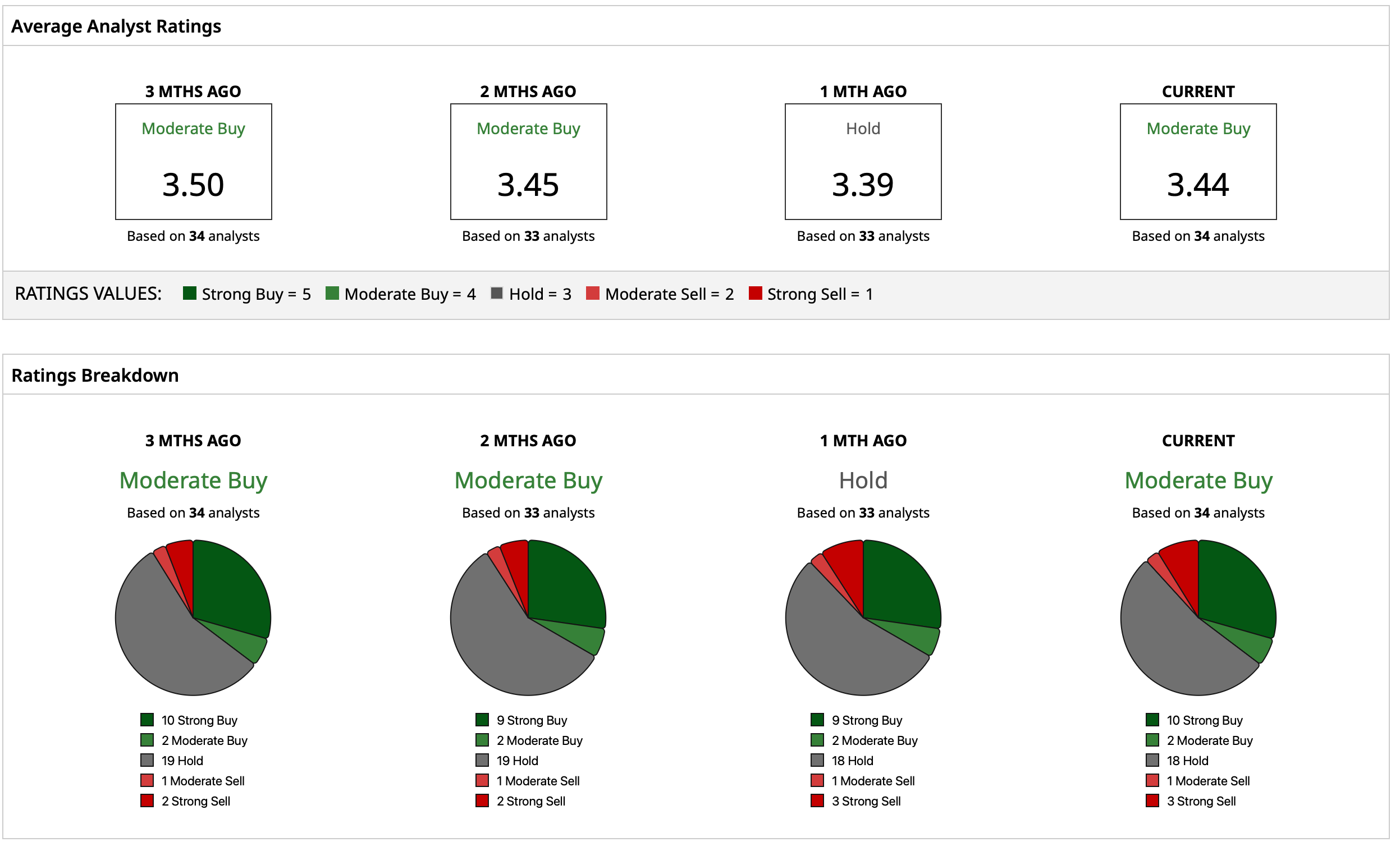
Overall, analysts have a consensus “Hold” rating for QCOM stock. Out of 34 analysts covering the stock, nine have a “Strong Buy” rating, two have a “Moderate Buy” rating, 19 have a “Hold” rating, one has a “Moderate Sell” rating, and three have a “Strong Sell” rating. The mean target price of $191.21 denotes potential upside of 8% from current levels.
On the date of publication, Pathikrit Bose did not directly have a position in any of the securities mentioned in this article. All information and data in this article is solely for informational purposes. For more information please view the Barchart Disclosure Policy here.