


Microsoft (MSFT) just signed a five year partnership with The Ohio State University Wexner Medical Center to apply its AI and cloud tools to smart hospital design, data infrastructure, and workforce training.
For context, Microsoft’s share price has pulled back in the short term, with a 1 day share price return of 2.26% down and a 30 day share price return of 4.11% down, even as the 90 day share price return of 5.19% and year to date share price return of 10.19% point to underlying momentum that appears intact.
Scan how other AI infrastructure plays are setting up by checking the 53 AI infrastructure stocks alongside Microsoft’s latest healthcare and cloud partnerships.
After a sharp pullback on Anthropic headlines, Microsoft now trades at roughly a 34% gap to one intrinsic value estimate and an 18% discount to analyst targets. Is that caution compensation for real risks, or is it a mispricing?
Most Popular Narrative: 24% Overvalued
On the Simply Wall St Community fair value of $419.91, Microsoft’s last close of $521.13 screens as richer than that estimate. This approach puts more weight on the cash flows investors are paying for today, rather than on analyst targets or short term headlines. According to CubanEros, an investor in the Simply Wall St Community who wrote the narrative, the current setup hinges on how the market weighs capital intensity against business quality.
The one real debate is capital intensity. Capex has roughly doubled to ~37% of revenue as Microsoft builds out AI infrastructure, and that has compressed free cash flow in the near term. The key point for a value investor: this is funded from operating strength, not debt. Whether it earns a good return is the thing to watch, but the company isn't stretching its balance sheet to do it.
See why 294 investors see Microsoft as 24% overvalued.
Result: Fair Value of $419.91 (OVERVALUED)
Still, that fair value view can crack if AI capex stops translating into higher quality earnings, or if regulatory scrutiny around big tech tightens meaningfully.
Find out about the key risks to this Microsoft narrative.
Another View: Microsoft Through Earnings Multiples
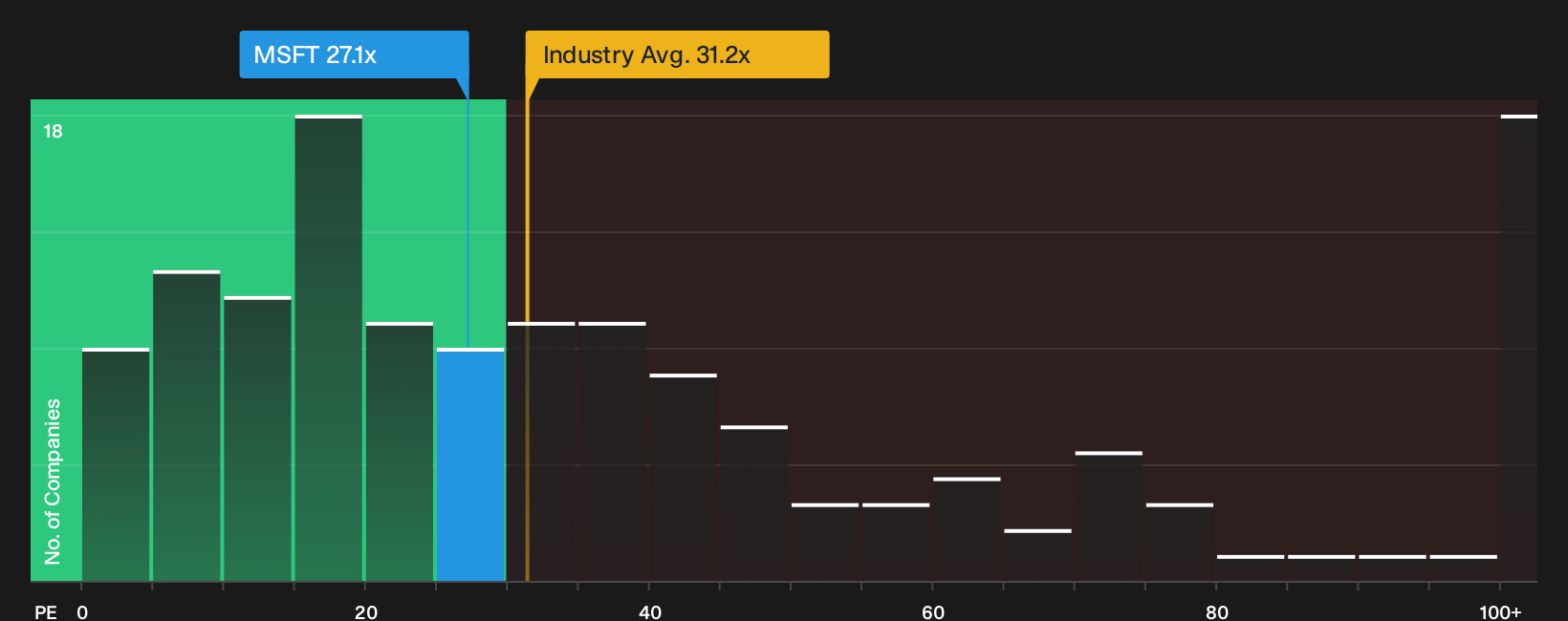
There is a second lens on Microsoft that pushes back on the “overvalued” tag. On a P/E of 27.1x, the stock trades below the US Software industry at 31.2x and under its peer group at 24.3x, while the fair ratio sits far higher at 56x.
That gap suggests the market is pricing in less upside than the fair ratio points to, even though the shares already trade at a premium to many direct peers. For an investor, the live question is whether that gap signals extra downside risk if expectations fade or potential upside if sentiment moves closer to the fair ratio.
To see how this earnings-based view lines up with other metrics, including profitability and peer comparisons, See what the numbers say about this price — find out in our valuation breakdown.
Next Steps
Mixed messages in the Microsoft story today, with both risks and rewards in play, are exactly why you should look through the data yourself and decide where you land. If you want a single, focused snapshot of what other investors are flagging on both sides, start with the 4 key rewards and 1 important warning sign.
Looking for more investment ideas beyond Microsoft?
If you only stop at Microsoft, you risk missing practical opportunities that fit your own risk tolerance, income needs, and time horizon.
- Target potential mispricings by scanning a curated pool of companies that combine strong fundamentals with appealing valuations through the 32 high quality undervalued stocks.
- Strengthen your income stream by focusing on resilient payers with higher yields using the 6 dividend fortresses.
- Dial down risk by zeroing in on companies that score well on resilience and financial stability through the 30 resilient stocks with low risk scores.
Have feedback on this article? Concerned about the content? Get in touch with us directly. Alternatively, email editorial-team@simplywallst.com