


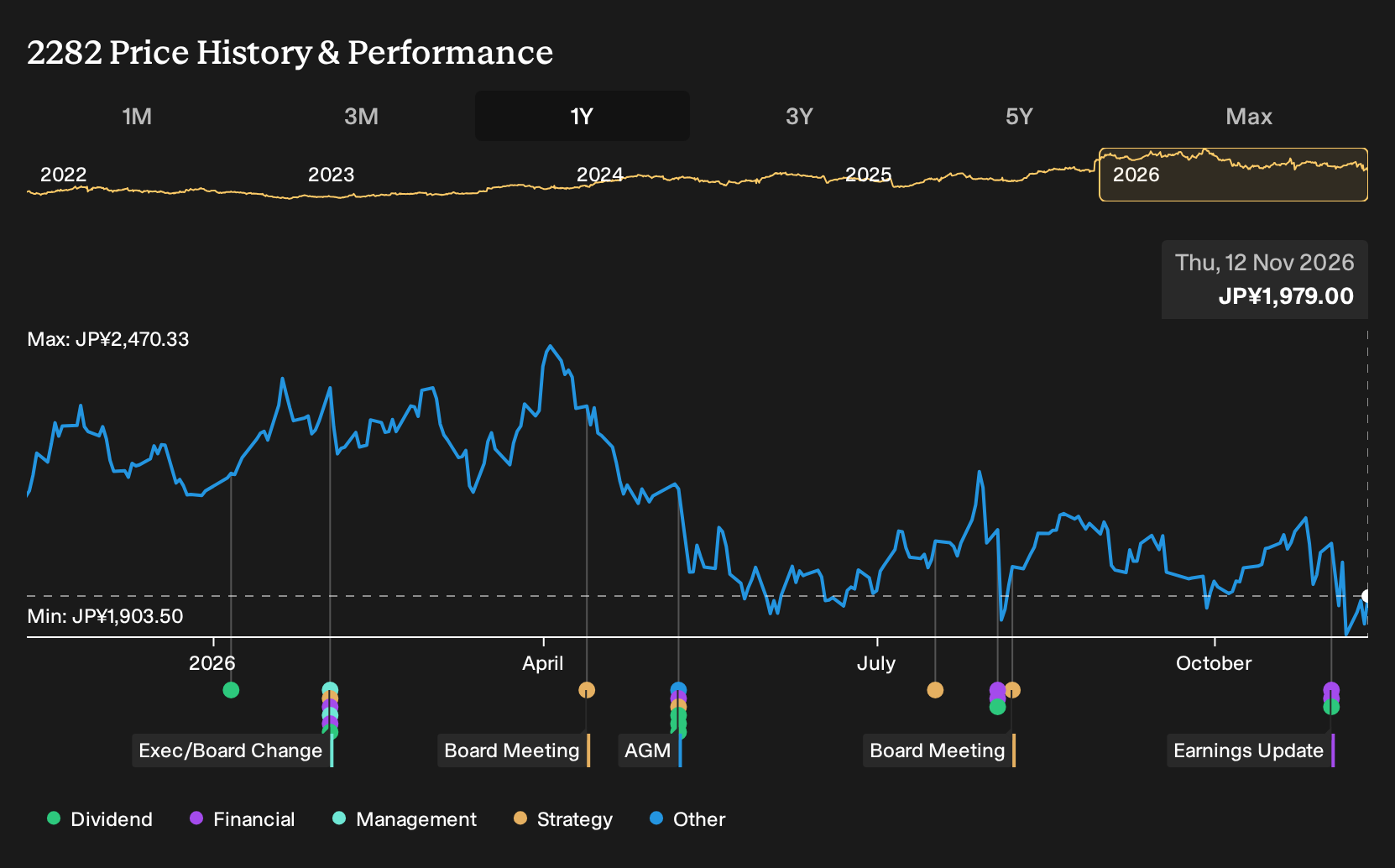
- NH Foods reported half year sales of JPY 769,358 million and net income of JPY 17,394 million, cut full year profit guidance, and adjusted dividend guidance after a three for one share split, with the year ending March 31, 2027 now expected to carry a JPY 60.00 year end dividend per share.
- Cost pressures tied to the situation in the Middle East, higher manufacturing expenses in processed foods, and rising cattle and feed prices in fresh meats are placing NH Foods' profitability under strain even as net sales forecasts remain unchanged.
- The focus now shifts to how NH Foods' investment narrative absorbs this lower profit guidance and cost inflation pressure across its core businesses.
Compare how NH Foods' reset profit outlook stacks up against other companies under cost pressure by scanning our curated list of 19 resilient stocks with low risk scores that may offer more resilient earnings profiles.
What Is NH Foods' Investment Narrative?
Owning NH Foods rests on a simple belief. You think a broad, everyday protein and processed foods business can keep passing input costs through to customers, while running an integrated supply chain that does not chew up too much capital. The latest half year update complicates that story. Sales of ¥769,358 million held up, yet profit slipped and full year earnings guidance was cut, which tells you cost inflation is biting harder than pricing power right now.
The reset to profit and dividend guidance after the three for one split makes the near term catalysts more about execution than demand. Investors are watching whether NH Foods can rein in manufacturing costs in processed foods, manage cattle and feed prices in fresh meats, and still support its dividend policy when free cash flow cover already looks tight and debt is not well cushioned by operating cash flow.
Yet one issue still hangs over the NH Foods investment case, and it only really comes into focus when you look at ...
There's only one way to know the right time to buy, sell or hold NH Foods. Head to Simply Wall St's company report for the latest analysis of NH Foods's Fair Value.
Decide For Yourself
Disagree with this assessment? Extraordinary investment returns rarely come from following the herd, so go with your instincts.
- A great starting point for your NH Foods research is our analysis highlighting 2 key rewards and 2 important warning signs that could impact your investment decision.
- See our latest analysis for NH Foods. The report includes a comprehensive fundamental analysis summarized in a single visual, the Snowflake, making it easy to evaluate NH Foods' overall financial health at a glance.
Looking For More Investment Ideas Beyond NH Foods?
If NH Foods has you thinking harder about cost pressure, balance sheets, and earnings resilience, it can help to widen the lens and compare it with other listed businesses facing different sets of trade offs.
- Prefer to keep risk in check while still staying exposed to equities? Review a curated 19 resilient stocks with low risk scores that focus on resilience and steadier fundamentals.
- If you are searching for quality at a price that looks reasonable, scan through a 20 high quality undervalued stocks that combine stronger cash generation with more grounded balance sheets.
- Income focused investors who care about consistency as much as yield can browse a 26 dividend fortresses that aim to pair higher payouts with sturdier financial profiles.
Have feedback on this article? Concerned about the content? Get in touch with us directly. Alternatively, email editorial-team@simplywallst.com