


Key Points
UPS’ business stabilized over the past year.
Its high yield, low valuation, and wide moat make it a reliable income play.
Over the past three months, the 10-year Treasury yield rose above 5% for the first time since 2007. That high yield is prompting issuers of other fixed-income investments -- including bonds, CDs, and T-bills -- to raise yields to stay competitive. That shift makes dividend stocks, which are riskier and more volatile, less attractive income plays.
However, blue chip dividend stocks that pay even higher yields should be better-insulated from that pressure. But as of this writing, only about 20 of the S&P 500's (SNPINDEX: ^GSPC) stocks pay forward dividend yields of more than 5%. If I had to add one of those high-yielders to my portfolio today, I'd pick UPS (NYSE: UPS) -- which pays a forward yield of 5.8%.
Missed AI’s "Act 1"? Act 2 Could Be 15x Bigger. Most investors think they missed the AI boat because they didn't buy Nvidia in 2005. But according to our analysts, we’re only at the end of "Act 1"—the R&D phase. "Act 2" is the global rollout. Continue »
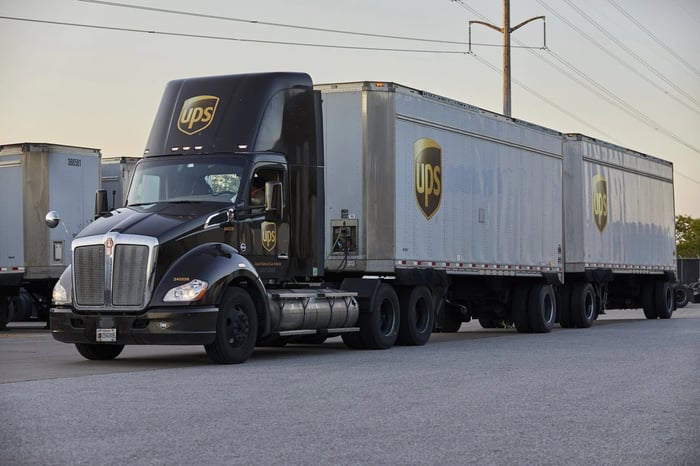
Image source: UPS.
Why is UPS a stable stock in an unstable market?
UPS is one of the world's largest shipping couriers. But from 2021 to 2025, its average daily package volumes declined, and its adjusted operating margins shrank.
Metric |
2021 |
2022 |
2023 |
2024 |
2025 |
|---|---|---|---|---|---|
Average Daily Package Volume |
25.25M |
24.29M |
22.29M |
22.42M |
20.85M |
Average Revenue Per Piece |
$12.32 |
$13.38 |
$13.62 |
$13.60 |
$14.50 |
Total Revenue |
$97.29B |
$100.34B |
$90.96B |
$91.07B |
$88.66B |
Adjusted Operating Margin |
13.5% |
13.8% |
10.9% |
9.8% |
9.8% |
Adjusted EPS |
$12.13 |
$12.94 |
$8.78 |
$7.72 |
$7.16 |
Data source: UPS.
That pressure was initially caused by a post-pandemic slowdown in online orders, competition from other courier services, and inflationary headwinds. Its expenses also rose after it signed a new contract with the Teamsters to avert a strike in 2023, and it reduced its low-margin deliveries for Amazon (NASDAQ: AMZN) -- one of its largest customers -- to stabilize its profits.
UPS' decision to pivot away from Amazon was risky, but it offset that pressure by securing higher-margin orders from smaller businesses and healthcare customers. It also trimmed its workforce and automated more of its logistics services.
For 2026, UPS expects its revenue to rise 4% to $92.6 billion as its adjusted EPS grows 2% to $7.28. That would mark the first time its revenue and adjusted EPS grew together since 2022.
At $112 per share, UPS trades at just 15 times this year's adjusted EPS. UPS has raised its dividend annually for 16 consecutive years. It has ample room for future hikes, since its dividends only consumed 85% of its free cash flow (FCF) over the past 12 months. UPS isn't an exciting investment, but it's one of the few high-yielders in the S&P 500 that's still worth buying.
Leo Sun has positions in Amazon. The Motley Fool has positions in and recommends Amazon and United Parcel Service. The Motley Fool has a disclosure policy.