


Nvidia (NVDA) stock continued to unwind Thursday morning after CEO and co-founder Jensen Huang resigned before he could be fired for not one, but two inappropriate affairs.
For years, I championed Huang as one of the best CEOs in corporate America. Until the wheels fell off earlier this month, I felt pretty good about my opinion. That’s now been shot to bits.
The hubris of billionaires never ceases to amaze me. Maybe it’s not such a good idea to have a billionaire president--but I digress.
I recently read a book about options. The author was particularly fond of vertical credit spreads as a sustainable, income-producing options strategy. This will form the foundation of today’s commentary about yesterday’s unusual options activity.
Most options experts, of whom I am not one, consider 30 to 45 days the best DTE (days to expiration) for Bull Put Spreads and Bear Call Spreads.
In yesterday’s unusual options activity, 18 calls or puts expired in 43 days, 91 in 37 days, and 28 in 30 days. I shouldn’t have trouble finding at least one call or put from each of the three DTEs to form at least one of the legs for at least one bull put spread and one bear call spread.
Here goes.
Opendoor Technologies (OPEN)

Opendoor Technologies’ (OPEN) Dec. 24 $1.50 call was one of the 18 unusually active options from yesterday, expiring in 43 days. The last trade at $1.37 is down 87% in the past 12 months and 95% over five years. With a 100% Strong Sell from the Barchart Technical Opinion and just one of the nine analysts rating OPEN a Buy (2.89 out of 5), I think it’s safe to go bearish here with a bear call spread.
For those unfamiliar with this strategy, it bets that the share price will fall. It involves selling a call option and buying a call option at a higher strike price. The difference between selling one call and buying a second call at a higher price produces a net credit.
Looking at yesterday’s options flow, the only large trade (10 or more) for the Dec. 24 $1.50 call was for 1,000 contracts at 12:02:08 ET. Shown below, it was a single-leg trade at $0.18 per share, right on the ask price, which suggests an institution wanted those contracts badly.

That’s not the trade I’m focusing on. Here’s the bear call spread data from Thursday morning trading.

As you can see above, the $0.11 per share in premium income from selling the $1.50 call is $0.06 per share more than the $0.06 per share cost of buying the $2.00 call. Add the $0.05 net credit per share to the $1.50 call strike price. That becomes the breakeven on the trade. From $1.54 down to $1.50, the trade makes money. Below the lower $1.50 strike, the bet makes a maximum profit of $0.05 (the net credit), or 11.11%.
Why do such a high risk-to-reward (9.00 to $1) bet? Because if you’re bearish about Opendoor in the near term (you should be), you have nearly a 75% chance of making some money. It might be counterintuitive, but it’s an excellent way to make a little from a lot of these high-probability bets.
TJX Companies (TJX)

TJX Companies’ (TJX) Dec. 18 $140 put was one of the 91 unusually active options from yesterday, expiring in 37 days. Of the 3,0011 contracts traded yesterday, 3,007 were for one trade at 10:45:53 ET. The $7.85 per share trade price was right at the midpoint of the bid and ask prices. This particular multi-leg trade was “to open,” which points to several possibilities.

Looking more closely at yesterday's options flow shown below, my first thought is that the 3,007-contract trade was part of a 2:1 Put Ratio Spread, which would involve the institution buying 3,007 put contracts at $7.85 per share while selling 6,014 put contracts for $3.15 per share in premium, for a net debit of $1.55 per share [1 * $7.85 - 2 * $3.15].

However, the $133 puts expire on Nov. 27, while the $140 puts expire three weeks later on Dec. 18. That rules out a traditional put ratio spread.
It could be a 2:1 Put Diagonal Ratio Spread, where the 3,007 long $140 puts are covered by half of the 6,014 short $133 puts through Nov. 27, leaving 3,007 short $133 puts representing 300,700 shares open to possible assignment should the share price be below $133 at expiration on Nov. 27, a little over a week after TJX reports its Q3 2026 results.
Analysts are fairly enthusiastic about TJX. Of the 25 covering it, 18 rate it a Buy (4.40 out of 5) with a $168.69 target price, up 25% from its current share price.
So, in this instance, the institution wants the share price to trade below $38.45 [$140 strike - $1.55 net debit] in the 21 days between Nov. 27 and Dec. 18, and higher than $134.55.
Neither of these is a bull put spread, so let’s look at the possible combinations utilizing the Dec. 18 $140 put.
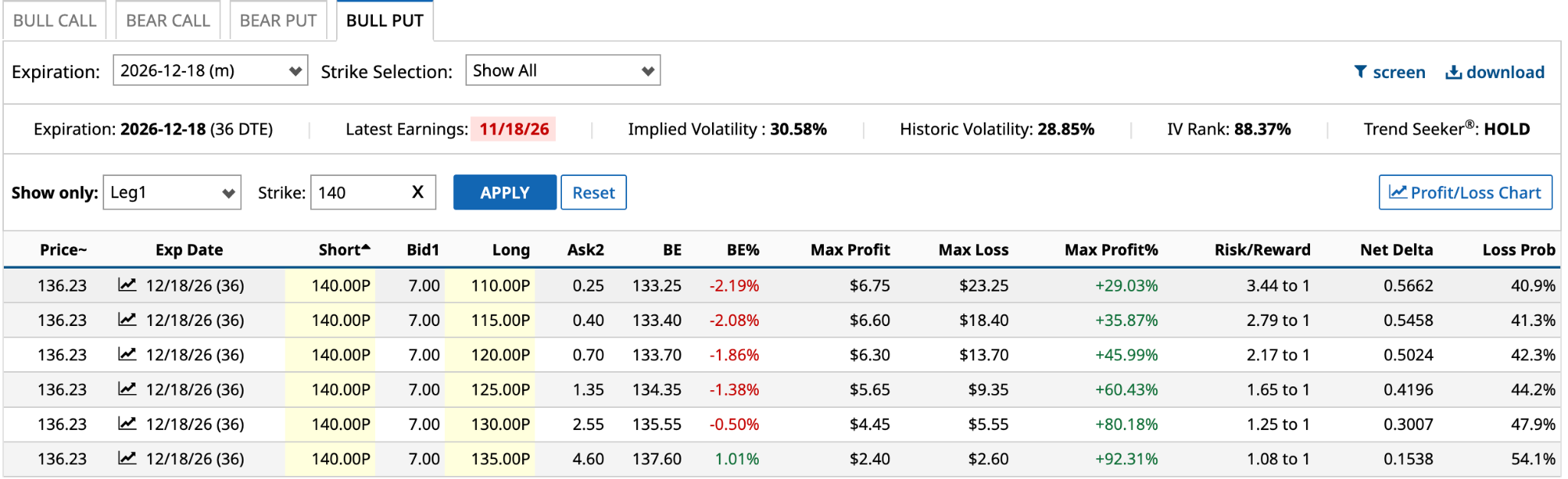
In this case, the odds of making money on the bull put spread range from 45.9% to 59.1%. Not terrible, but you can still lose money despite a net credit. I’d consider selling the $140 put and buying the $125 put for a $5.65 net credit. It cuts the risk/reward in half, while the profit probability stays at 55.8%.
Sofi Technologies (SOFI)

Sofi Technologies’ (SOFI) Dec. 11 $16 put was one of the 28 unusually active options expiring in 30 days. I’ve always been quite bullish on the fintech stock, despite its inability to stay above $20 for long.
Given my bullish stance, here’s how the $16 put looks today for a bull put spread options strategy.
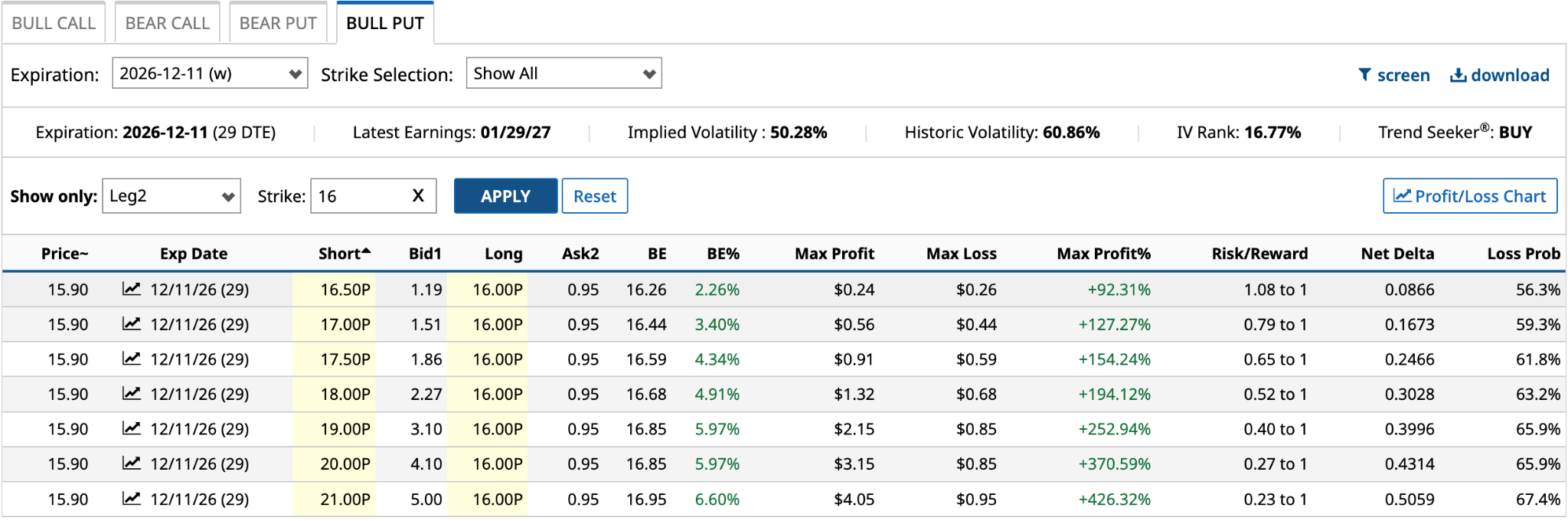
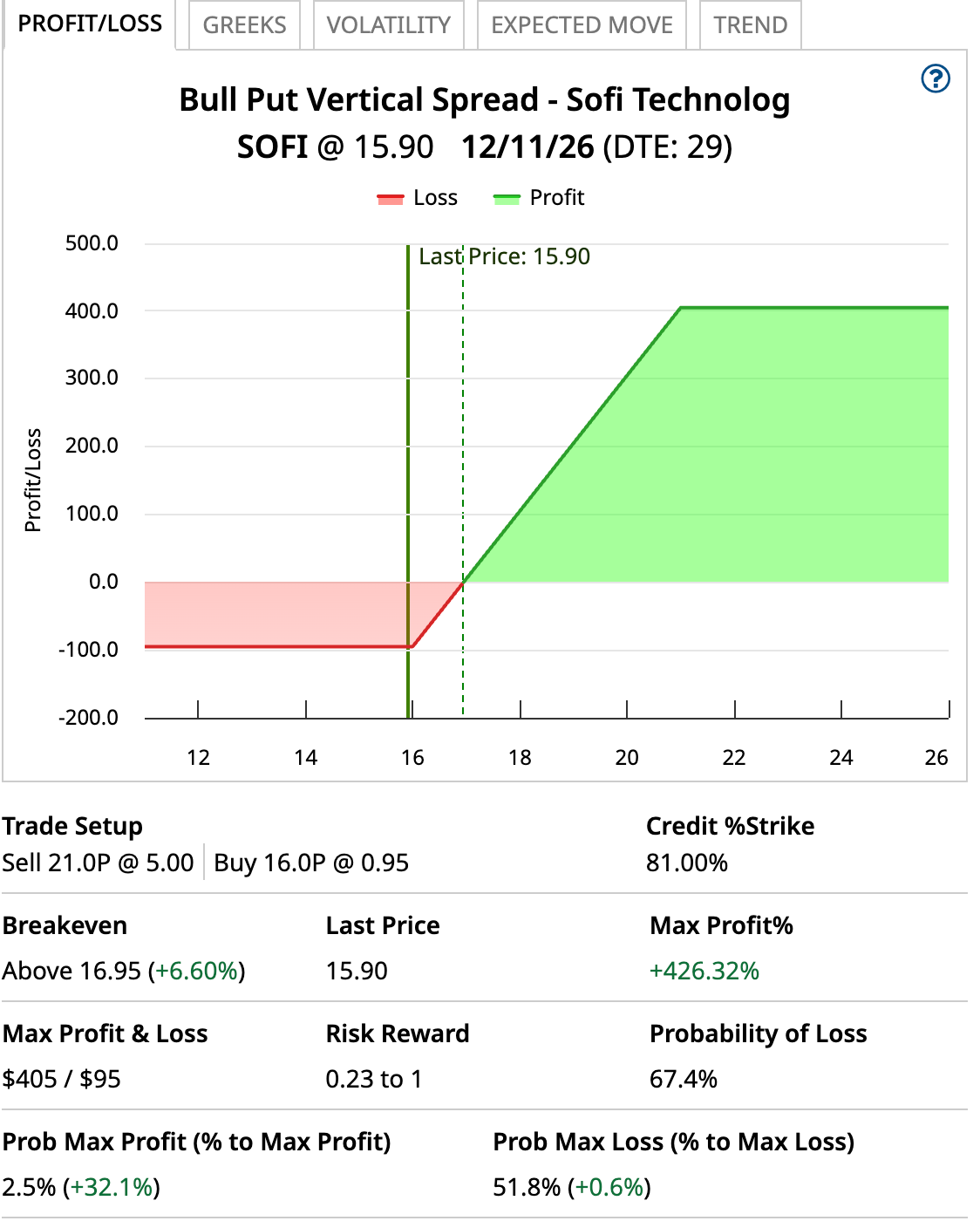
In this example, the probability of loss is high, but the maximum loss is relatively benign. For this reason, I like the short $21 put combined with the long $16 put. The $4.05 net credit [$5.00 bid price - $0.95 ask price] is 81% of the difference between the $21 and $16 strike prices. You’re risking 23 cents to make $1.
To generate a maximum profit of $4.05, the share price must be $21 or higher on Dec. 11. Based on the $15.90 share price, that’s a 32% gain in 30 days. Unlikely. More likely, however, is the share price being between the $16.95 breakeven and $21. It’s a good balance between risk and reward.
On the date of publication, Will Ashworth did not directly have a position in any of the securities mentioned in this article. All information and data in this article is solely for informational purposes. For more information please view the Barchart Disclosure Policy here.