


Key Points
Apple and Alphabet account for over 30% of Berkshire Hathaway's stock portfolio.
Berkshire has bought over 60 million shares of Alphabet since Greg Abel took over as CEO this year.
Meanwhile, Apple's relatively low AI spending has made it an outlier compared to other mega-cap tech companies.
Since Greg Abel took over the reins at Berkshire Hathaway (NYSE: BRKA)(NYSE: BRKB) after longtime CEO Warren Buffett retired at the end of last year, the company has made notable portfolio changes. It got rid of stakes in blue chips like Amazon and UnitedHealth Group, but kept Apple (NASDAQ: AAPL) as its top holding and turned its stake in Alphabet (NASDAQ: GOOG)(NASDAQ: GOOGL) up a notch.
As of June 30, Berkshire owns 227,917,808 Apple shares, worth around $79.4 billion at its Nov. 10 share price. It also owns 105,979,600 shares of Alphabet (both share classes), worth around $30.4 billion. Together, they make up over 30% of Berkshire's stock portfolio.
Missed Nvidia in 2009? This Rare Signal Is Flashing Again. In 2009, a "Double Down" signal flashed for a little-known chipmaker called Nvidia. For the first time in years, that same "Total Conviction" signal is flashing for a company 1/100th the size of Nvidia. Continue »
Given Berkshire's investing record and its bullish stance on both companies, should investors follow suit? I believe so.
Image source: The Motley Fool.
Apple is picking up steam again
Berkshire started selling a lot of its Apple shares in 2024 and 2025, dropping from around 915 million shares at its mid-2023 peak to nearly 228 million today. Berkshire hasn't bought or sold Apple shares since Abel took over, so it seems Abel is comfortable holding steady.
So far this year, not selling definitely seems like the smart route because Apple's stock is thriving. Through Nov. 10, it's up over 28%, leading all "Magnificent Seven" stocks by a nice margin. It's also up 7% since John Ternus replaced longtime CEO Tim Cook on Sept. 1.
Part of the reason Apple's stock has been thriving is that investors are shying away from some major tech stocks that are spending aggressively on AI and are embracing the stability and predictability that come with Apple. During the earlier phases of the current AI boom, Apple got a lot of flak for seemingly lagging in the arms race. Now, its discipline is paying off.
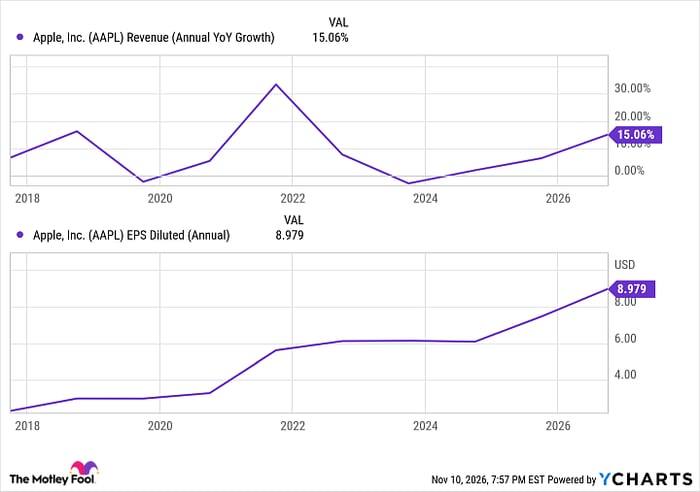
Apple's revenue growth has been unimpressive leading up to this year, but it has accelerated a bit. In its fiscal 2026 (ended Sept. 26), the company generated $478.8 billion in revenue, up 15% year over year, and increased its earnings per share (EPS) by 20% to $8.98.
AAPL Revenue (Annual YoY Growth) data by YCharts
Apple noted that it sold the most iPhones in company history in its September-ended quarter, an encouraging sign that the company still has momentum with its main moneymaker.
Its stronghold on consumer hardware should remain strong. It won't have the revenue and earnings growth you're seeing from companies like Nvidia and other AI standouts. Still, I expect it to continue delivering good long-term returns.
Buy the Alphabet dip?
Berkshire first began investing in Alphabet when Buffett was still in charge, but it has doubled down since Abel took over. After adding over 60 million shares this year, it's now Berkshire's fourth-largest holding behind Apple, American Express, and Coca-Cola.
Unfortunately, Alphabet's stock has been on the opposite trajectory of Apple's. It's down over 8% this year, including an 18% drop over the past month. Regardless, now seems like the time to buy the dip rather than take it as a warning sign to jump ship.
Much of Alphabet's stock struggles can be tied to its huge spending on building out data centers and other AI infrastructure, and to investors worrying whether Alphabet will get a good enough return on those investments. An earnings miss doesn't help, either.
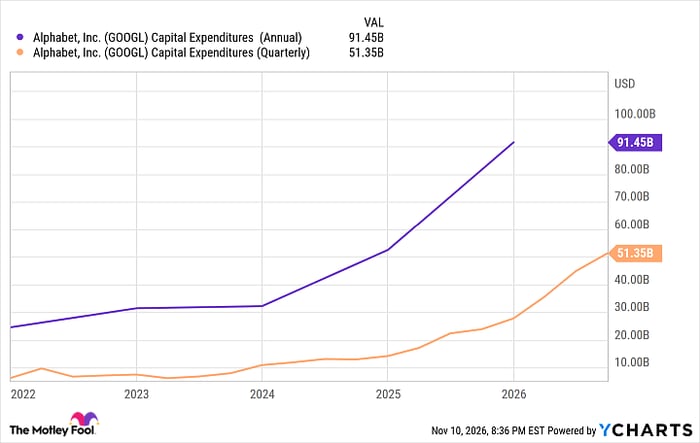
In the third quarter, Alphabet missed both revenue and earnings estimates for the first time in years, though revenue was up 25%. It also spent $51.4 billion in capital expenditures, with a full-year projection between $195 billion and $205 billion. That would be well over double the $91.5 billion it spent in 2025.
GOOGL Capital Expenditures (Annual) data by YCharts
Alphabet's spending might not be ideal, but its cloud growth is a sign that it has at least something to show for it. Google Cloud revenue grew 103% to $30.7 billion, far outpacing the growth of both Amazon Web Services (AWS) and Microsoft Azure.
Search remains Alphabet's bread and butter, accounting for half of its revenue. It's the engine that keeps money flowing in, but Google Cloud will be Alphabet's main growth driver for the foreseeable future. As long as it continues to deliver strong growth, investors can afford to be more forgiving of Alphabet's spending, especially for a company with $265.1 billion in cash and short-term investments.
Alphabet's competitive moat and value (the cheapest of the Magnificent Seven by price-to-earnings ratio) make it a no-brainer for long-term investors.
American Express is an advertising partner of Motley Fool Money. Stefon Walters has positions in Apple, Coca-Cola, and Microsoft. The Motley Fool has positions in and recommends Alphabet, Amazon, American Express, Apple, Berkshire Hathaway, and Microsoft. The Motley Fool recommends UnitedHealth Group. The Motley Fool has a disclosure policy.