


I asked if the dollar index was heading for new lows in 2026 in a September 15, 2026, Barchart article, and I concluded with the following:
While the dollar index’s 2026 trend remains marginally bullish, at 99.00 to 99.50, the U.S. faces issues that could derail the positive trend over the coming weeks and months. With under four months until the end of 2026, a break below short-term technical support at 97.425 could lead to a test of the 2026 low of 95.44. The dollar index's path could significantly influence the path of least resistance for commodity prices. The U.S. dollar is the pricing mechanism for most raw materials because it is the world’s reserve currency. A falling dollar tends to support higher commodity prices, leading to rising inflation, which further erodes the dollar’s value.
The dollar index futures contract was trading at 99.34 on September 14, 2026, and moved higher to near 103 in November 2026.
The dollar index has been trending higher in 2026
The dollar index has made higher lows and higher highs throughout 2026.
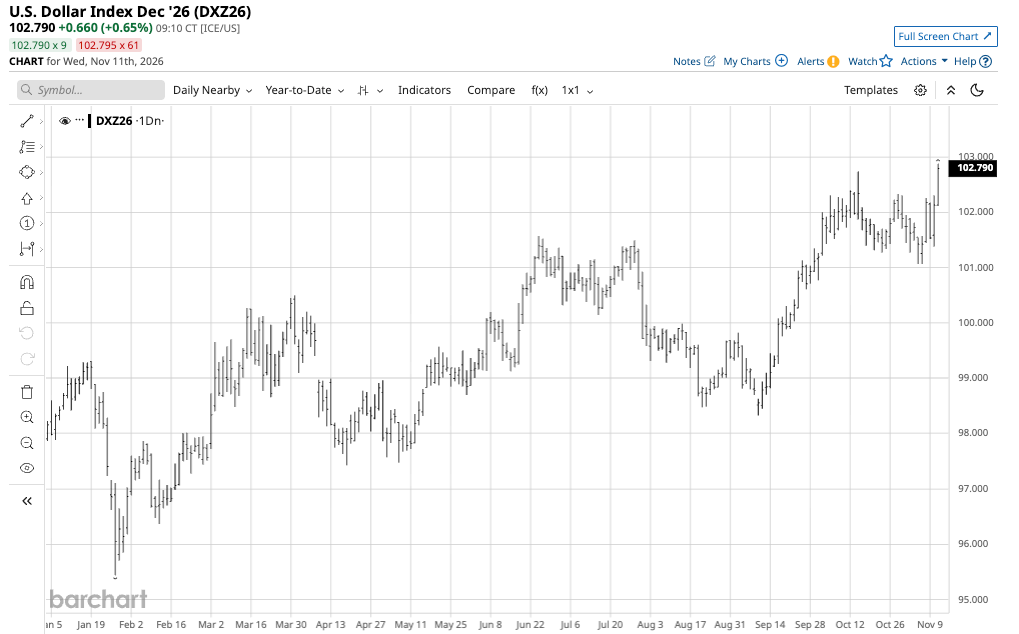
The daily continuous dollar index futures chart shows that after reaching a low of 95.44 on January 27, 2026, the dollar index has rallied throughout the year, rising 7.8% to a high of 102.880 on November 11. At the high on November 11, 2026, the dollar index remains in an aggressive bullish trend.
A rising index does not mean the U.S. currency is stronger
The dollar index measures the dollar’s strength or weakness against a basket of reserve currencies, with the euro weighing the most at 57%. The euro was second only to the dollar as a reserve currency until central bank accumulation pushed the euro into third place.
The currencies comprising the dollar index are fiat currencies that derive their value from the full faith and credit of the governments that issue the legal tender. Inflation, geopolitical events, trade sanctions, tariffs, and other factors have reduced faith in governments and have caused credit to decline. Therefore, a rising dollar index does not necessarily mean the U.S. currency is becoming more valuable; it may only be more valuable than the other index components. In the current global economic environment, all fiat currencies, including the U.S. dollar, are losing value as purchasing power declines.
Violence in Europe could support the dollar index
One factor that could continue to lift the dollar index is the ongoing and escalating protests and violence gripping France and spreading to other EU countries. While there is conjecture about the root causes of the violence, the result could continue to weaken the euro currency. Because the euro accounts for most of the U.S. dollar index, a weaker euro pushes the dollar index higher.
The U.S. election could cause volatility
On November 3, 2026, U.S. voters decided on the future majority in the House of Representatives and Senate. The opposition party tends to do well in midterm elections, and the only exception in the 2026 contest was how well the Democrats did, capturing majorities in both the House of Representatives and the Senate and winning many local races, even in traditionally red states, across the United States.
The current Republican administration now faces more roadblocks to its policy initiatives. Immigration, energy, foreign, economic, tax, and social policies from the past two years will now face legislative opposition.
In the past, gridlock in the U.S. government created by opposition forces controlling the executive and legislative branches has supported markets. However, the current environment suggests that the separation of powers is anything but ordinary. Therefore, the U.S. dollar’s value could become highly volatile as friction between the branches of the U.S. government mounts.
While inflation above the Fed’s 2% target erodes the U.S. dollar’s value, a more hawkish monetary approach by the U.S. central bank could support the dollar versus other reserve currencies, pushing the dollar index higher. Interest rate differentials are a critical factor in determining the path of least resistance of one currency versus another. The latest hot October CPI data points to further rate hikes.
The bottom line is that events over the next two years in the economic and geopolitical landscape could cause periodic volatility in the U.S. dollar’s value and the path of least resistance for the U.S. dollar index.
The odds favor a stable dollar index but a weaker dollar, along with weaker fiat currencies
The dollar index trend is bullish in 2026, but it remains bearish since the 2022 high.
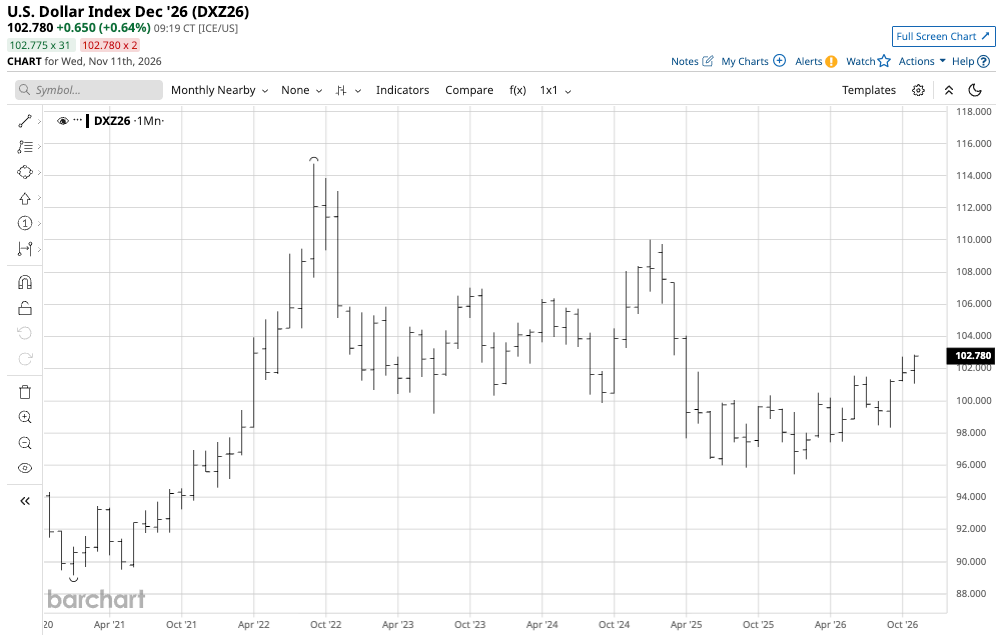
The monthly chart shows a bearish trend of lower highs and lower lows, taking the index from the September 2022 high of 114.745 to the January 2026 low of 95.44. These are the medium-term technical resistance and support levels.
The short-term dollar index trend is higher, the medium-term trend is lower, and the long-term trend since 2008 is higher.
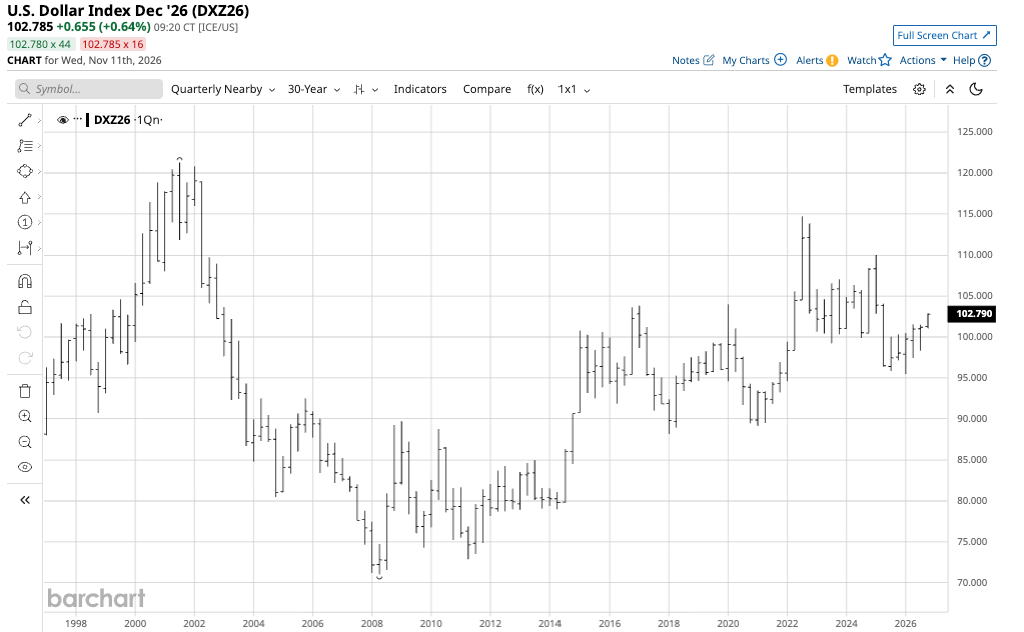
The quarterly chart shows that since the 2008 low of 71.05, the dollar index has made higher lows and higher highs, rising to the most recent high of 114.745 in Q3 2022.
At around 102.80 on November 11, 2026, the dollar index is above the midpoint of the long-term range, below the midpoint of the medium-term range, and above the midpoint of the short-term range, creating a confusing picture. Therefore, the dollar index's price action continues to suggest stability, while global economic and geopolitical factors point to continued inflationary pressures that will weigh on the U.S. currency’s value and the value of all fiat currencies.
Therefore, the dollar index's direction could be meaningless. I see critical technical support and resistance at 90 and 110. With the dollar index above the midpoint of these two technical targets, fading moves toward either support or resistance could be the optimal approach over the coming months and throughout 2027.
The most direct route for a risk position in the dollar index is the futures and futures options contracts on the Intercontinental Exchange. The Invesco DB U.S. Dollar Index Bullish Fund ETF (UUP) tracks dollar index price action, while its bearish counterpart, the Invesco U.S. Dollar Bearish ETF (UDN), moves higher when the dollar index declines and lower when it appreciates.
The odds do not favor a significant move in the dollar index over the coming months, but surprises in the economic or geopolitical landscape can still cause significant volatility. The U.S. dollar and dollar index have historically been a safe haven during tumultuous periods. However, there is no guarantee that the dollar’s role as the world’s reserve currency will continue to provide safe-haven status. In November 2026, the dollar index remains range-bound and is going nowhere fast.
On the date of publication, Andrew Hecht did not directly have a position in any of the securities mentioned in this article. All information and data in this article is solely for informational purposes. For more information please view the Barchart Disclosure Policy here.