


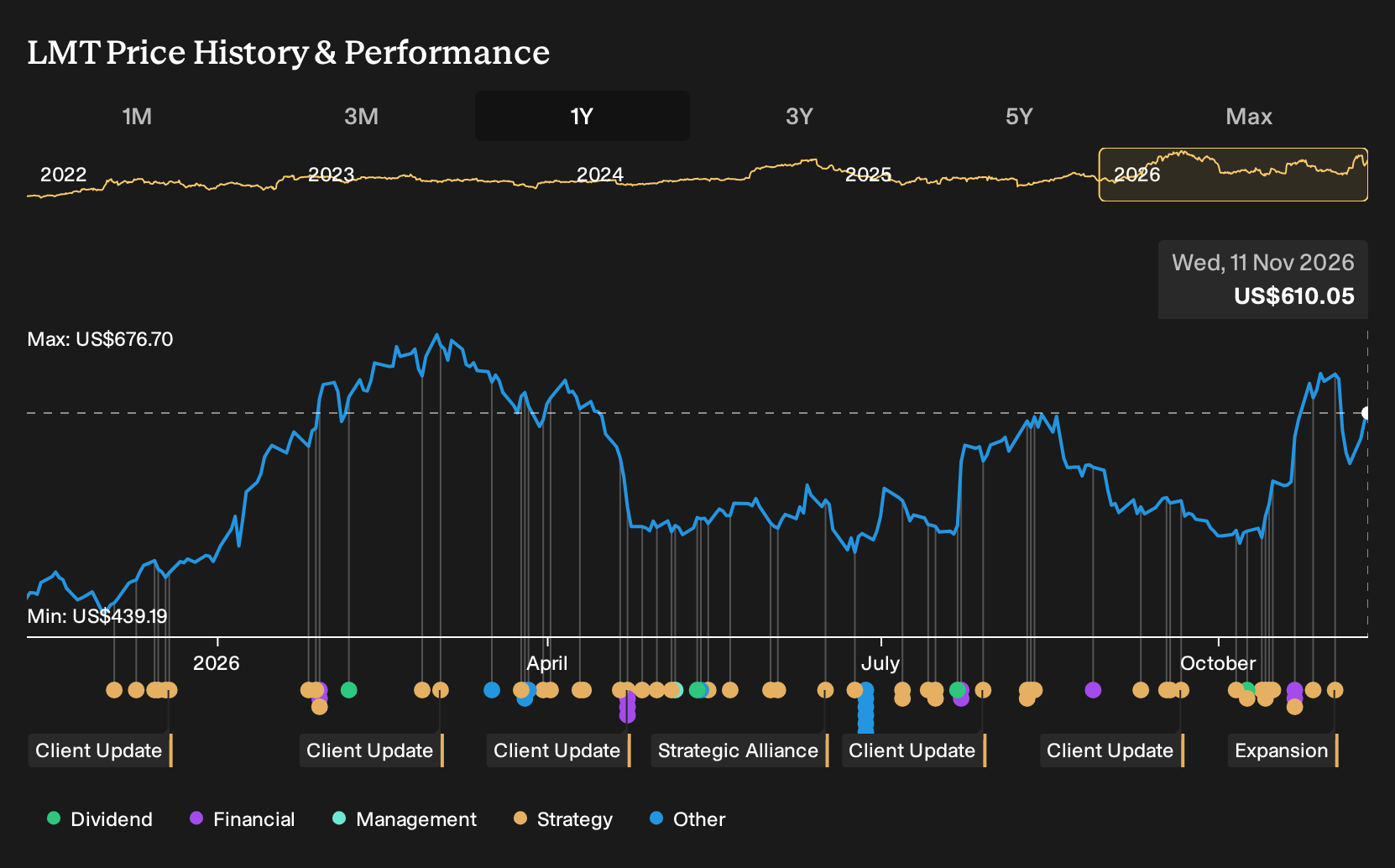
- Lockheed Martin has expanded its Camden, Arkansas manufacturing operations with a US$420 million investment that is expected to add 650 full time jobs, increase capacity for PAC-3, THAAD and PrSM production, and deepen the site’s role in the U.S. defense industrial base.
- The build out in Camden, along with the Munitions Acceleration Center and advanced manufacturing focus, underscores how Lockheed Martin is reshaping its missile production footprint to handle larger volumes across multiple long term programs.
- The focus now shifts to how this expanded Camden capacity could influence Lockheed Martin's investment narrative and long term execution story.
Scan how Lockheed Martin's expansion theme plays out across other defense suppliers by tracking our hand picked 30 resilient stocks with low risk scores, which aim to balance resilience with potential upside.
Lockheed Martin Investment Narrative Recap
To be comfortable owning Lockheed Martin, an investor needs to believe the analyst consensus narrative on Simply Wall St that a record backlog and multi year missile frameworks can keep turning into steady revenue, earnings and free cash flow. The Camden expansion fits directly into that story because it is geared to PAC 3, THAAD and PrSM capacity, which sit at the center of those longer munitions agreements.
In the near term, the key upside hinge is clean execution on these higher volume missile contracts without running into fresh cost issues on complex fixed price or legacy programs. The biggest watchpoint is still potential charges or technical setbacks on large classified and helicopter projects, along with any new regulatory or compliance findings that could drag on margins and free cash flow.
The recent acceleration in GMLRS production sits closest to this Camden narrative. Lockheed Martin has delivered its 100,000th GMLRS rocket and is producing nearly 14,000 rockets per year, and that operational tempo shows what higher volume output can look like when the supply chain, workforce and industrial partners line up around a single family of systems.
For a shareholder, pairing that GMLRS track record with the Camden build out and the Munitions Acceleration Center gives a clearer picture of the execution bar. The same playbook needs to translate to PAC 3, THAAD and PrSM for the backlog to convert smoothly, while any material cost overruns or supply disruptions across these lines would work directly against the capacity story investors are leaning on.
Lockheed Martin's narrative projects US$94.4b revenue and US$8.6b earnings by 2029. That path is built on analysts assuming 6.0% yearly revenue growth and an earnings increase of about US$2.1b from US$6.5b today to the 2029 consensus level.
Uncover why Lockheed Martin's fair value indicates an 8% potential upside to its current price that could narrow quickly.
Exploring Other Perspectives
One alternate view focuses less on Camden’s added capacity and more on execution strain. The most cautious analysts, who were pencilling in 4.0% annual revenue growth to about US$88.9b and US$8.4b in earnings by 2029 before this news, worry Lockheed Martin could face production or contract hiccups. That gap in expectations shows how widely opinions can differ. It is worth exploring both sets of forecasts and deciding which story you think may evolve as this expansion is absorbed into new estimates.
Explore 5 other Lockheed Martin fair value estimates, including one that suggests it could be worth just $660.86.
Reach Your Own Conclusion
Don't just follow the ticker. Dig into the data and build a conviction that's truly your own.
- A great starting point for your Lockheed Martin research is our analysis highlighting 5 key rewards and 1 important warning sign that could impact your investment decision.
- See our latest analysis for Lockheed Martin. The report includes a comprehensive fundamental analysis summarized in a single visual, the Snowflake, making it easy to evaluate Lockheed Martin's overall financial health at a glance.
Looking for more investment ideas beyond Lockheed Martin?
If the Lockheed Martin story has sharpened your thinking, use that momentum to scan a wider field of opportunities with the Simply Wall St Screener. You can filter for the mix of quality, resilience and income that fits your own plan, instead of relying on a single defense stock to do all the work.
- For investors who want potential upside with a margin of safety, start by reviewing companies flagged as 32 high quality undervalued stocks based on their fundamentals.
- If capital preservation sits high on your priority list, focus on businesses highlighted in the 30 resilient stocks with low risk scores to see which ones pair financial strength with relatively lower risk scores.
- For those building a portfolio that leans on income, scan the 6 dividend fortresses to find higher yielding candidates that may complement a defense holding like Lockheed Martin.
Have feedback on this article? Concerned about the content? Get in touch with us directly. Alternatively, email editorial-team@simplywallst.com