



Networking technology giant Cisco (NASDAQ:CSCO) announced better-than-expected revenue in calendar Q3 2026 [fiscal Q1 2027], with revenue rising 24.4% year on year to $18.52 billion. Guidance for next quarter’s revenue was better than expected at $18.1 billion at the midpoint, 1.7% above analysts’ consensus estimates. Its non-GAAP profit of $1.40 per share was 5.6% above analysts’ consensus estimates.
For more on Cisco, read our free full research report.
Cisco Q3 CY2026 highlights:
- Revenue $18.52 billion vs S&P consensus estimates of $18.07 billion (24.4% year-on-year growth, 2.5% beat)
- Adjusted EPS $1.40 vs S&P consensus estimates of $1.33 (5.6% beat)
- Revenue guidance The company lifted its revenue guidance for the full year to $75.3 billion at the midpoint from $72.8 billion, a 3.4% increase
- Adjusted EPS guidance Management raised its full-year adjusted EPS guidance to $5.50 at the midpoint, an 8.3% increase
- Operating margin 30.2%, up from 22.6% in the same quarter last year
- Free cash flow margin 20.8%, up from 19.4% in the same quarter last year
- Market capitalization $396.7 billion
"In Q1, we delivered the strongest revenue and non-GAAP earnings per share growth rates for Cisco in over 15 years," said Chuck Robbins, chair and CEO of Cisco. "Organizations are turning to Cisco for our trusted, market-defining technology and our expertise to help them scale, secure and optimize their environments for the agentic AI era. We are in the very early stages of a multi-year networking supercycle, and we're confident in our ability to continue capturing the multi-billion-dollar opportunity it represents for Cisco."
Revenue growth
Examining a company’s long-term performance can provide clues about its quality. Any business can have short-term success, but a top-tier one grows for years. Cisco’s revenue grew at a solid 5.7% compounded annual growth rate over the last five years. Its growth was slightly above the average business services company and shows its offerings resonate with customers.
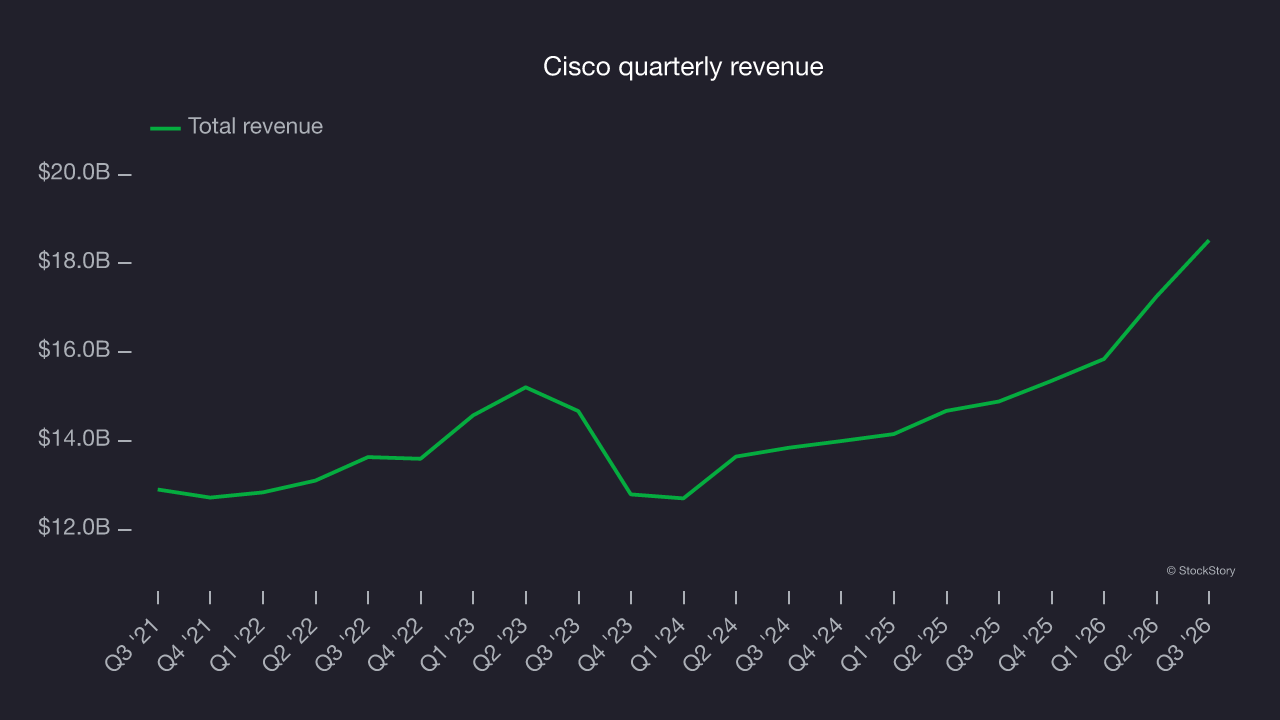
Long-term growth matters most, but within business services, a half-decade historical view may miss recent innovations or disruptive industry trends. Cisco’s annualized revenue growth of 12.4% over the last two years is above its five-year trend, suggesting its demand recently accelerated. 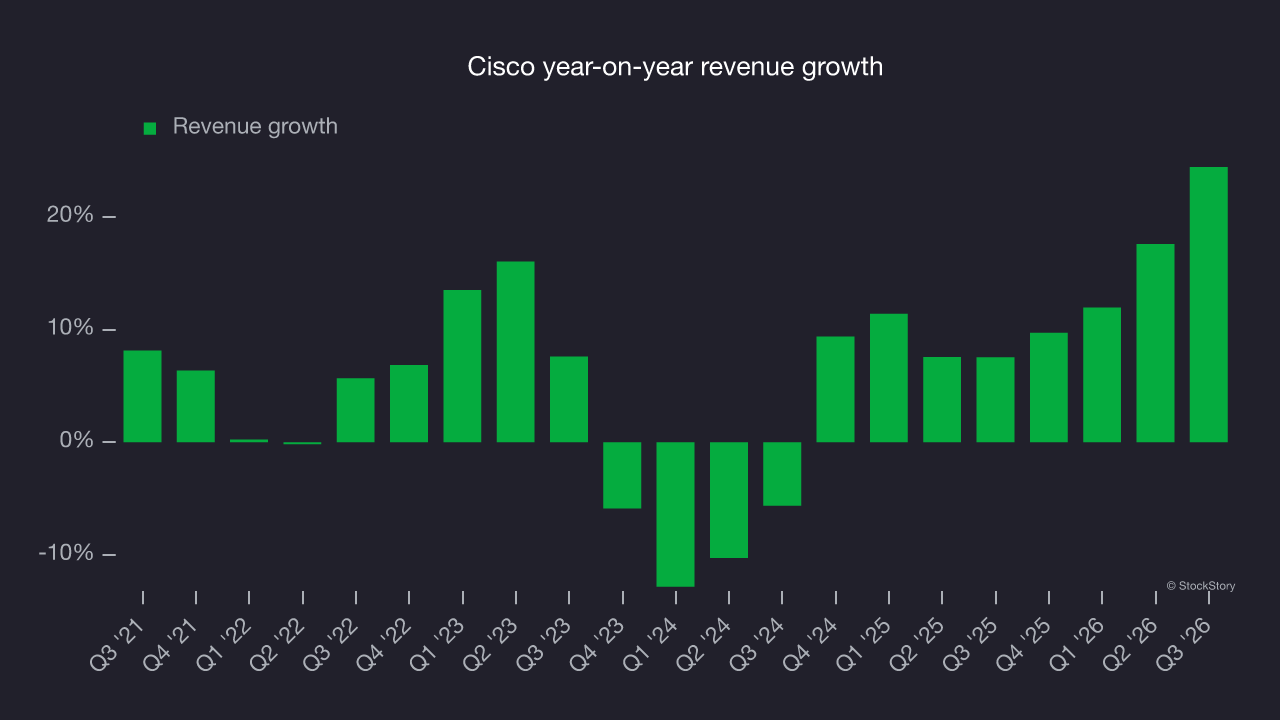
This quarter, Cisco reported strong year-on-year revenue growth of 24.4%, and its $18.52 billion of revenue topped Wall Street’s consensus estimates by 2.5%. Management is guiding for a 17.9% year-on-year increase in revenue next quarter.
Looking further ahead, sell-side analysts expect revenue to grow 10.5% over the next 12 months, according to S&P, a slight deceleration versus the last two years. Given its scale, that growth trajectory is attractive and suggests the market sees success for its products and services.
Adjusted operating margin
Cisco has performed well over the last five years. It demonstrated strong profitability for a business services company, with an average adjusted operating margin of 34.2%.
Cisco’s adjusted operating margin rose by 1.7 percentage points over the last five years, as its revenue growth gave it operating leverage.
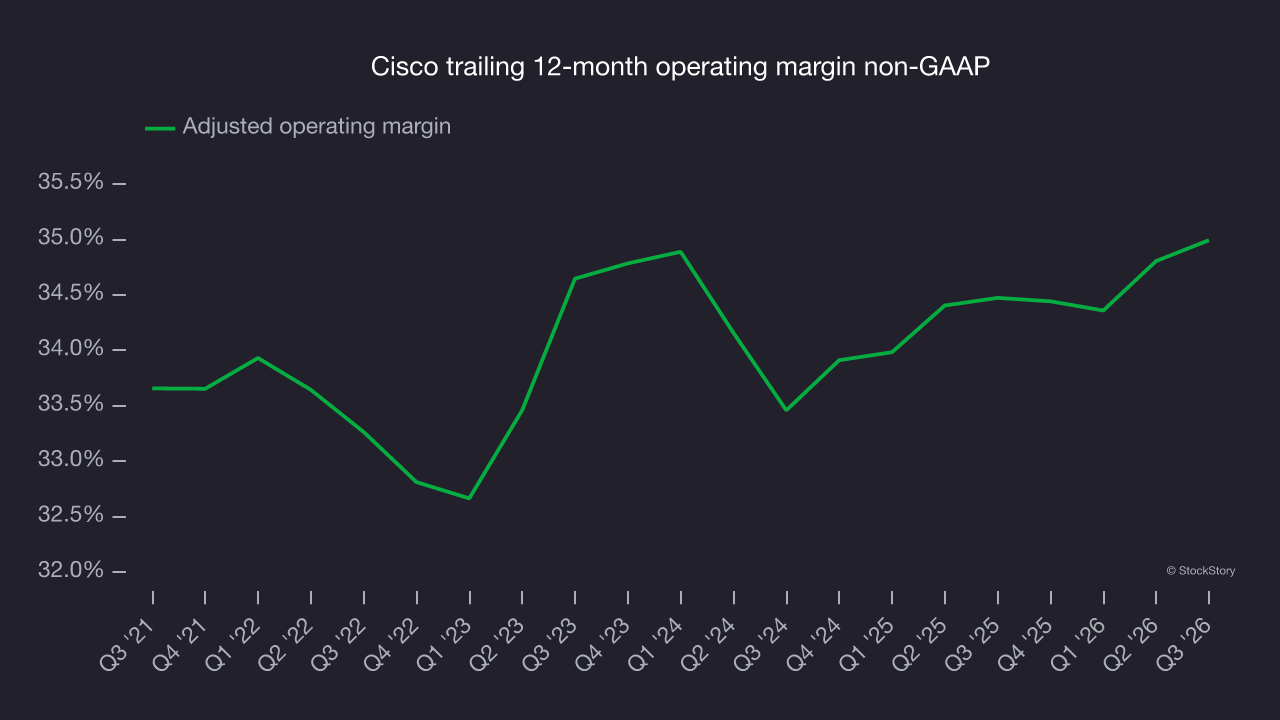
This quarter, Cisco generated an adjusted operating profit margin of 35.2%, in line with the same quarter last year. This indicates the company’s overall cost structure has been relatively stable.
Earnings per share
Revenue trends explain a company’s historical growth, but the long-term change in earnings per share, or EPS, points to the profitability of that growth. For example, a company could inflate its revenue through excessive spending on advertising and promotions.
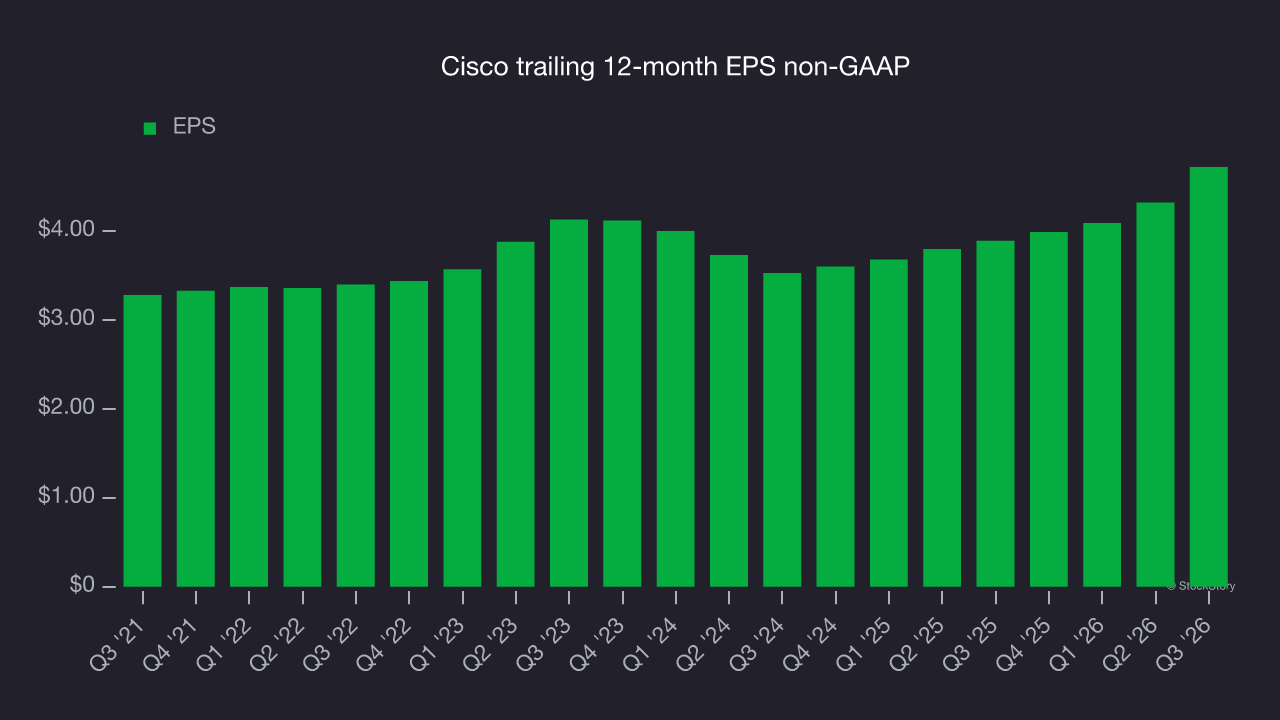
Cisco’s solid 7.6% annual EPS growth over the last five years aligns with its revenue performance, indicating that its incremental revenue was profitable.
As with revenue, examining EPS over a shorter period can reveal a change in the business.
Cisco’s two-year annual EPS growth of 15.6% was strong and topped its 12.4% two-year revenue growth.
Cisco’s adjusted operating margin was flat this quarter, as noted earlier, but a two-year view shows its margin has expanded. This was the most relevant factor aside from revenue growth behind its higher earnings; interest expenses and taxes can also affect EPS but don’t tell us as much about a company’s fundamentals.
In Q3, Cisco reported adjusted EPS of $1.40, up from $1 in the same quarter last year. This result beat analysts’ consensus estimates by 5.6%. Over the next 12 months, Wall Street expects Cisco’s full-year EPS to grow 9.6% from $4.72 to $5.17, according to S&P.
Key takeaways from Cisco’s Q3 results
Cisco’s EPS outlook gave the quarter some clear positives, with guidance for next quarter well ahead of analysts’ consensus estimates and the full-year forecast topping Wall Street’s consensus by a wide margin. Shares rose 2.4% to $104.55 immediately after the release.
Cisco had a solid quarter, but one earnings result doesn’t necessarily make the stock a buy. The latest quarter matters, but longer-term fundamentals and valuation matter much more when deciding whether the stock is a buy. Read the full research report here (it’s free).