


Key Points
Taiwan Semiconductor Manufacturing has a virtual monopoly on manufacturing advanced AI chips.
TSMC benefits from growing AI demand, regardless of which chip designers and hyperscalers are more successful.
TSMC's annual revenue growth should remain above 25% through 2030.
For much of its existence, Taiwan Semiconductor Manufacturing (NYSE: TSM), or TSMC, has been one of the more underappreciated companies in the tech world. We don't interact with its products or services, but as the world's largest semiconductor foundry, it makes chips for virtually all the electronics we use every day.
TSMC has been around for nearly four decades, but the recent AI boom has brought it into the spotlight. Over the past three years, its stock is up 325%, and it's now the world's sixth-most-valuable public company.
Missed AI’s "Act 1"? Act 2 Could Be 15x Bigger. Most investors think they missed the AI boat because they didn't buy Nvidia in 2005. But according to our analysts, we’re only at the end of "Act 1"—the R&D phase. "Act 2" is the global rollout. Continue »
TSMC has strong momentum, up 35% this year, but what could $500 monthly investments in the stock look like over the nearly three years leading into 2030? Let's take a look.
Image source: The Motley Fool.
Could your investment double?
For illustration, let's assume TSMC finishes this year flat from its current price, giving you three full years of investing from 2027 to 2030. At $500 per month, you would personally invest $18,000 over that time. Here are three scenarios based on different average annual returns in those three years:
| Average Annual Returns | Projected Value | Total Gain |
|---|---|---|
| 10% (Conservative) | $23,958 | 33.1% |
| 12.5% (Historical average) | $25,629 | 47.9% |
| 25% (AI boom) | $35,156 | 95.3% |
Calculations by author. Values rounded to the nearest dollar.
The exact percentages and values will inevitably fluctuate because each $500 monthly investment compounds differently, but they roughly reflect what you can expect under various growth environments. Which is more likely?
TSMC has been trading on the market since October 1997 (on the New York Stock Exchange), but most of its all-time gains have come in the past three years, during which it has averaged nearly 60% annual returns. I don't see it continuing at that pace over the next three years, but I believe the 25% AI boom scenario is very doable, and investors could see their stake grow above $35,000.
The AI cash flow isn't stopping in the next few years
Many investors would agree that valuations have grown out of control during the current AI mania. That could cause some stock sell-offs over the next few years, but from a business standpoint, the data center and AI infrastructure build-out isn't ending for TSMC anytime soon.
TSMC's business is well positioned for the next few years because it's the go-to for virtually all advanced AI chip manufacturing needs. It doesn't matter whether AMD catches up to Nvidia's GPU dominance, whether the hyperscalers (Amazon, Microsoft, Alphabet, and Meta Platforms) begin designing their own chips, or whether Broadcom has a stronghold on AI accelerators. TSMC is who'll bring their chip designs to life.
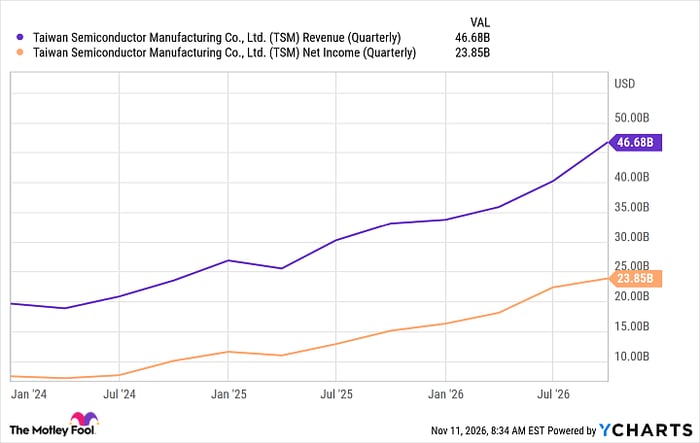
Being the only game in town has given TSMC unprecedented pricing power, which it has used to expand margins and drive record profits. In the past three years, its revenue has jumped 138% ($46.7 billion in the third quarter), while its net income has jumped 219%.
TSM Revenue (Quarterly) data by YCharts
TSMC's high-performance computing segment (which includes its advanced AI chips) accounted for 68% of its revenue last quarter, so there's no doubt an AI-specific slowdown would affect its growth rate.
However, TSMC's management has remained confident about sustainable demand, citing multiyear agreements and the rise of agentic AI, which requires more compute and, therefore, more advanced chips that only TSMC can manufacture at scale.
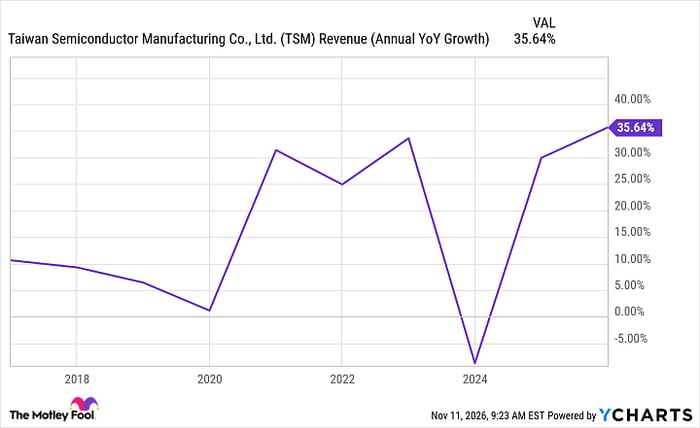
TSMC projects 2026 revenue to be 44% higher than 2025, putting it around $176 billion. At its size, revenue growth rates will eventually slow, but I don't see it dropping below 25% annually before 2030.
TSM Revenue (Annual YOY Growth) data by YCharts
Play the long game beyond 2030
One thing to always remember is that nobody can predict how a stock will perform. Even if TSMC keeps posting impressive results (which I think it will), that doesn't necessarily mean its stock will follow suit. The market can sometimes be irrational.
That said, TSMC is a great investment option well beyond the next three years. Even if the stock hits a rough patch, the company's industry dominance and expertise give it one of the largest competitive moats in the tech world.
Semiconductor manufacturing will only become more important over time. So regardless of how the current AI arms race plays out, TSMC stands to gain a lot. It's a stock you can comfortably hold for the long haul and invest in regularly.
Stefon Walters has positions in Microsoft and Taiwan Semiconductor Manufacturing. The Motley Fool has positions in and recommends Advanced Micro Devices, Alphabet, Amazon, Broadcom, Microsoft, Nvidia, and Taiwan Semiconductor Manufacturing. The Motley Fool has a disclosure policy.