


Rules on where an electric vehicle is built and where its battery comes from sound like fine print, until a tariff switch threatens to reshape what UK and European automakers earn on every car they export. Shifting deadlines on EU UK EV rules, battery supply gaps and possible changes to Chinese import duties are turning into a live pricing story. This piece walks through three stocks exposed to that news and explains why their next moves could matter for your portfolio.
The three automaker stocks below are just a sample from this theme, and the full screen surfaced 1 more listed European or UK car company with an equally interesting EV narrative that is not covered here. To see the broader field and identify which tickers best fit your own thesis, go straight to the European and UK Automakers Focused on Electric Vehicles screener.
Renault (ENXTPA:RNO)
Overview: Renault is a long-established French automaker that designs, builds and sells electrified and conventional vehicles worldwide, anchored in Europe.
Operations: Renault generates about €53.8b from Automotive and €6.8b from Sales Financing, supported by a large footprint across France and wider Europe.
Market Cap: €7.7b
Renault appears in this EV-focused screen because it is a large European producer already pushing electrified models into mass-market segments. The analyst consensus Narrative on Simply Wall St outlines how that shift could affect the business over time.
"The significant reduction in development time and costs due to the Ampere initiative allows Renault to bring competitive EVs to market more rapidly."
The key question is what happens to Renault’s margins if one less visible cost pressure linked to this acceleration does not move in step with the new models.
If that squeeze on profitability is what you are watching, read the full narrative for Renault to see how Renault’s EV push could reshape returns and risk.

Mercedes-Benz Group (XTRA:MBG)
Overview: Mercedes-Benz Group develops and sells premium cars, vans and related financial and digital services, including offerings linked to electric vehicle charging.
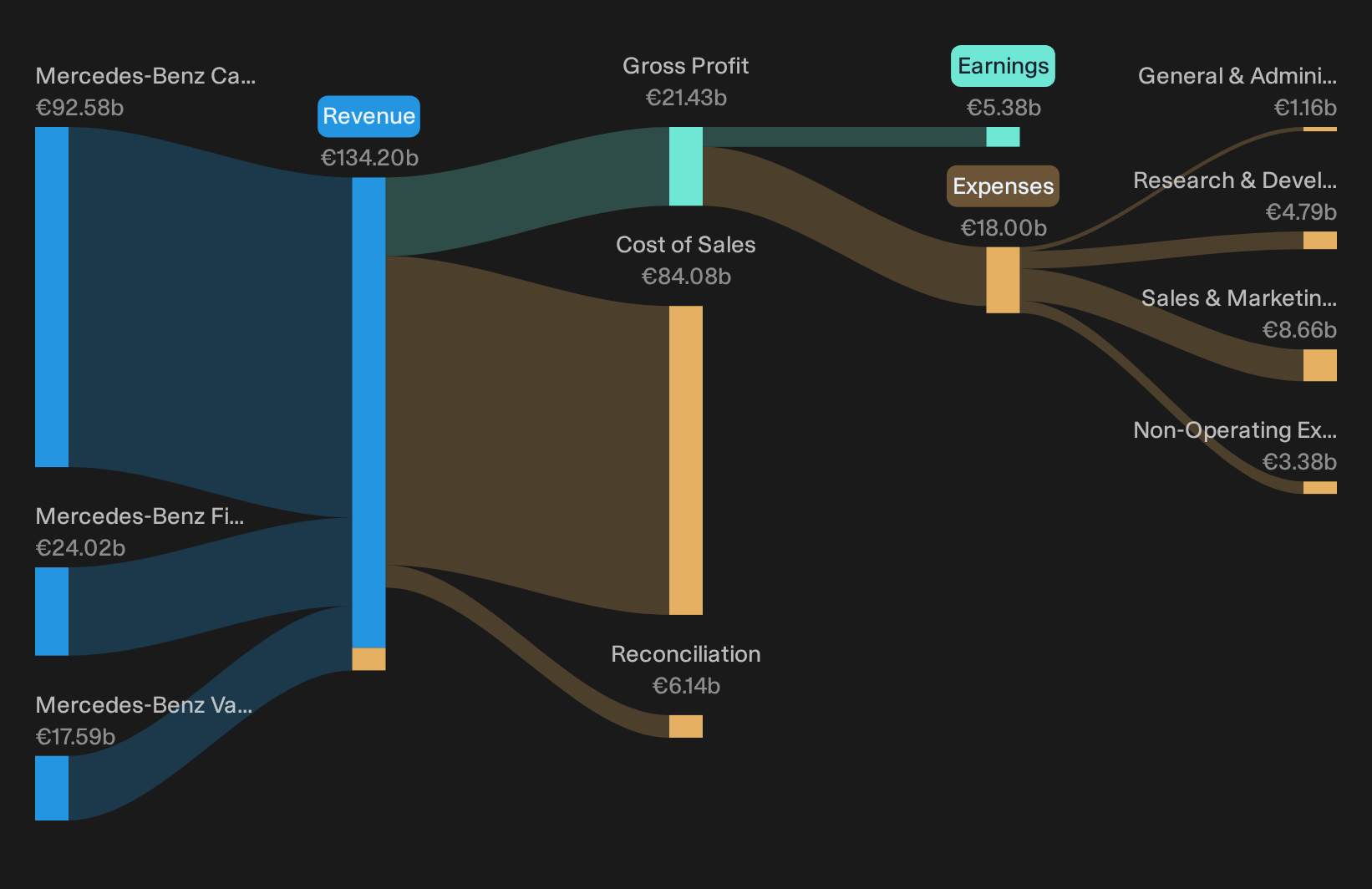
Operations: The group generates about €92.6b from Mercedes-Benz Cars, €17.6b from Vans and €24.0b from Financial Services, offset by reconciliation items.
Market Cap: €37.3b
Mercedes-Benz Group fits this EV-focused screen as a premium European exporter whose growing BEV and hybrid mix is closely tied to tariff rules. The analyst consensus Narrative on Simply Wall St highlights how that shift could change how the business earns its money.
"The rollout of Mercedes-Benz MB.OS and higher content of advanced driver assistance features across both BEV and ICE line ups is expected to support a larger share of high margin software and connected service revenue over time, which would directly influence operating margins and earnings."
What happens to Mercedes-Benz Group’s margins now largely depends on how one less-visible cost pressure interacts with that software-heavy shift.
That pressure point is exactly where the story gets interesting, and the full narrative for Mercedes-Benz Group explains how Mercedes-Benz Group’s software push could decouple earnings from rising build costs.
Volvo Car AB (publ.) (OM:VOLCAR B)
Overview: Volvo Car AB (publ.) is a Swedish automaker focused on electrified SUVs, estates and saloons, selling BEV, hybrid and combustion models globally.
Operations: Volvo Car AB (publ.) generates about SEK 311.6b from its Automotive Business, with sales spread across Europe, China, the US and other international markets.
Market Cap: SEK 34.3b
Volvo Car AB (publ.) is central to this EV-focused screen because its high mix of battery electric and plug-in hybrids ties directly into how EU UK rules of origin, tariff talks and local battery capacity shape what each electrified car actually earns. This is a point the bearish analyst Narrative on Simply Wall St captures clearly.
"Expansion of electric and hybrid offerings, regionalized production, cost-cutting initiatives, Geely collaborations, and emissions credit sales position Volvo for improved growth, profitability, and resilience."
The real swing factor is how one unresolved pressure on costs versus pricing ultimately filters through to Volvo Car AB (publ.) margins.
That cost versus pricing gap is exactly what the full narrative for Volvo Car AB (publ.) unpacks, highlighting where Volvo Car AB (publ.) could see accelerating upside if sentiment shifts.

Curious About What You Might Be Missing?
New themes can build momentum quickly, then move on before the crowd notices what is rising or falling. Scan fresh ideas while it matters and aim to position yourself early.
- Spot companies quietly building strength before momentum appears by running the list of solid balance sheet and fundamentals (199 results) and see which tickers still sit under most radars.
- Explore potential opportunities in early tech shifts by checking the 25 quantum computing stocks and focusing on businesses tied directly to real-world quantum adoption.
- Look for companies with cash flow supporting the AI narrative by reviewing the 41 profitable AI stocks that aren't just burning cash and filtering for firms already reporting earnings from AI-related activity.
Have feedback on this article? Concerned about the content? Get in touch with us directly. Alternatively, email editorial-team@simplywallst.com