


The Zhitong Finance App learned that after a year of sharp fluctuations, the yen unexpectedly entered a period of calm — in recent months, the exchange rate has been closely anchored within a narrow range of around 158 yen per dollar. But on Wednesday, it broke through again: to the surprise of traders, the yen unexpectedly weakened and approached the 160 mark.
This sudden market situation just confirms just how difficult it has become to trade the yen. Traditional signals such as interest spreads are becoming less reliable, and the Bank of Japan's tightening of monetary policy, continued capital outflows, and unprecedented market intervention are pulling the yen in a conflicting direction.
The stakes far surpass Japan alone. The yen is one of the most actively traded currencies in the world, with a daily trading volume of around $1.6 trillion. Its direction can determine the success or failure of global investors, and its long-term trajectory affects everything from Japan's inflation trend to the country's huge savings flow to overseas markets.
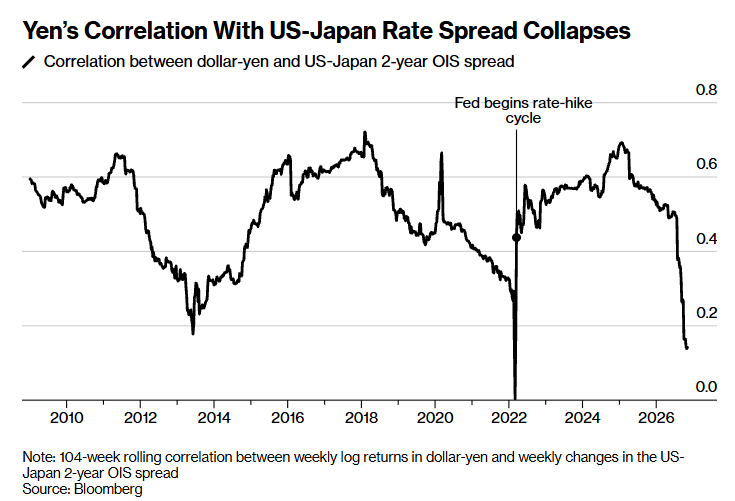
“The challenge is that these conflicting forces make it extremely difficult to predict the timing and magnitude of the yen market,” said Rajeev De Mello, global macro portfolio manager at Gama Asset Management, which manages assets of around 600 million Swiss francs. “As a result, I have reduced my yen position to reflect greater uncertainty.”
The long and empty arguments are equally strong; institutions choose to “leave the scene and wait and see”
There are plenty of reasons to be bullish on the yen: the Bank of Japan is raising interest rates at the fastest rate since 1990, Japan's domestic yield is close to decades-high levels, and Tokyo and Washington officials have shown a willingness to intervene when the yen falls too fast.
But the reason for being bearish is also strong: Japan's interest rates are still far below the US and other major economies, and some investors think the Bank of Japan is too slow to bridge interest spreads. This makes arbitrage trading still attractive, and Japanese companies, institutions, and households continue to export large amounts of capital overseas.
The long-term view is even more tit-for-tat: James Athey of Marlborough Investment Management expects the yen to appreciate sharply, while Lei Zhu of Fidelity International (Fidelity International) believes that further depreciation is a greater risk.
Others simply quit the game. T. Rowe Price's David Clewell has stayed away from the yen for a long time; Brandywine Global's Carol Lye avoided the dollar against the yen this year and instead traded the yen against the euro.
Costly tug-of-war: “floor” bought for 27.1 trillion yen
The yen is also difficult for policy makers to control. In late July, Japan's finance minister, Satsuki Katayama (Satsuki Katayama), led a round of intervention to back up the yen, and US Treasury Secretary Scott Bessent provided support — the latter invested a small amount of money but placed a lot of credit.
Japan has spent a record 27.1 trillion yen (about 169.7 billion US dollars) to buy yen this year, almost three times the size of the country's trade deficit and direct investment outflows combined. The intervention helped the yen recover from a 40-year low of nearly 164 in July, but since then the yen has regained most of its gains.
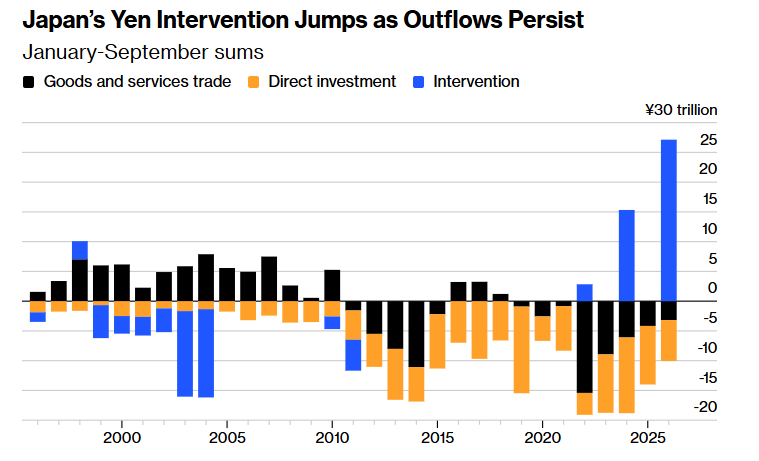
A currency that continues to weaken is driving up import costs, squeezing household expenses, and complicating Prime Minister Takaichi Sanae's efforts to revive the economy — which also explains why Tokyo has repeatedly supported the yen.
“The market should not underestimate the authorities' ability to fight back strongly against one-way markets, but intervention has its limits,” said Masahiko Loo, chief fixed income strategist at State Street Investment Management. “Interventions can slow down the market, but they rarely change the fundamental direction of the market.”
A new era for the yen: from an export powerhouse to a mature creditor country
A few decades ago, the yen was an export power—manufacturers earned foreign exchange by selling cars and electronics globally. What followed was the era of zero interest rates: Japan's huge savings flocked overseas in search of returns, and the yen became the preferred financing currency for global arbitrage transactions.
Withdrawing from zero interest rates should theoretically benefit the yen — it weakens the motivation to “borrow cheap yen and invest overseas.” However, decades of cheap capital have left Japan with 811 trillion yen in overseas securities assets and an overseas investment model that may be difficult to reverse.
Fidelity's Zhu believes that Japan's transformation into a mature creditor economy poses a structural headwind for the yen: pensions, insurance companies, and households continue to invest heavily overseas, and even if higher yields on Japanese treasury bonds encourage some capital to return, it will be difficult to overcome these outflows — unless Japanese yields become truly attractive.
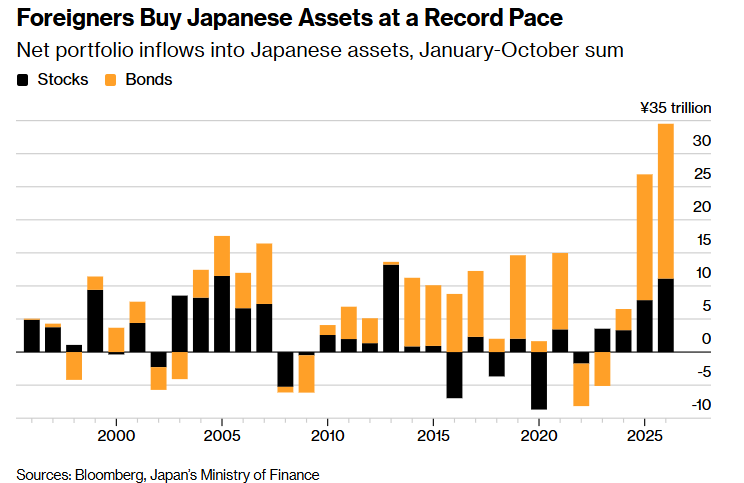
Not even the record inflow of capital helped. From January to October of this year, overseas investors bought a total of 34.5 trillion yen of Japanese bonds and stocks, the highest in the same period, but the yen is still weak. Citigroup strategists pointed out that one possible reason is that foreign investors are hedging their exposure to Japanese stocks by selling yen.
The biggest suspense: will Japanese money “go home”
The biggest question for the yen in the next phase is whether Japan's capital will finally start to stay in the country.
There are initial signs: since this year, Japanese investors have net sold 689 billion yen of foreign stocks and bonds, reversing the 12.5 trillion yen purchase scale last year. Domestically, yields on Japanese treasury bonds are close to decades' high, returns in the Japanese stock market are strong, and corporate governance reforms are also improving the prospects for shareholder returns.
However, these factors alone are not enough to trigger a wave of capital flows back. “The problem is not valuation, but uncertainty,” said Masayuki Nakajima, senior strategist at Mizuho Bank in London. “Many institutions are still worried that yields will rise further if inflation, BOJ austerity expectations, or fiscal concerns intensify.”
Moreover, the reversal of securities investment flows does not mean that Japan has stopped sending capital overseas: this year, Japanese companies invested 11.9 trillion yen overseas through foreign direct investment (excluding reinvestment income) to continue expanding their overseas market.
The world's largest pension, the Government Pension Investment Fund (GPIF), is a litmus test for much attention, but despite market speculation that it may increase domestic assets, its allocation structure remained largely unchanged in the latest quarter.
The higher the bet if you cross the barrier
For Tokyo, the risks are piling up. As Japan explores a new era of inflation and high interest rates, the yen is becoming an increasingly important variable: continued weakness may complicate the Bank of Japan's policy normalization and put additional pressure on the already volatile bond market.
“If the yen gains some strength (strengthening), it will help control headline inflation issues and control the long-term end of the bond market,” said James McAlevey, head of global fixed income and absolute return at BNP Paribas Asset Management.
Washington also has reason to be concerned: Japan is the largest foreign holder of US treasury bonds, and deepening unilateral intervention may force Tokyo to sell off part of its holdings. Earlier this year, the US intervened by reducing Japan's demand to sell US bonds, thereby limiting the risk of boosting US yields.
However, for investors, there are still no obvious deals at the moment. Maxence Visseau, chief investment officer at Dubai's Arkevium Capital, said that since the joint intervention of the US and Japan in July, the yen was “almost impossible to predict.” “I'd love to stay on the sidelines for a while,” he said. “I'm guessing I'm not the only one who thinks this way.”