


The Zhitong Finance App learned that the decades-old system used by the copper industry to price mined copper ore is collapsing in the face of a serious supply shortage.
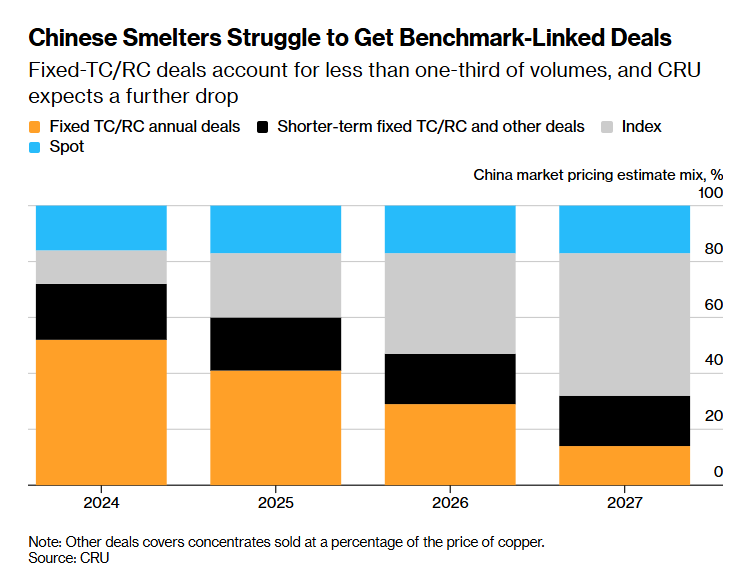
Since the 80s of the last century, every year in the copper industry, a leading mining company has conducted annual negotiations with a large smelter to reach a “benchmark” price that is used by the entire industry to divide the mining and smelting industries in the profits of copper production. However, according to the consulting agency CRU Group, as annual contract negotiations enter a critical stage, the number of transactions linked to the benchmark price has been drastically reduced, and it will decline further next year.
This is a far-reaching upheaval — the way copper concentrate is priced at over $200 billion a year is being reshaped. Similar changes in the iron ore market nearly 20 years ago are thought to have brought huge profits to mining companies.
A “rare divergence” between the base price and the spot price
Under annual supply agreements, mining companies usually deduct fixed refining and refining fees (TC/RC) from the price of copper concentrate to cover the cost of smelting the ore into finished copper products. In decades, the first deal between a major buyer and seller has been the benchmark for the entire industry.
In the past few years, tight mine supply combined with a surge in smelting capacity and intense bidding from traders has brought benchmark processing costs to an all-time low. However, the spot market has fallen even deeper: spot TC/RC is currently at a deep negative value — which essentially means that this fee is not deducted from the price of copper concentrate, but is added to the cost of mining companies.
When negotiations began in London last month, mining company executives required any fixed price agreement to be close to the level of the spot market, according to people familiar with the matter involved in the negotiations. Meanwhile, the smelter warned that losses have deepened to the point where it has begun to cut production, and plans to cut production further next year.
Mining companies and smelters will meet again for key negotiations at an important industry conference in Shanghai next week, but the debate over next year's supply is so polarized that many in the industry doubt whether the two sides can reach any benchmark agreement.
Unusually, the market relies heavily on Wood Mackenzie's supply and price predictions, and has decided not to forecast next year's benchmark price. “The challenge this year is that negotiations are being conducted under a huge divergence between benchmarks and spot conditions, which is rare in recent years,” said Anna Xu, senior analyst at Wood Mackenzie.
The reversal of dominant buyer position: Chinese smelters from “having a say” to “being squeezed”
The drastic changes in the copper concentrate market stemmed from a surge in China's smelting capacity — China now processes more than half of the world's copper mining.
For many years, as the dominant buyer, China has had a say in annual supply negotiations; however, the scarce supply of copper ore now puts its smelters at a disadvantage. Although Chinese smelters are still negotiating next year's benchmark agreement, much of the industry has switched to pricing linked to spot TC/RC indices from third parties such as Fastmarkets and SMM.
This trend is similar to the transformation of the iron ore market in the 2010s, when mining giant BHP Billiton pushed Chinese steel mills to accept passive exposure pricing based on the spot price index. The transformation coincided with China's infrastructure boom driving up iron ore prices, bringing huge profits to the largest iron ore mining companies; while the market has cooled down in recent years, China has been actively rebuilding its pricing power.
Chinese smelters have been resisting indexed pricing for years, fearing the same profit squeeze, and warning that the index may be manipulated. But this year, as the shortage of copper concentrate worsened, many smelters were unable to withstand the pressure.
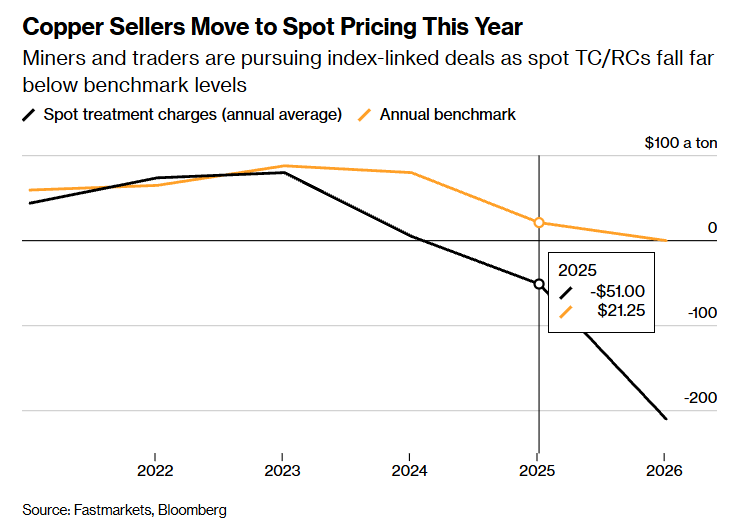
Many producers and traders have switched to floating TC/RC pricing this year — usually a back-up mechanism after long-term contract negotiations have broken down.
According to CRU data, the proportion linked to the benchmark price in China's copper concentrate trade this year is less than 30%; two years ago, this ratio was still above 50%. CRU is expected to shrink further in 2027: it is likely that only 14% of copper ore imported from China will follow the benchmark price.
This means index pricing will become the mainstream method for pricing copper ore in China. However, in the wider global market, the benchmark system may be more difficult for mining companies to shake — CRU expects that about 45% of global copper concentrate sales will still be linked to the benchmark price, including mine life span agreements that do not require regular renegotiation.
The rift spread beyond the Chinese market
Promises are also beginning to appear outside of the Chinese market. Japanese smelters have been particularly active, reaching their own fixed price agreements that do not follow Chinese standards — some Japanese factories hold large shares in copper mines and successfully argue that they need better terms to protect profit margins.
But this practice has also spawned a commercial dispute: Canadian mining company Teck Resources and Japan's Sumitomo Metal Mining are arbitrating whether the multi-year supply agreement should use China or Japan's benchmark price.
Doubts about production cuts: an opportunity for smelters to “fight back”?
Even for Chinese smelters, the economic accounts are becoming increasingly difficult to calculate — leading producers, including Tongling Nonferrous Group, are weighing drastic production cuts, as falling by-product prices may cause heavy losses.
However, many mining companies are skeptical about whether these production cuts can be implemented: the smelter set a profit record this year. However, those profits are based on the smooth flow of rising prices of by-products such as sulfur and gold, and this round of gains is being reversed; if the market further shifts to the spot index, commercial pressure on smelters may increase further next year.
Notably, spot TC/RC has stopped falling in recent weeks. The risk for mining companies is that if the smelter actually cuts production, the decline in demand for copper concentrate may — for the first time in many years — turn the market back to the side that favors the smelter.
“Broader discussions still revolve around the pattern of copper concentrate supply versus smelting capacity,” Wood Mackenzie's Xu said. “How the industry balances these two pressures will determine the final outcome of the negotiations.”