


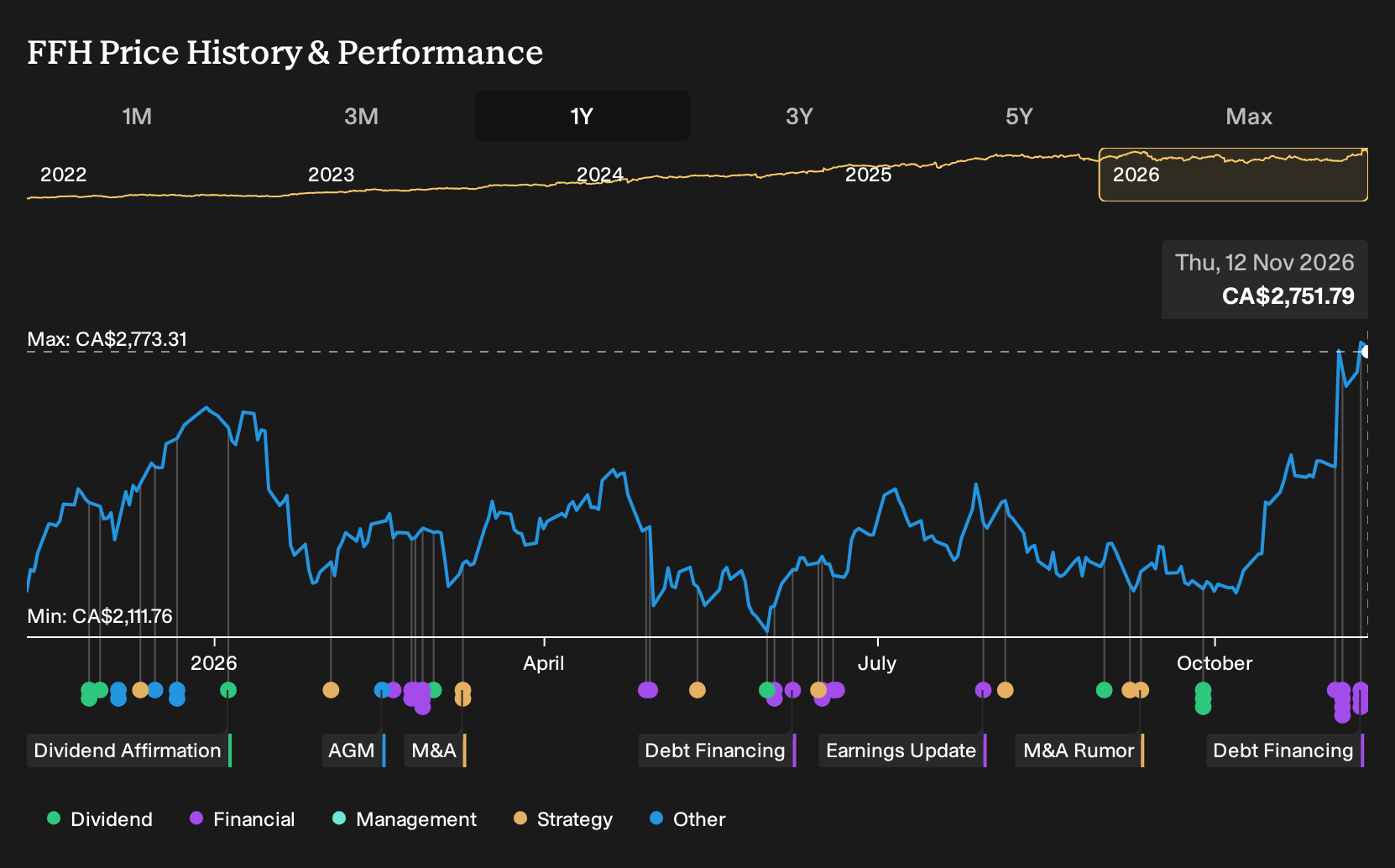
Fairfax Financial spent the year in headlines for big moves, from redeeming C$450 million of near‑term notes to backing the proposed US$8.9 billion Boots acquisition and securing approval to pursue a US$5.6 billion control stake in IDBI Bank. Holding Fairfax Financial over the past year would have returned 23.3%, including dividends. If you had been deciding on 12 November 2025, what would you have needed to believe about these capital bets to be comfortable buying in?
If the move has made Fairfax Financial harder to judge, start where the gap is still open and scan 6 high quality undervalued stocks.
The Argument You Would Have Been Weighing On Fairfax Financial
The shares cost CA$2,253 at the start of the period, so any case for Fairfax Financial began with whether that was below or above what you thought the business was really worth.
The bullish story saw a Fair Value of CA$2,634, a rough guide to the price implied if revenue grew 3.4% a year and profit margins settled near 6.9% on a future P/E of 16.5x.
The more cautious view pointed to a Fair Value of CA$1,535 and focused on rising climate risks and technology driven competitors steadily eroding underwriting profitability over time.
What The Fairfax Financial Evidence Actually Tested
The clearest test of the Fairfax Financial story came from its Q3 2026 report, where revenue moved from US$9,787.9m in Q3 2025 to US$9,978.7m. Over the same period, net income slipped from US$1,151.7m to US$929.6m and net margin declined from 11.8% to 9.3%. That pattern supported some points for both the optimistic and cautious arguments about future profitability.
The transferable lesson is simple. When a thesis leans on better margins, do not just watch the top line. Track net income and net margin together to see whether scale is turning into actual earning power.
What Fairfax Financial's Price Now Demands You Believe
Fairfax Financial trades at CA$2,752 today, up 23.3% over the past year. The bearish analyst Narrative on Simply Wall St sets its Fair Value below that level, arguing the market already credits the group with resilient underwriting and meaningful earnings from associates.
To pay today’s price, you would need confidence that Fairfax can keep generating steady operating income. This would need to occur while investment and associate volatility stays contained despite higher debt and softer property markets.
"The main thing that has to go right is that Fairfax Financial Holdings must keep converting disciplined global underwriting and a larger fixed income book into stable operating income while managing softer property markets, catastrophe losses and associate volatility."
Not everyone reads the same price the same way. → See the lower figure this Narrative lands on, and how it gets there
Looking One Step Beyond Fairfax
Fairfax gives you one version of global insurance, built around underwriting discipline and investment calls.
You could also look at insurers leaning harder into technology. Some are rebuilding their systems so AI threads through pricing, claims handling and customer contact.
That work is not just cosmetic. The ambition is to squeeze costs, sharpen risk selection and turn routine interactions into data that compounds.
One large group now ties that AI push to how it runs health cover and long term contracts. If that shift sticks, what might a tech heavy insurer look like a few years from now?
That argument has a Narrative and a number behind it. → See the company one Narrative values 42% above its price
Have feedback on this article? Concerned about the content? Get in touch with us directly. Alternatively, email editorial-team@simplywallst.com