


New trade agreements, fresh regulatory reforms and a policy push for market transparency are reshaping how globally exposed large caps are priced and perceived right now. This shift can reward investors who position early and help them avoid being anchored to old assumptions. The article breaks down three large, trade-linked stocks from our screener, explaining how this policy reset could matter for their future and where the risks might sit for each one.
The three stocks covered next are just a sample set. The full screen surfaced 20 more large, trade-exposed companies with equally compelling narratives that are not included in this article. To identify, compare and analyze those additional opportunities in one place, head straight to the Global Trade-Exposed Large-Cap Stocks screener.
Ciena (CIEN)
Overview: Ciena is a global network technology company that sells optical hardware, software, and services to telecom operators and cloud data center customers worldwide.
Operations: Ciena generates about US$4.8b from Networking Platforms, US$714 million from Global Services, US$379 million from Platform Software and Services, and US$101 million from Blue Planet Automation Software and Services.
Market Cap: US$41.8b
Ciena matters in this Global Trade-Exposed Large-Cap Stocks screener because its telecom and cloud customers span the Americas, EMEA and APAC, and the analyst consensus Narrative on Simply Wall St highlights how that international footprint ties directly to long term demand for high capacity networks.
"Ciena's optical platforms, including RLS, WaveLogic 6 Extreme, pluggables and related interconnect systems, are now tied to a record backlog that has more than doubled in each of the last two years to a projected US$10b exiting 2026, which supports the view that current orders have not yet fully flowed through to revenue and earnings."
What happens to Ciena's margin and cash generation will hinge on how one less visible cost pressure resolves over the next few years.
If that cost pressure is the real swing factor, read the full narrative for Ciena to see how Ciena's backlog, pricing power and capital needs could be decoupling.

Uber Technologies (UBER)
Overview: Uber Technologies runs a global app platform that connects riders, eaters and shippers with drivers, couriers and carriers across major regions.
Operations: Uber generates about US$29.9b from Mobility, US$20.7b from Delivery and US$5.9b from Freight across its worldwide footprint.
Market Cap: US$144.3b
Uber Technologies fits this Global Trade-Exposed Large-Cap Stocks theme because its mobility, delivery and freight networks directly track cross-border travel and commerce. According to Ivoed, an investor in the Simply Wall St Community, the real debate now is how its global cash generation holds up if the driver eventually disappears.
"Autonomous vehicles have become Uber’s most important valuation variable. Management intends to commit more than $10 billion over several years to autonomous-vehicle partners, fleet operations and vehicle commitments."
What ultimately happens to Uber’s profitability hinges on how that future traffic is shared, priced and funded if a single key assumption breaks.
If that assumption is wrong, read the full narrative for Uber Technologies to see how Uber Technologies’ autonomous push could accelerate upside or mask bigger long term risks.

Southwest Airlines (LUV)
Overview: Southwest Airlines runs a large Boeing 737 fleet that carries leisure and business passengers across the United States and select near-international destinations. This makes it a direct play on cross-border travel demand.
Operations: Southwest Airlines generates about US$31.5b in revenue from its core Transportation Airlines segment, reflecting its focus on passenger air services.
Market Cap: US$22.8b
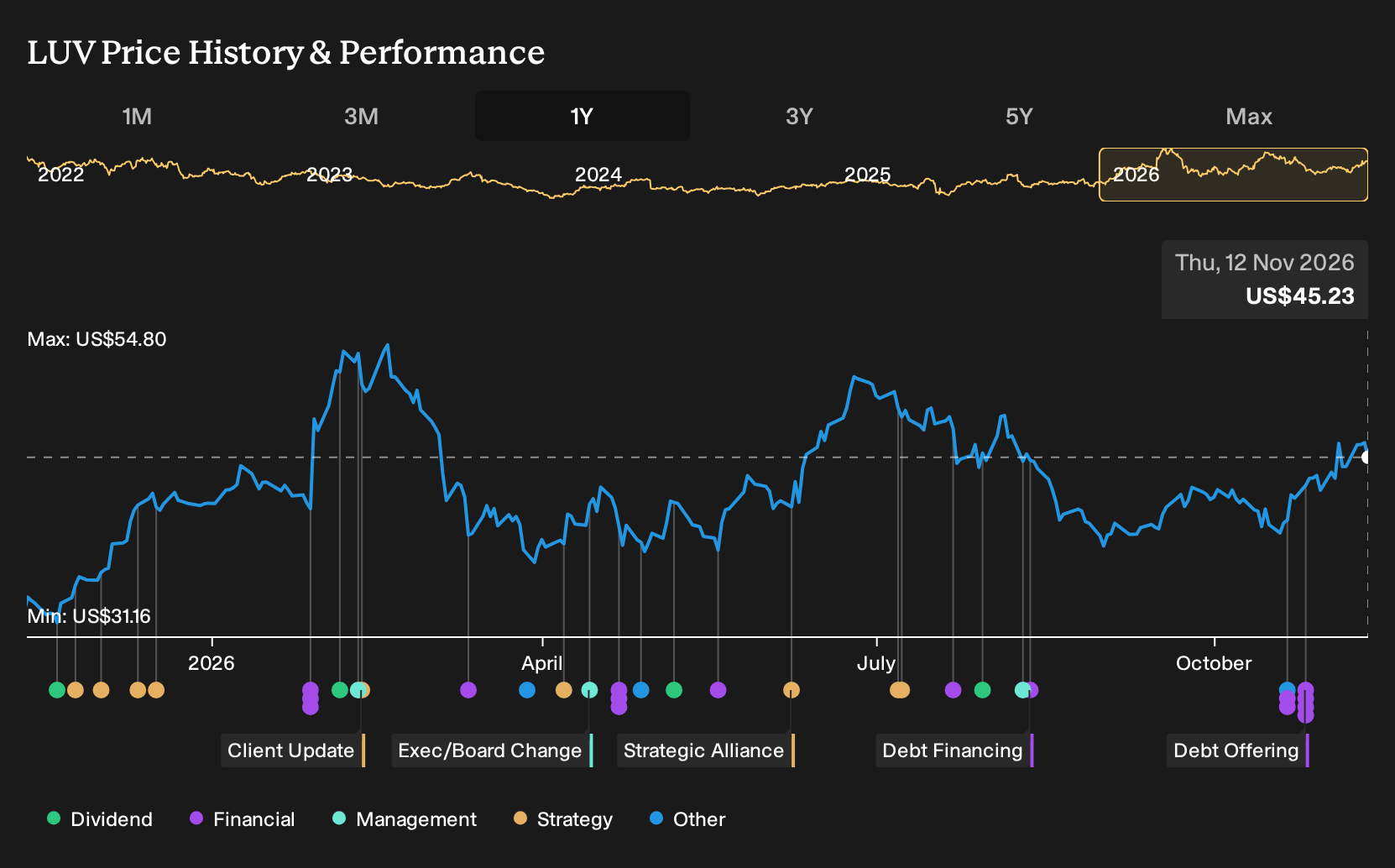
Southwest Airlines matters in this Global Trade Exposed Large Cap Stocks screener because its passenger networks and loyalty engine are tightly linked to international travel flows, and the analyst consensus Narrative on Simply Wall St argues that the commercial overhaul now underway could reshape how investors think about its earnings power.
"Planned introduction of premium and assigned seating, along with basic economy offerings, can enhance revenue yield through differentiated pricing strategies catering to varied consumer preferences, thereby potentially boosting net margins and overall earnings."
What happens to Southwest Airlines’ valuation and cash generation will depend on how one unresolved cost pressure interacts with that richer fare mix.
That trade off is the real pivot point, and the full narrative for Southwest Airlines unpacks how Southwest Airlines’ fare changes, costs and loyalty engine could be quietly accelerating upside potential.
Seeking Fresh Alternatives Before They Fly
Fresh opportunities do not stay quiet for long. Breakout stories gain momentum, laggards get caught dropping, and under-the-radar winners fade into the crowd. Act now and get in early.
- Target steady compounding potential by focusing on a curated 6 dividend fortresses that aim to keep income flowing while the market noise keeps changing.
- Hunt for mispriced quality using a refined 32 high quality undervalued stocks that screens for cash flow strength and balance-sheet resilience before the crowd catches on.
- Ride the infrastructure backbone of AI by scanning a filtered set of 53 AI infrastructure stocks powering data centers, connectivity and compute while the theme is still under the radar for now.
Have feedback on this article? Concerned about the content? Get in touch with us directly. Alternatively, email editorial-team@simplywallst.com