


Figma earnings event puts fresh focus on the stock
Figma (FIG) just released third quarter and nine month results to September 30, 2026, giving investors new numbers on sales momentum and the pace at which losses are narrowing.
The design software company reported third quarter revenue of US$391.42 million, compared with US$274.17 million a year earlier. Net loss was US$81.35 million, compared with US$1,097.02 million previously, and basic loss per share improved to US$0.15 from US$2.72.
Despite the stronger quarterly report, Figma’s recent share price return tells a different story. The stock is down 13.05% on a 30 day share price basis and 25.57% over 90 days, contributing to a 53.35% decline in 1 year total shareholder return from a latest share price of US$18.92. This indicates that momentum has been fading even as losses narrow.
Seize this earnings reset in Figma to review how other software players are priced by screening for 32 high quality undervalued stocks that combine solid cash generation with balance sheet strength.The share price has slipped significantly, while analyst targets and intrinsic estimates appear to be at very different levels. Where might fair value for Figma actually land within that range?
Most Popular Narrative: 15% Undervalued
On the latest figures, the narrative fair value of $22.36 for Figma sits above the last close at $18.92, which puts the spotlight on whether the product story can justify that gap. According to TickerTickle, an investor in the Simply Wall St Community who wrote the narrative, the real debate is less about growth and more about when the economics line up with the product.
The moat is not that Figma has every individual feature. It is that design, code, collaboration, company context and now agents can all live in the same environment.
Why the market still reacted badly
The initial 15% decline was mostly about the cost of delivering all this growth. Free cash flow margin was 14%, compared with 24% a year earlier, and Figma recorded a $117 million GAAP operating loss. Increased AI inference spending was the largest driver of the weaker cash-flow comparison. Many of the new products are also still in beta, meaning Figma is covering the AI costs without yet charging customers for their usage.
See why 65 investors see Figma as 15% undervalued.
Result: Fair Value of $22.36 (UNDERVALUED)
Still, the narrative around Figma could unravel quickly if AI spending keeps compressing free cash flow, or if large rivals narrow its product differentiation.
Find out about the key risks to this Figma narrative.
Another View On Figma’s Valuation
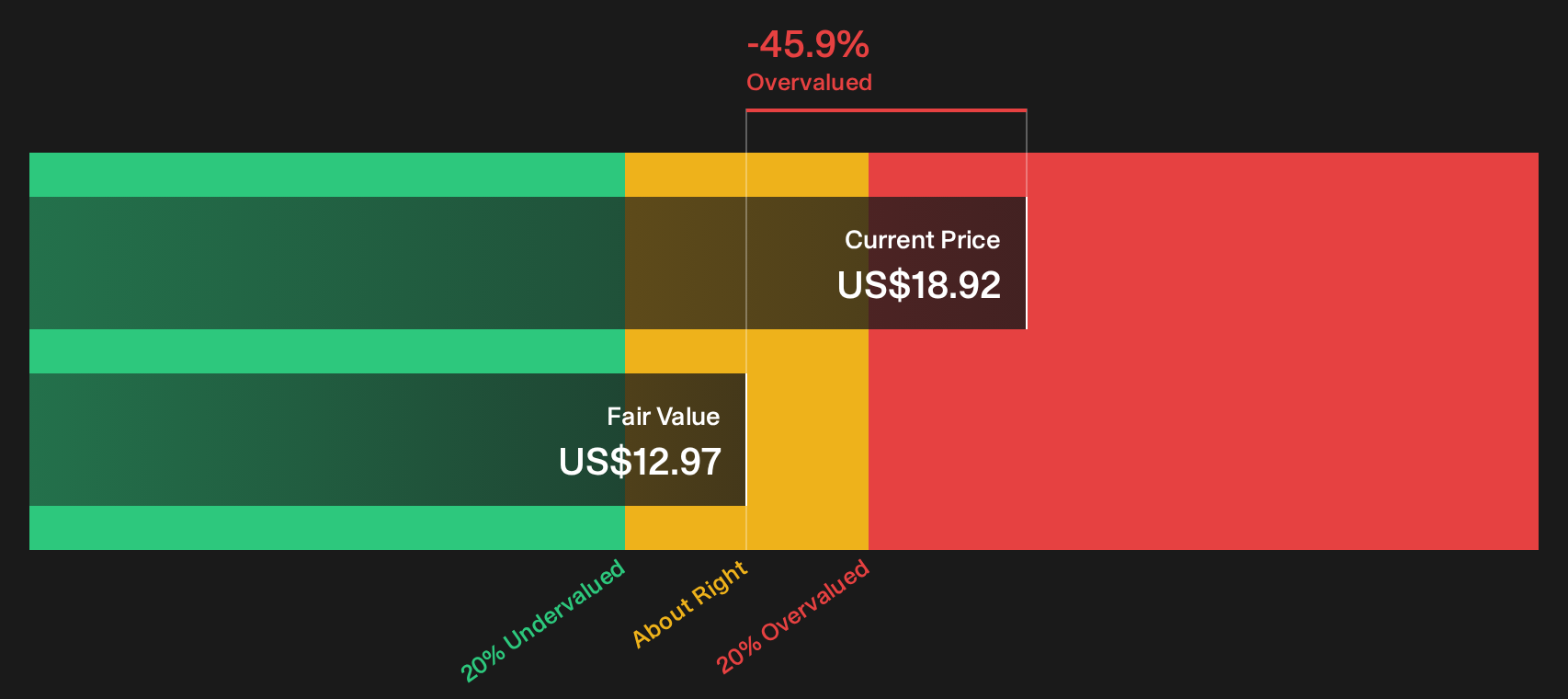
The first narrative pegs Figma at a fair value of $22.36, but the SWS DCF model points in the opposite direction. On those cash flow assumptions, fair value is $12.97, which would leave the current $18.92 level looking expensive rather than cheap. Which story do you think is closer to reality?
Look into how the SWS DCF model arrives at its fair value.
Next Steps
Mixed messages on Figma’s value and risk profile rarely stay unresolved for long. Move quickly, review the data yourself, and then compare your findings with the 2 key rewards and 1 important warning sign.
Looking for more investment ideas beyond Figma?
Use this earnings reset as a springboard. Freshen your watchlist with new contenders that match your risk, income, and quality preferences before the next wave of results hits.
- Target potential turnaround opportunities by scanning 11 elite penny stocks with strong financials that already show stronger financial underpinnings than typical speculative trades.
- Prioritize quality and price discipline by reviewing the 32 high quality undervalued stocks that pair healthier fundamentals with lower implied expectations.
- Reduce portfolio stress by focusing on the 29 resilient stocks with low risk scores that screen well on resilience and financial strength.
Have feedback on this article? Concerned about the content? Get in touch with us directly. Alternatively, email editorial-team@simplywallst.com