


- Marks and Spencer Group reported half year sales of £9,168.6m and net income of £265.8m, with basic EPS from continuing operations at £0.129.
- The food arm appears central to this shift, with over 850 new product launches and stronger appeal among younger shoppers supporting higher profitability and a doubled ordinary dividend to 8.4p.
- This article examines how Marks and Spencer Group's higher half year earnings may be reshaping the existing investment narrative around food-led growth.
Marks and Spencer Group Investment Narrative Recap
To own Marks and Spencer Group today, you need to believe the reshaped food business, broader store rotation and logistics upgrades can keep turning heavy capital spend into better profitability. The latest half year, with £9,168.6m in sales and £265.8m in net income, supports that narrative but does not resolve it. The clearest near term catalyst is operational delivery in Food and Clothing & Home during peak trading, while the biggest risk is execution slippage in supply chain and tech projects after the cyber incident.
There is also lingering pressure from weaker International performance and structurally lower online margins in Clothing & Home compared with stores. If online participation keeps rising without cleaner economics, group returns could feel the strain even as food led growth looks healthy. On balance, the recent figures are supportive but not transformative for the short term risk and reward trade off.
The analyst consensus Narrative on Simply Wall St focuses heavily on Marks and Spencer Group’s plan to extract structural cost savings and improve returns from store rotation and automation. In that context, the board’s decision to double the ordinary dividend to 8.4p is the announcement that ties most directly to the current earnings story. It signals confidence in cash generation capacity from the ongoing cost out programme and food performance.
For you as a shareholder or prospective investor, that higher payout keeps attention on two things. First, whether management can complete the targeted £600m structural cost savings while spending around £800m a year on capital projects without squeezing free cash flow. Second, whether Clothing & Home and International can improve margins enough to support both the dividend and the heavy logistics and digital investment that underpin the longer term catalysts set out in the analyst consensus Narrative on Simply Wall St.
What The Current Assumptions Ask You To Believe
Analysts covering Marks and Spencer Group are effectively asking you to back a story where a steadier, food led retailer grows into its existing footprint rather than trying to reinvent it. The core assumption is that revenue climbs by 5.0% a year for the next few years while profit margins shift from 2.8% today toward 3.7% as the store rotation, logistics investments and automation start to show through in cleaner economics.
On the earnings side, the consensus picture is specific. Analysts are modelling profit moving from £519.0m today to £785.7m by about 2029, with earnings per share at £0.34. That implies an earnings increase of around £267m from the current base, which is a meaningful uplift and not just cost tidy up. The spread between the most optimistic forecast at £901.9m and the most cautious at £703.5m shows how much uncertainty still sits around execution, especially on supply chain and digital delivery.
Marks and Spencer Group's narrative projects £21.4b revenue and £785.7m earnings by 2029. This rests on 5.0% yearly revenue growth and an earnings increase of about £267m from £519.0m today.
Those forecasts rely on more than sales growth alone. The margin bridge from 2.8% to 3.7% assumes the heavy capital spend on automation, new food halls and technology translates into a lower cost to serve, cleaner stock flow and tighter shrink control. If the food operation keeps benefiting from premium positioning and dense urban locations, that can help support the required uplift, but the numbers also depend on Clothing & Home and International not leaking profit as more trade moves online.
Valuation assumptions wrap all of this into a single snapshot. To line up with the analyst consensus, you would be working with 2029 revenue of £21.4b, earnings of £785.7m and a P/E of 16.2x on those projected profits, compared with 17.3x on current earnings and 17.8x for the wider GB Consumer Retailing industry. The implied discount rate of about 7.8% in the Simply Wall St work gives you a sense of the risk level analysts plug into their models, but your own hurdle rate may be higher or lower depending on how you weigh execution risk versus the perceived resilience of the food led plan at Marks and Spencer Group.
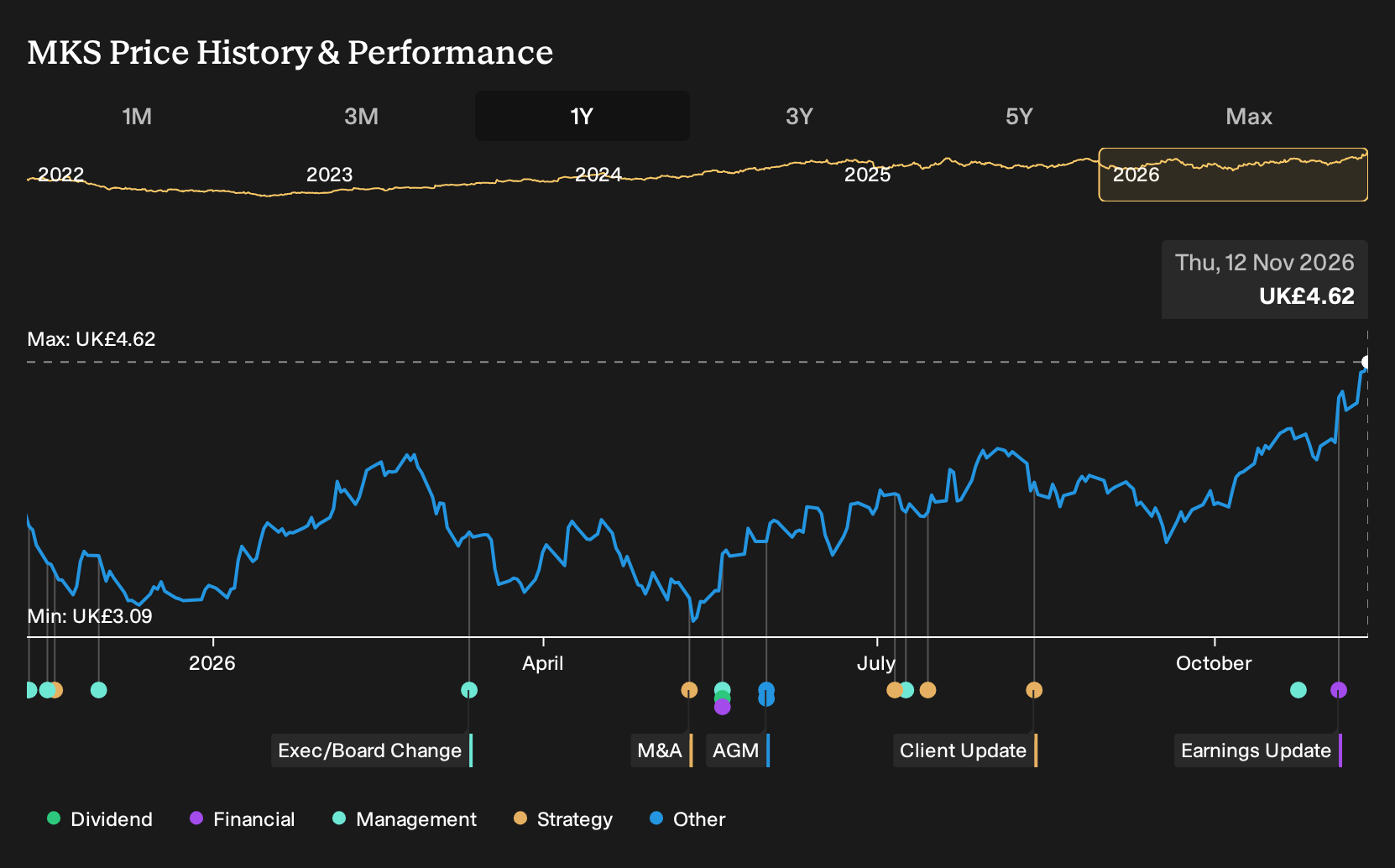
Uncover why Marks and Spencer Group's fair value indicates a 3% potential upside to its current price that could narrow quickly.
Exploring Other Perspectives
A more optimistic angle on Marks and Spencer Group puts food led store renewal at the centre. The most upbeat analysts were already pencilling in about £22.7b of revenue and £859.5m of earnings by 2029, well above consensus. This earnings release can be treated as a fresh test of those bolder assumptions, and you can explore how views may shift.
Explore 2 other Marks and Spencer Group fair value estimates, including one that suggests as much as 95% upside from the current price.
Reach Your Own Conclusion
Disagree with existing narratives? Extraordinary investment returns rarely come from following the herd, so go with your instincts.
- A great starting point for your Marks and Spencer Group research is our analysis highlighting 3 key rewards and 1 important warning sign that could impact your investment decision.
- See our latest analysis for Marks and Spencer Group. The report includes a comprehensive fundamental analysis summarized in a single visual, the Snowflake, making it easy to evaluate Marks and Spencer Group's overall financial health at a glance.
Looking For More Investment Ideas Beyond Marks and Spencer Group?
If the Marks and Spencer Group story has sharpened your thinking about food led resilience and execution risk, it can be useful to compare it with other businesses that share similar strengths or offer a different balance of quality, income and defensiveness. The Simply Wall St Screener can help you quickly filter for listed companies that match the traits you care about most, then stack those candidates against Marks and Spencer Group on fundamentals, earnings power and balance sheet strength.
- If you want income to do more of the heavy lifting in your returns, start with companies that offer stronger yields and have the balance sheet to support them over time by scanning 5 dividend fortresses.
- If capital preservation and steadier fundamentals matter most to you, focus on businesses with cleaner finances and less fragile leverage profiles by reviewing a list of solid balance sheet and fundamentals (9 results).
- If you are hunting for opportunities that the broader market might be overlooking, concentrate on underfollowed companies with strong fundamentals that still trade at conservative valuations using a curated list of 6 high quality undiscovered gems.
Have feedback on this article? Concerned about the content? Get in touch with us directly. Alternatively, email editorial-team@simplywallst.com