


The Zhitong Finance App learned that Lisa Shalett (Lisa Shalett), chief investment officer of Morgan Stanley Wealth Management, said that NVDA.US (NVDA.US) management turmoil and the Democratic Party's victory in the mid-term elections further heightened market concerns about the artificial intelligence (AI) market, but these factors will not shake the capital expenditure of AI infrastructure, which is the core driving force of this bull market.
She believes that the election results should not be viewed as a denial of AI investment or data center construction. The core of voters' demands is to strengthen AI security supervision and make the distribution of costs and benefits of data center construction more fair. In an interview, Shalit mentioned that investors focused too much on political trends and technology stock fluctuations, and instead ignored the long-term main logic of the market.
“Long-term investors need to firmly grasp the general direction: the underlying logic of a bull market driven by AI capital expenditure and AI industry transformation remains firmly rooted. In my opinion, the larger narrative is extremely bullish,” she said.
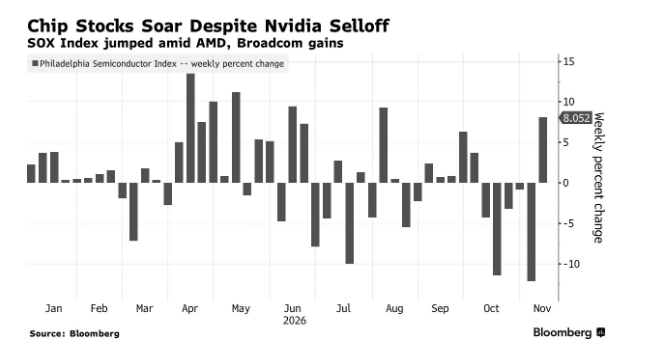
AI concept stocks have been driving the market upward for most of this year, but recent trends have fluctuated sharply. The Philadelphia Semiconductor Index closed down 3.4% on Friday. However, against the backdrop of Nvidia-related negative impacts, the index continued to rise 8.1% throughout the week. Nvidia's stock price plummeted 13% this week because CEO Wong In-hoon was mired in a scandal and announced his resignation.
Shalit pointed out that suppliers providing equipment and supporting infrastructure to expand AI production have a large backlog of orders, and the order cycle has already been scheduled to 2027, and some even continue until the first half of 2028. Even if subsequent policies are introduced to significantly delay the implementation of the project, it is likely that the real impact will not be apparent until 2028 or 2029.
She further suggested that even if regulatory pressure slows down the expansion of the industry and reduces long-term profit margins, it may reduce the risk of the industry's ups and downs and the bursting of the bubble. Investments in AI at a slower pace can help ease inflationary pressure, reduce the burden on the credit market, and reduce the scale of additional equity financing that the market needs to undertake. Shalit said that not only will such changes not destroy the bull market, but they may prolong the bull market cycle.
Within the technology sector, Shalit maintains a merit-based layout and favors hyperscale cloud service providers and some software companies. In addition to this, she is also optimistic about opportunities in grid infrastructure, the industrial sector, financial services, and healthcare.
Regarding overseas stocks (including emerging markets), Shalit also has a positive attitude. She sees it as a combined decentralized allocation tool rather than an alternative target for US stocks.