


Vertex (VERX) is back in focus after a busy early November, with raised full year revenue guidance, fresh fourth quarter targets, third quarter results, and a new payroll tax partnership with Asure Software.
Vertex’s recent guidance hike and the Asure Software payroll tax deal have arrived alongside a sharp shift in momentum, with a 30 day share price return of 41.05% and a 90 day gain of 41.27%. This is occurring even though the year to date share price return and the 1 year total shareholder return remain negative, and longer term total shareholder returns over three and five years are still weak.
Scan beyond Vertex and see how it stacks up against a hand picked 32 high quality undervalued stocks with stronger fundamentals and more appealing pricing setups.
The share price has sprinted ahead while Vertex remains at a double digit discount to analyst targets and an even steeper gap relative to some fair value models. Does the recent surge close that gap or barely touch it?
Most Popular Narrative: 1% Undervalued
Vertex’s analyst consensus Narrative on Simply Wall St points to a fair value of $18.23, which sits slightly above the latest close at $17.97. That small gap reflects a view that updated growth and margin assumptions roughly line up with where the stock trades today.
The numbers imply a share price that reflects moderated revenue growth expectations and improved EBITDA margins rather than fully pricing in this narrative’s view that Vertex is undervalued and that its cash flow plan and AI-driven efficiencies could support a higher valuation.
See why 13 investors see Vertex as 1% undervalued.
Result: Fair Value of $18.23 (UNDERVALUED)
Still, the narrative around Vertex can fray if large enterprises keep delaying cloud and e-invoicing projects, or if expansion within existing customers stays underwhelming.
Find out about the key risks to this Vertex narrative.
Another View: Vertex Through A Cash Flow Lens
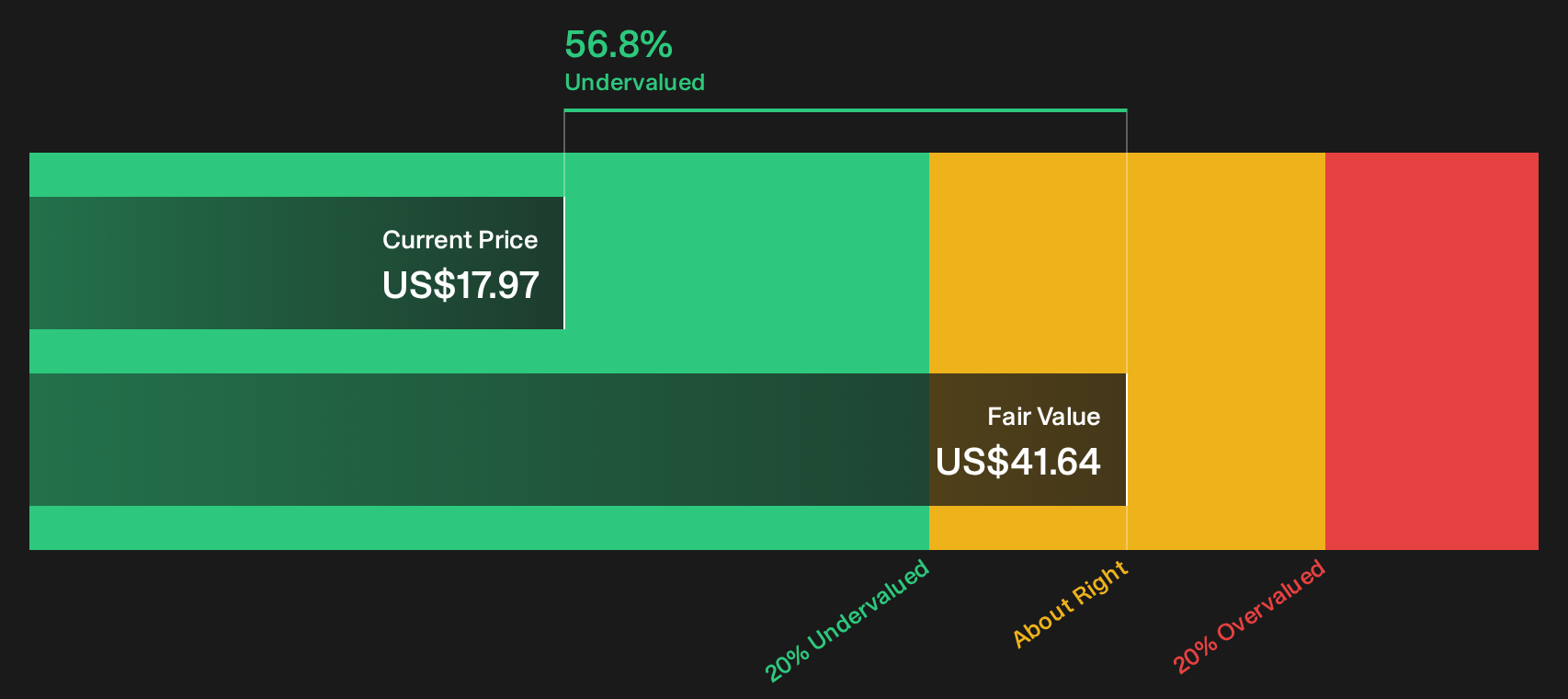
The earlier discussion leaned on analyst targets, which put Vertex close to fair value at around $18 per share. A different tool, the SWS DCF model, points to a future cash flow value of $41.64 instead. That almost 57% gap raises a blunt question: Is the market overly cautious about Vertex, or are the cash flow assumptions too generous?
Look into how the SWS DCF model arrives at its fair value.
Next Steps
If this combination of caution and optimism around Vertex leaves you unsure, act quickly and review the underlying numbers yourself, including Vertex's 2 key rewards.
Looking for more investment ideas beyond Vertex?
Do not stop with Vertex. Keep widening your watchlist and give yourself better odds of spotting opportunities before they feel obvious to everyone else.
- Chase potential mispricings by scanning a curated 32 high quality undervalued stocks that combine stronger fundamentals with pricing that still looks out of sync with business quality.
- Secure your income stream by reviewing a focused 6 dividend fortresses that aim to pair higher yields with balance sheets built to handle stress.
- Protect your downside first by filtering for a 31 resilient stocks with low risk scores where financial strength and lower risk scores do more of the heavy lifting for you.
Have feedback on this article? Concerned about the content? Get in touch with us directly. Alternatively, email editorial-team@simplywallst.com