


The Zhitong Finance App learned that the China Index Research Institute published an article stating that on November 16, the National Bureau of Statistics released the “Basic Situation of the National Real Estate Market from January to October 2026". According to the data, the sales area and sales of newly built commercial housing across the country decreased by 13.7% and 14.3%, respectively, from January to October. Real estate development investment and new housing construction area declined by 21.6% and 24.4%, respectively, and the new housing market continued to adjust. At the end of October, the area of commercial housing for sale declined year-on-year for 8 consecutive months, and inventory for sale continued to decline. Meanwhile, according to data from the Ministry of Housing, Urban-Rural Development, from January to October, the national second-hand housing transaction area was 680 million square meters, an increase of 11.4% over the previous year, and the increase continued to expand.
Looking ahead to the end of the year, on the demand side, the central level has clearly implemented the incremental policies already in place, such as lowering interest rates on supplementary mortgages, increasing reloan amounts, and interest rate discounts on residential home purchase loans, which will help reduce residents' housing purchase costs. Combining the promotion of housing enterprises at the end of the year and the entry of high-quality projects in core cities is expected to provide some support for new housing transactions, but the overall trend is still bottoming out. Second-hand housing transactions are expected to remain active, but due to weak market expectations, prices are expected to remain volatile.
On the supply side, with August 28 as an important point, many cities such as Wuhan, Tianjin, Hangzhou, Shenzhen, and Chengdu have successively issued implementation opinions on commercial housing sales system reform. It generally requires that newly announced plots be prioritized for existing housing sales. Pre-sale projects need to complete the main structure cap, set a transition period for the classification of projects in transit, and optimize land concession price payment arrangements and support phased development and acceptance. The lengthening of the capital return cycle and increased capital occupation of housing enterprises under the New Deal will limit their ability to acquire land and their willingness to invest to a certain extent. It is expected that the land market will gradually reflect the impact of the policy at the end of the year and 2027; however, the transition period arrangement for ongoing projects will help cushion short-term new housing supply pressure, and the substantial impact of the policy on the supply of new housing is expected to gradually become apparent in subsequent new project development.
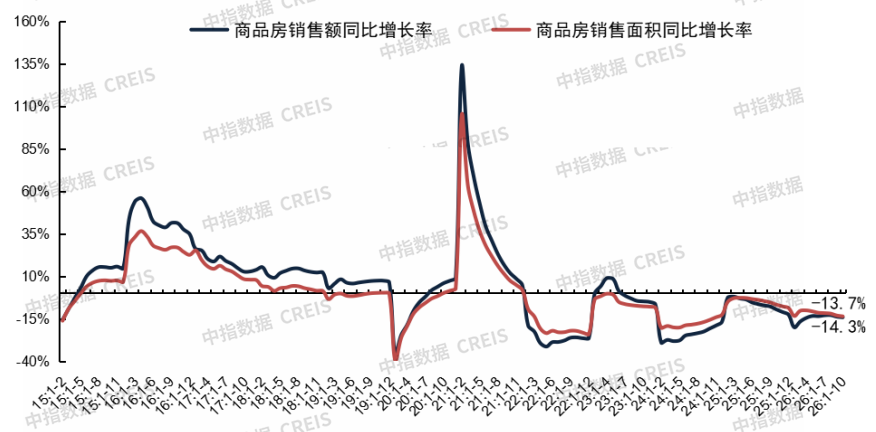
Demand: From January to October, the sales area of newly built commercial housing across the country decreased by 13.7% year-on-year, and sales decreased by 14.3%
Sales area of new homes: According to data from the National Bureau of Statistics, from January to October 2026, the sales area of newly built commercial housing nationwide was 614 million square meters, down 13.7% year on year, up 0.5 percentage points from January to September; residential sales area was 512 million square meters, down 14.2% year on year, up 0.4 percentage points from January to September.
New home sales: From January to October 2026, the national sales volume of newly built commercial housing was 5.86 trillion yuan, down 14.3% year on year, up 0.4 percentage points from January to September; of these, residential sales were 5.17 trillion yuan, down 14.1% year on year, up 0.4 percentage points from January to September.
Figure: The cumulative sales area of newly built commercial housing across the country and the year-on-year growth rate of sales
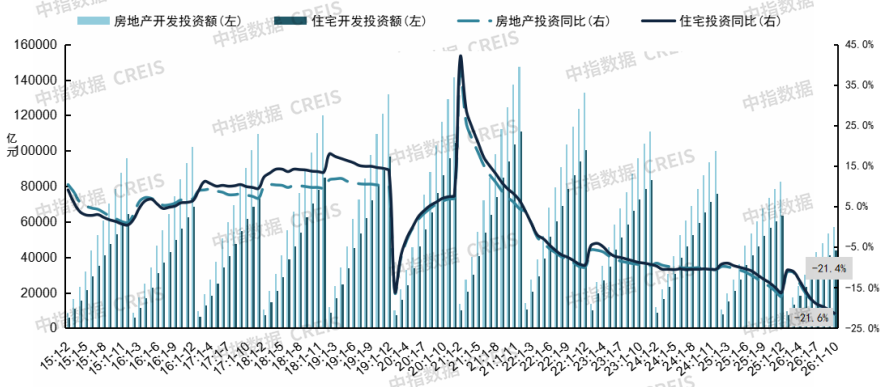
Supply: Real estate development investment fell 21.6% year-on-year in January-October
Real estate development investment: From January to October, the country's real estate development investment amount was 5.72 trillion yuan, down 21.6% year on year, and the decline was 1.0 percentage point higher than in January-September; of these, investment in residential development was 4.41 trillion yuan, down 21.4% year on year.
Figure: The country's cumulative real estate and housing development investment and its year-on-year growth rate
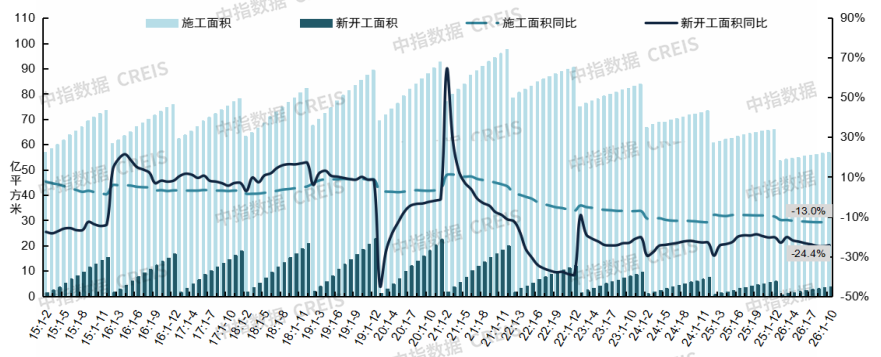
Housing construction area: From January to October, the country's housing construction area was 5.682 billion square meters, down 13.0% year on year, and the decline was 0.2 percentage points higher than in January-September; of these, the residential construction area was 3,946 billion square meters, down 13.3% year on year.
New housing construction area: In January-October, the country's new housing construction area was 370 million square meters, a year-on-year decrease of 24.4%, and the decline was 0.5 percentage points narrower than in January-September; of these, 270 million square meters of new residential construction area, a year-on-year decrease of 24.9%.
Housing completed area: In January-October, the country's completed housing area was 255 million square meters, down 26.6% year on year, and the decline was 1.5 percentage points higher than in January-September; of these, the completed residential area was 179 million square meters, down 27.9% year on year.
Figure: The country's cumulative new housing construction and construction area and its year-on-year growth rate
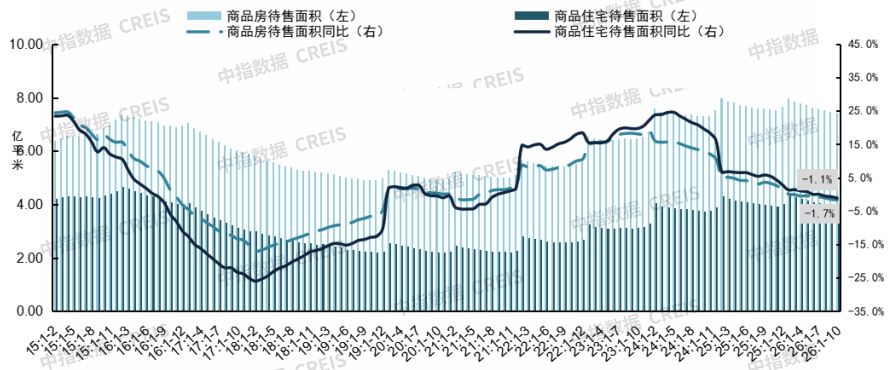
Inventory: The area of commercial housing for sale fell 1.7% year-on-year in October
Area of new homes for sale: At the end of October 2026, the area of commercial housing for sale was 744 million square meters, down 1.7% year on year, up 0.2 percentage points from the previous month, and has been declining for 8 consecutive months. Of these, 537 million square meters have been sold for less than 3 years, a year-on-year decrease of 5.3%. The commercial residential area for sale was 393 million square meters, a year-on-year decrease of 1.1%.
Figure: Nationwide commercial housing and residential sales area and cumulative year-on-year growth rate
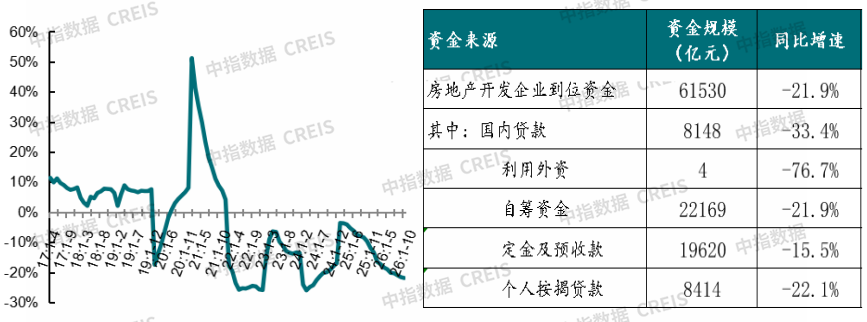
Funding source: From January to October, housing enterprises received 6.15 trillion yuan in capital, a year-on-year decrease of 21.9%
Capital available for real estate development companies: From January to October, the amount of capital available to real estate development companies was 6.15 trillion yuan, a year-on-year decrease of 21.9%.
Domestic loans: From January to October, domestic loans were 814.8 billion yuan, a year-on-year decrease of 33.4%, accounting for 13.2%.
Self-financing: In January-October, self-financing was 2.22 trillion yuan, a year-on-year decrease of 21.9%, accounting for 36.0%.
Deposit and advance payments: From January to October, deposits and advance payments were 1.96 trillion yuan, a year-on-year decrease of 15.5%, accounting for 31.9%.
Personal mortgage loans: From January to October, personal mortgage loans were $841.4 billion, down 22.1% year on year, accounting for 13.7%.
Figure: Comparison of the year-on-year growth rate of capital available to housing enterprises and the year-on-year growth rate of various funding sources
October Real Estate Policy Updates
In terms of policy, on October 20, the National Development and Reform Commission's press conference proposed “promptly introducing pragmatic and effective incremental policies. Take good care of the implementation of incremental policies that have been introduced recently, such as lowering interest rates on supplementary mortgage loans, increasing reloan amounts, interest rates on residential home purchase loans, and financial support for the development of the service industry, and push them to be implemented and effective as soon as possible. At the same time, do a good job of economic monitoring and early warning, and promptly introduce new incremental policies as needed to ensure that the economy remains within a reasonable range.”
At the local level, the reform of the commercial housing sales system has entered a period of intensive implementation of rules, and cities such as Wuhan, Tianjin, Hangzhou, Shenzhen, Ningbo, Shiyan, Wenzhou, Suzhou, Hefei, Chengdu, Changsha, Xi'an, Nanjing, and Shenyang have successively issued implementation opinions. With August 28 as an important point, all regions generally require that newly announced land plots be selected first for sale, and that the main structure of pre-sales should be capped; a transition period is also set for various types of projects in transit, which can be executed according to the original pre-sale conditions and strengthen the supervision of pre-sale funds; at the same time, all regions optimize land concession price payment arrangements, stipulate that the down payment within 30 days is not less than 50%, and no interest is accrued within a maximum of two years. Wuhan, Changsha, Xi'an, etc. require payment ratios of not less than 50% within half a year; many cities clearly support installment development, installment processing of construction permits and construction permits Term acceptance, etc.; mortgage loans On the other hand, all regions require projects to obtain pre-sale permits starting August 28, and personal housing mortgage loans can only be issued after completion and filing. In terms of the Provident Fund policy, Shenzhen, Tianjin, Hangzhou, Dongguan and other places have added decoration and property fee withdrawals. Hangzhou raised the increase ratio of loan amounts for multi-child families from 50% to 60%, and raised the maximum loan amount to 3.24 million yuan. In terms of urban renewal, Shanghai issued the “Three-Year Action Plan for Urban Renewal (2026-2028)”, which clarifies the complete renovation of 700,000 square meters of old housing units and the renovation of about 24 million square meters of old neighborhoods. In addition, in October, Anhui, Hubei and other provinces and cities issued about 23 billion yuan of special bonds to collect and buy unused land stocks.