


Key Points
AMD has multiple positive factors affecting its stock.
AMD's stock is still quite pricey for its business.
Advanced Micro Devices (NASDAQ:AMD) investors have been on quite the roller-coaster ride since it reported Q3 earnings on Nov. 3. While the initial reaction to its earnings was fairly muted, the stock sold off along with the market shortly after its results came out and was down over 15% at one point.
Then AMD got a second catalyst for change: On Nov. 9, the stock surged 13.3% on news that Google Cloud selected its fifth-generation EPYC processors for the TPU 8tx platform. As a result, Oppenheimer upgraded AMD’s rating to Outperform.
Missed Nvidia in 2009? This Rare Signal Is Flashing Again. In 2009, a "Double Down" signal flashed for a little-known chipmaker called Nvidia. For the first time in years, that same "Total Conviction" signal is flashing for a company 1/100th the size of Nvidia. Continue »
That was followed later in the week by a third catalyst: Big trouble at its primary competitor, Nvidia (NASDAQ:NVDA).

Image source: Getty Images.
Last week, Nvidia's CEO, Jensen Huang, resigned amid misconduct allegations, and with its primary competitor now without its visionary leader, AMD's stock rose. While the rise peaked at about 20%, up from the level it entered earnings at, it's now about equal its pre-earnings price on recent general market turmoil.
The question is, is AMD still a buy at these levels, or have these catalysts drastically affected the AMD investment thesis? Let's take a look, as investors need to consider multiple factors before investing in AMD.
AMD's gains may not be immediate
Let's take a look at AMD's Q3 results, since that occurred first in the timeline. During Q3, AMD's overall revenue rose 45% year over year to $13.4 billion. Its data center business rose 97% year over year to $8.5 billion, showcasing strong demand in the most important computing sector. While it also has other business units, what investors really care about is the data center division, as it's the biggest growth area right now.
Nvidia has a huge market-share lead in this sector, and it will be difficult for AMD to catch up. But with a new leader coming in at Nvidia, will this potentially allow it to close the gap? I don't think so.
The reality is that Nvidia's products and ecosystem are better than AMD's right now. Furthermore, switching from one computing unit provider to another isn't easy. Additionally, while Jensen Huang was leading the company, he couldn't do everything. He had a talented team working for him, and those people are largely still in place.
The next few years of development are still in place; the question is what comes after that. That will determine how AMD fares against Nvidia in the three-to-five-year time frame, and depending on who is selected to replace Huang, it could inform whether AMD looks like a better long-term investment option.
We may not know who will lead Nvidia in the near future, but there is one undeniable fact about AMD's stock.
AMD is one of the more expensive stocks in AI
AMD has had a great year and has risen significantly. While the recent deal with Google might say otherwise, not all of the stock’s gains came straight from business growth. Instead, the market is willing to pay a far higher premium for its stock than it used to. Furthermore, it's valued at a much higher premium than Nvidia right now.
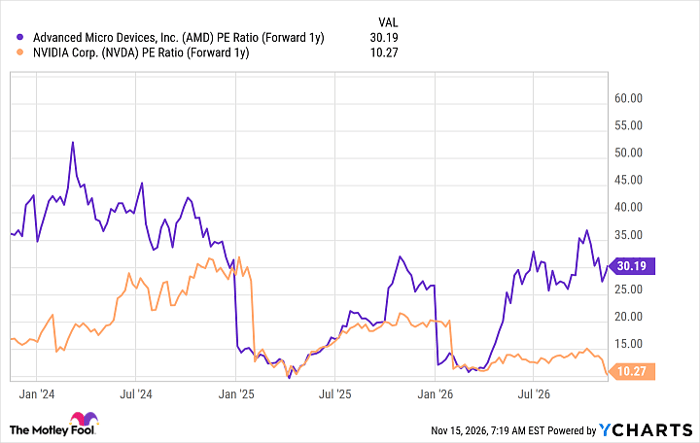
AMD PE Ratio (Forward 1y) data by YCharts
At 30 times next year's earnings versus Nvidia's 10 times, it's triple the price tag. That's an absurd premium, but because of the turmoil in the CEO role, it may not be the best comparison.
Instead, I think Broadcom (NASDAQ:AVGO) makes for a better comparison. Broadcom makes custom artificial intelligence chips that compete directly against Nvidia and AMD's GPUs for data center market share. It's rapidly growing and could have a great few years ahead as AI hyperscalers start deploying custom AI chips.
Broadcom's fiscal year 2027 has already begun, and it trades about 18 times fiscal 2027's earnings. That's a far more reasonable price tag for AMD, and I think it shows that AMD is overpriced at these levels.
AMD's situation has improved in recent weeks, but I don't think it's a buy. There is significant growth already priced into its stock, and there are far better AI investment options out there.
Keithen Drury has positions in Alphabet, Broadcom, and Nvidia. The Motley Fool has positions in and recommends Advanced Micro Devices, Alphabet, Broadcom, and Nvidia. The Motley Fool has a disclosure policy.