


The Zhitong Finance App learned that after the US midterm election results caused artificial intelligence (AI) transactions to be sold off and the personal scandal of former CEO (CEO) Huang Renxun dragged Nvidia (NVDA.US) stock prices down sharply, bears lost tens of billions of dollars in book revenue as a result. According to S3 Partners, since hitting a record high on October 6, Nvidia's stock price has fallen by a cumulative total of 35%, which has enabled traders who bet on the falling stock price of this AI chip giant to earn about 24 billion US dollars in book revenue as a result.
As the corporate governance crisis continues to unfold, Nvidia's stock price recorded the biggest weekly decline since US President Trump announced tariff measures in April 2025. Nvidia shares fell another 4.1% on Monday. Earlier, it was reported that Hwang In-hoon is considering returning to Nvidia as CEO, and his Silicon Valley allies are pressuring Nvidia's board of directors to reinstate his position. However, the media later quoted people familiar with the matter as reporting that Nvidia's board of directors is currently not considering reinstating Hwang In-hoon as CEO and is focusing on investigating whether his personal actions involved Nvidia trade secrets, and the two sides have yet to discuss his reinstatement.
Joe Gilbert, portfolio manager at Integrity Asset Management, said, “Nvidia's stock price is still likely to fall further as previously confident shareholders try to protect existing earnings. After Hwang In-hoon leaves, the company will face a lack of vision.”
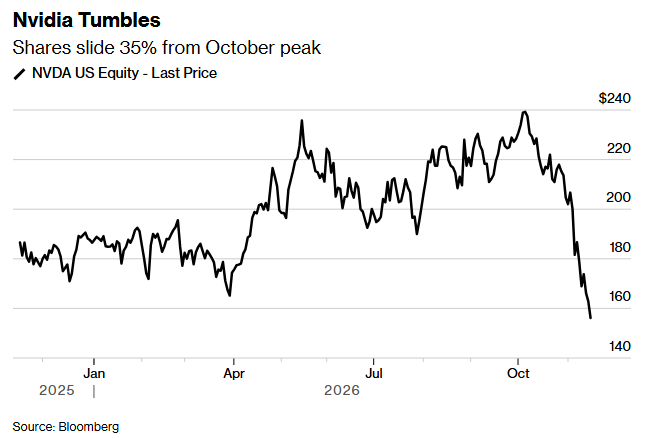
Nvidia's stock price fell 35% from October high
In the weeks before Hwang In-hoon left Nvidia due to a personal scandal, the US stock technology sector had been in turmoil. The market is concerned about the sustainability of capital-intensive AI infrastructure construction. At the same time, the results of the US midterm elections have also heightened investors' concerns that increased regulation will slow down AI infrastructure construction.
Data from S3 Partners shows that as Nvidia's stock price began to be pressured at the beginning of November, traders adopting a reverse investment strategy also increased their short bets on the stock. As an indicator of market bearishness, Nvidia's current short selling ratio accounts for about 1.22% of its tradable shares, with a nominal value of about $46 billion.
However, at a time when Nvidia's stock price has plummeted, some investors have already begun to buy on dips. According to data from market data and research firm Vanda, retail investors bought a record $2 billion of Nvidia shares during the sell-off in Nvidia stock last week.
Dave Mazza, CEO of Roundhill Financial, said, “Nvidia has gone from being a market darling to a market abandonment, and this reset in valuation and market sentiment is the reason the stock is currently receiving renewed attention. There are many bearish voices, but retail investors are entering the market to buy, and the stock's current valuation multiples are quite attractive no matter what scenario you measure, except for the worst-case scenario. This is an opportunity to 'buy out of fear', not an opportunity to 'sell after the benefits have been cashed'.”
Nvidia's earnings report is about to be announced
Nvidia's next potential catalyst is the company's results for the third quarter of fiscal year 2027, which will be announced after the US stock market on November 17 (Tuesday). What is special about this report card is not the numbers, but the person who delivered it: it is the first financial report since the resignation of Hwang In-hoon and Chief Financial Officer (CFO) Colette Kress as interim CEO. The real question is whether the temporary management team can provide an AI growth curve that will convince the market.
Nvidia's previous Q3 revenue guidance was US$108 billion, fluctuating 2% (approximately US$105.8 billion to US$110.2 billion), up about 12% month-on-month from US$96.2 billion in the second quarter. The Wall Street consensus forecast is around $109 billion. Compared with revenue of $57.01 billion in the same period last year, the growth rate is about 91%.
It should be noted that the historical pattern of “exceeding expectations” in this financial report is strained by the actual signals of the current season: Nvidia's profits for the past four quarters all exceeded market expectations, with an average surprise margin of 5.82%, but the Zacks model showed a difference of -0.55% in profit forecasts for this quarter, which means that analysts have filled their expectations, but there is limited room for surprise. As XTB Research Director Kathleen Brooks said, the market “still anticipates another strong performance from Nvidia,” but for stock prices, the future outlook is more important than ever.
The market is concerned about three things: how to choose a successor, whether the established computing power expansion strategy can continue, and whether the company can stabilize internally after the founder leaves the market. According to information, Kress plans to hold an all-staff meeting at 12:00 p.m. EST on November 18. The employees' demands for Hwang In-hoon's return and management handover arrangements may all be the focus. Musk and some important shareholders have publicly expressed their support for Hwang In-hoon. Furthermore, the “Stand with Jensen” petition to reinstate Hwang In-hoon has been signed by more than 120,000 people. During the earnings call, Kress paid no less attention to how to explain the succession selection process and strategic continuity.
In terms of specific numbers, the digital center business received the most attention. The business's revenue for the previous quarter was US$89 billion, up 117% year over year, accounting for more than 90% of total revenue. It is still the only window for determining AI infrastructure needs. In addition to Blackwell's shipping pace, the market will focus on verifying the volume of the next-generation Vera Rubin platform — management previously anticipated in a conference call that Rubin will contribute about 20% of data center revenue this season. If delivery progress and customer deployment fall short of this caliber, it will be viewed as a sign of demand or execution problems.
The second is gross margin and supply. Nvidia's Q2 gross margin was 75%, the Q3 guideline was 74%, fluctuating 0.5 percentage points up and down, and management had previously warned that gross margin for the fourth quarter could be further pressured—against the backdrop of an overall rise in the prices of components such as memory chips (financial reports from companies such as Qualcomm and Kioxia all confirm “storage contraction”), whether the cost curve can be hedged by the product structure directly determines the profit quality narrative. Supply capacity is also critical: AI data center construction is still in progress, but any aspect of the chip, storage, and machine process may affect the point at which revenue is recognized.
This season's guidance clearly excludes data center computing revenue in the Chinese market, meaning any updates in China — whether recovery or further tightening — are variables outside the guidelines. Investopedia also suggested that investors will pay special attention to the interim management's statement on the Chinese business.
Brian Colello, stock strategist at Morningstar Investment Services, said, “We expect the company to hand over a financial report that exceeds expectations and raises performance guidelines, as in many previous quarters. I mean, all of this happened even after the third-quarter accounts had been settled.”
He added: “But if Nvidia does have problems, or if the problems already existed in the third quarter and the company disclosed these situations in the earnings report, then this would be a huge blow to the stock price.”
Notably, this financial report also hit a more noisy macro background: the sustainability of huge AI spending is being re-examined by the market, the Democratic Party's full administration in the midterm elections raised concerns about tightening data center regulations, and the Anthropic IPO pricing for the same week was also seen as a real-time barometer of the AI market. In other words, Nvidia gave not only a copy of its own report card, but a pricing benchmark for the entire AI transaction — and the one reading out the results for it this time is a new face on Wall Street who will have had time to fully understand.
Watch out for sound waves to block Nvidia
“Big Short” and well-known investor Michael Burry continued to hold put options until Nvidia released its earnings report on Tuesday EST. Despite his admission, retail buying still had a chance to push up the stock price of this stock.
“I still hold Nvidia put options due in February 2027,” Bury told users in a chat on the subscription community Cassandra Unchained. When asked if retail investors are likely to continue to push Nvidia's stock price higher in the short term, he responded: “It's very likely.”
This batch of put options gave him months to wait for the share price to fall back. Whether to continue to increase positions depends on the cost of the option. Some readers asked if he would add positions. Barry said, “It depends on whether the price is cheap enough. I think there will be a better time to buy put options in the future than now.”
Burry anticipated Nvidia's earnings report this week to be strong last week. The reason is that any impact related to the Hwang In-hoon crisis will take time to be reflected in the financial report. At the time, he said, “The quarterly earnings report to be released in less than a week is ready, and it will be excellent. Everything is in place, all terms and structures have been settled. And unraveling this intricate web will take time.”
But at the same time, Burry believes that this financial report provides another good opportunity for the bulls to sell off. He warned that the crisis surrounding Wong In-hoon may threaten financing arrangements and customer transactions that support Nvidia's growth, while leadership uncertainty, increased customer bargaining power, and regulatory risks may slow the company's growth and put pressure on profit margins.
Musk wrote on the X platform that some of Nvidia's most important supply chain contracts rely on the finalization of Hwang In-hoon's personal credit. “Without Hwang In-hoon, at least some of the core agreements would be lost.”
Patrick Moorhead, chief analyst at Moor Insights & Strategy, said that CEOs of several major Nvidia customers told him that Wong In-hoon could finalize multi-billion dollar supply promises on the spot, and the supplier also acknowledged his ability to clap. But he and Musk disagree — the biggest contract risks have been exaggerated, and these deals have all been put on paper.
Moorhead said that Nvidia's supply chain and product plans for at least the next 18 months have basically been finalized, and Kress has also taken the initiative to connect with suppliers to reassure all parties. His concerns focus on the next round of negotiations: if Nvidia's decision-making pace slows down and it is unable to lock in production capacity on the spot, competitors will be the first to win the share of production capacity that may have been decided by Wong In-hoon. “As long as Nvidia doesn't win, competitors will compete.”