


The Zhitong Finance App learned that the US dollar has recovered all of its decline since President Trump announced the so-called “Liberation Day” tariffs. A resilient economy, rising interest rates, and a boom in artificial intelligence have all boosted the dollar's appeal.
The US dollar index, which tracks the exchange rate of the US dollar against the six major currencies, including the euro and yen, once rose 0.2% to approach 103.60 on Monday, and is expected to close at its highest level since April 2, 2025 — on that day, Trump's comprehensive tariffs on US trading partners shocked the global market. The broader Bloomberg Dollar Spot Index, which covers emerging market currencies such as the Mexican peso, rose to its highest level since May 2025.
“Liberation Day has proven to be a critical but brief point in the 'sell America' debate,” Bank of America strategist Kamal Sharma and others wrote in the report. “As AI monopolizes all the attention, de-dollarization has almost faded out of the background.”
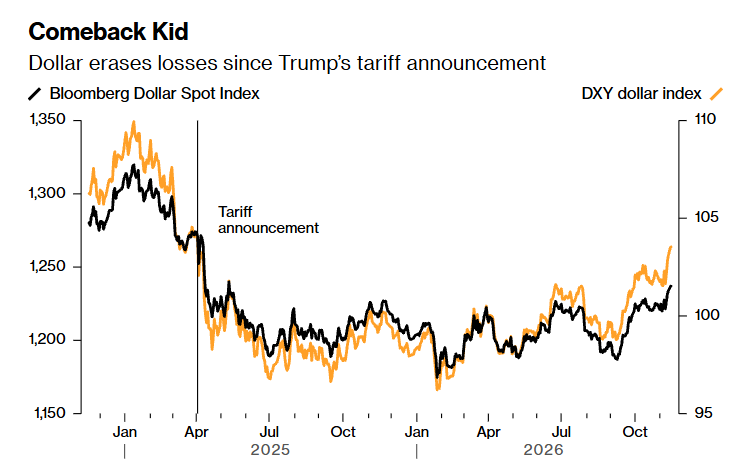
From the “three kill” scare to full recovery
The US dollar, US debt, and US stocks fell simultaneously within a few weeks after the impact of tariffs, which at one point raised concerns that foreign investors would sell off US assets in a big way. All of this weighed down on the dollar — the dollar index plummeted by more than 9% last year, the worst performance since 2017.
Looking at it now, investors' fears of either selling the dollar directly or hedging their exposure have hardly come true. On the contrary, the US economy outperformed its peers, and the boom in AI investment offset the drag on tariffs. Meanwhile, the Federal Reserve made a U-turn: after two years of loose monetary policy, the central bank began to raise interest rates to curb inflation and expand the dollar's yield advantage.
“Higher yields combined with the AI boom have allowed foreign investors to increase their dollar holdings rather than decrease them,” said Win Thin, chief economist at Bank of Nassau 1982.
The strength is comprehensive, and the position of sensitivity to intervention has been broken
The strength of the US dollar is all-round: it has risen against all G10 currencies over the past six months. Against the yen, the US dollar is currently trading around 160 — a level that previously triggered intervention by the Japanese authorities; the dollar broke through this key level last week for the first time since September last year.
Gold, which is one of the “bearish dollar” trading agent indicators, has plummeted nearly 30% since its peak in January.
However, Bank of America and ING remain cautious. Bank of America strategists said they are still structurally bearish on the US dollar because central banks around the world will continue to diversify their dollar holdings. Citing IMF data for the second quarter, they pointed out that there was the first “meaningful” shift in the allocation of the US dollar by global reserve managers — to other currencies such as the euro and Australian dollar.
ING, on the other hand, believes that the market has overestimated the extent of the Federal Reserve's austerity and how long high interest rates can be maintained.
But right now, traders are betting that the rally has only begun last week, and leveraged funds are raising their bullish bets on the dollar against the euro to near the highest level since 2020.
“The 'dollar depreciation' theory, rest in peace (RIP 'dollar debasement'),” said Ed Al-Hussainy, fund manager at Columbia Threadneedle Investments. He added that the forces that weakened the dollar last year — cyclical factors such as the weakening labor market and the Federal Reserve's interest rate cuts — have now all been reversed.