The Zhitong Finance App learned that after re-establishing short positions on US debt, bond traders are facing a potential risk of emptying: concerns surrounding artificial intelligence (AI) are heating up again, compounded by repeated technical system failures, and safe-haven funds are rushing back into US debt. As a result, crowded short positions are exposed to the risk of a rapid reversal.
Over the past week, the Fed's policy outlook turned hawkish, once suppressing safe-haven purchases that have just begun — at the beginning of this month, 10-year US Treasury yields fell to a low level of 4.81% due to safe-haven demand, but this shift left long-standing US bond short positions largely intact. Bank of America (BAC.US) strategists warned that this pattern is rapidly evolving into a “pain trade” (pain trade) for the market.
Bank of America strategists wrote in a report released on Monday: “After last week's sell-off, bears were given a resurgence as market momentum turned back in favor of bears.” The report also pointed out that some accounts that rely on kinetic energy trading have recently re-entered short positions, but the scale is “relatively small.”
Strategists said that short positions are easy to reverse quickly when risk aversion is high. “If interest rates rise, short positions are still the most concentrated position and probably the most painful transaction, but given recent price trends, the trigger threshold has been raised.” they said.
These risks became apparent on Tuesday. On the same day, the US retail sales data for October was better than expected, which should have suppressed the trend of US debt; however, later there were reports that a highly confidential network used by the US National Security Agency for internal communications went down, and US debt quickly recovered its lost ground. This is the latest in a series of failures affecting Microsoft (MSFT.US) and several banking systems since last week. As a result, market concerns about widespread system failure have heated up. The cash market rose in response. Yields for various periods hit intraday lows one after another, while futures trading volume soared to the highest level of the day.
Prior to these fluctuations, market demand for hedging had clearly heated up. The previously released US inflation data for October was higher than expected. Coupled with Federal Reserve Governor Christopher Waller's remarks that brought into view the possibility of a sharp interest rate hike, traders have stepped up their hedging risk of raising interest rates by 50 basis points during the December 9 interest rate meeting.
Traders are using options to trade, betting on the trend of the Guaranteed Overnight Financing Rate (SOFR) after the announcement of the Federal Reserve's interest rate decision next month. The December SOFR option has become a popular hedging tool, and its expiration date is exactly two days after the end of the Federal Reserve's last meeting of the year.
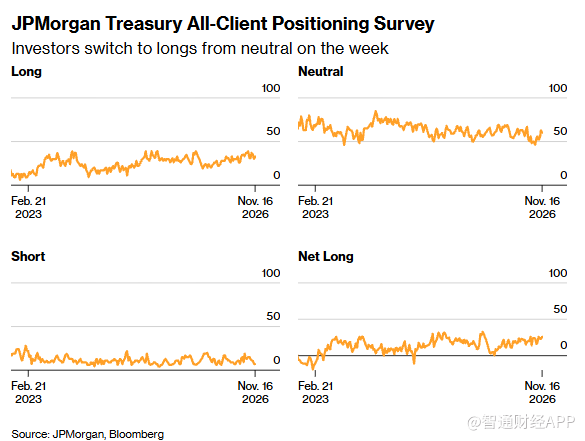
On the spot market side, there are signs that crowded short positions may have begun to loosen up. For the week ending November 16, J.P. Morgan's US debt customer survey showed that net short positions remained at their lowest level in about three months. At the same time, investors switched from neutral positions to long positions, and net long positions increased.
Here are the changes in other interest rate market position indicators over the past week:
SOFR options positions
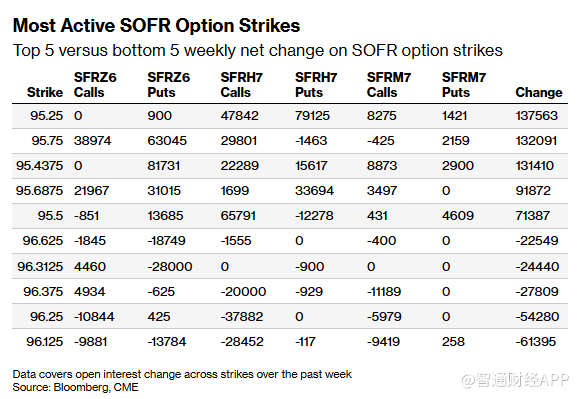
Among SOFR's options expiring on December 26, March 27, and June 27, the risk of call options due to the large number of new positions in the SFRH7 95.25/95.50/96.00 call option spread combination over the past week, the risk of call options due on March 27 has increased significantly. These call option spread combinations were bought through the SFRH7 96.00/96.25 call option spread combination. The SFRH7 95.50/95.75/96.00 call option spread combination of the same period has also been very popular recently. In addition, SOFR's 95.75 put option, which expires on December 26, has also recently seen direct purchases, increasing the number of open positions at this exercise price. Last week, a put option at the strike price was traded at 7.25, and on Monday, buyers continued to buy a put option at the right price at 6.75.
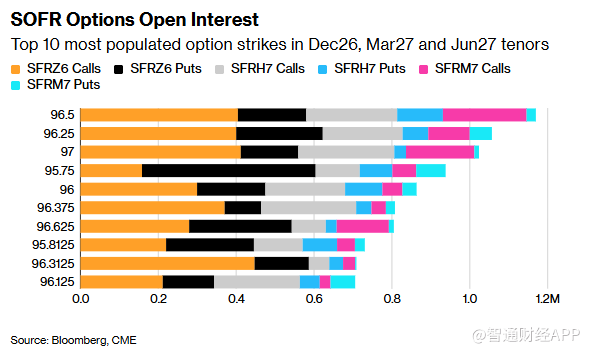
Of the SOFR options that expire on December 26, March 27, and June 27, positions at 96.50 are still the most crowded. Recent transactions surrounding this exercise price include buying the 96.50/97.25 2x3 bullish spread of SFRM7 and selling the 96.25/97.00 2x3 bullish spread combination of March 2027; in addition, recent transactions surrounding this stock price mainly focused on the 96.50/97.00/97.50/98.00 bullish option portfolio due on June 27.
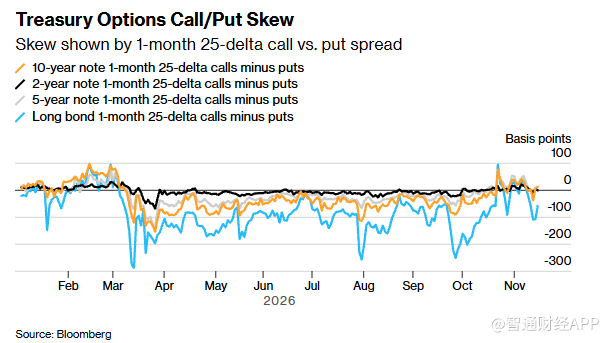
US bond options bias
Although the premium for hedging US bond options has become neutral in recent trading days, long-term put option premiums for futures contracts are still too high. As the 10-year US Treasury yield returns to 5%, there are mixed trends surrounding US bond options trading with a maturity of 12 months. Notable transactions include the 1x2 put option spread combination for December 105.00/105.50 and the call option spread combination for December 106.00/107.00, all aimed at hedging US bond yields.
J.P. Morgan US Treasury Client Survey
For the week ending November 16, investors switched from neutral positions to long positions, and short positions remained unchanged. The share of net longings increased by 3 percentage points, and neutral positions declined by the same margin. The survey continues to show that net short positions are at their lowest level since August 17.