


The Zhitong Finance App learned that on November 18, the Passenger Link Branch released a weekly car market scan. From November 1 to 15, the national passenger car market retailed 611,000 vehicles, down 25% from the same period in November last year, down 6% from the same period last month. Since November 1, 15.589 million units have been sold, down 22% year on year; from November 1 to 15, passenger car manufacturers sold 722,000 vehicles, down 23% from the same period last month, up 11% from the same period last month, and a total of 23.092 million vehicles this year, down 7% year on year.
New energy: From November 1 to 15, the national passenger car market retailed 447,000 new energy vehicles, down 13% from the same period in November last year, up 7% from the same period last month. The cumulative retail sales volume since this year was 9.316 million units, down 13% year on year; from November 1 to 15, passenger car manufacturers sold 592,000 new energy vehicles, up 3% from November last year, up 18% from the same period last month. Since this year, 13.815 million vehicles have been sold, up 9% year on year.
Penetration rate: On November 1-15, the penetration rate of NEV retail sales in the national passenger car market was 73.2%; on November 1-15, the NEV wholesale penetration rate of cheekbone passenger car manufacturers was 82%.
1. Retail sales trend in the national passenger car market in November 2026
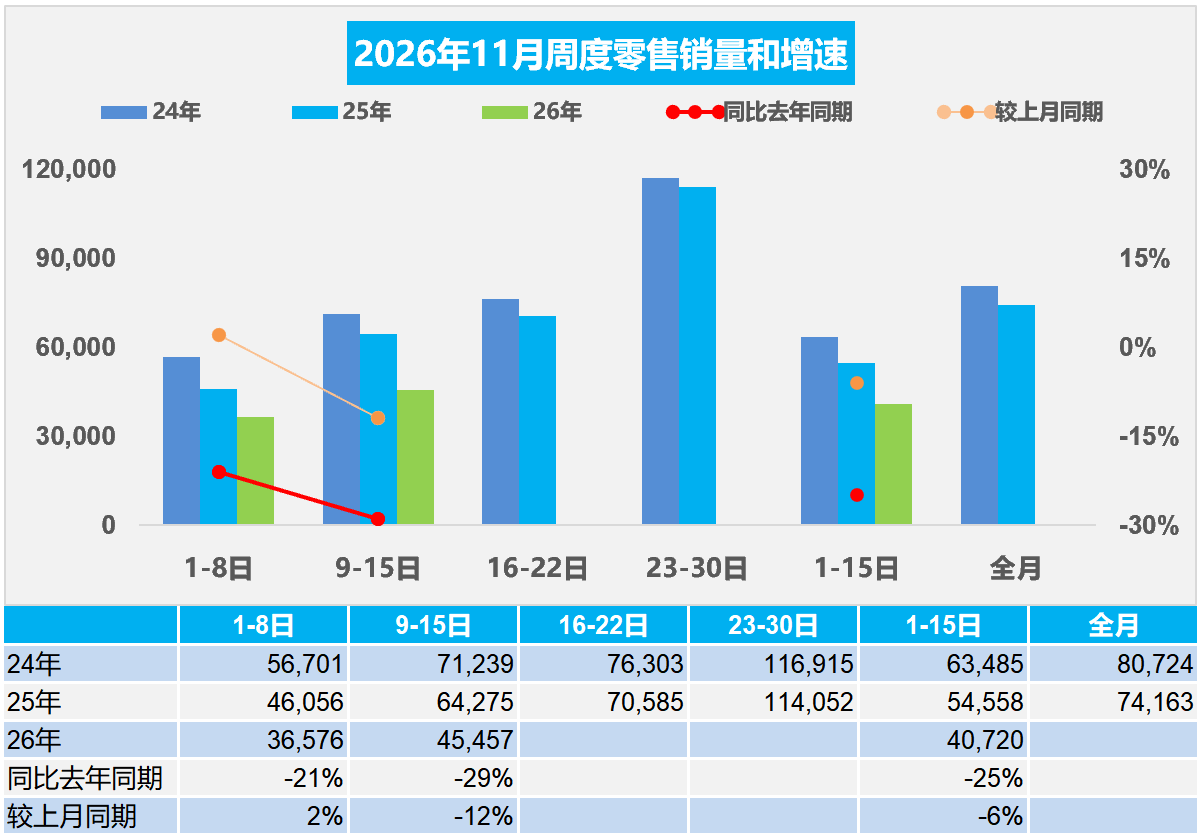
In the first week of November, the national passenger car market sold an average of 37,000 vehicles per day, down 21% from the same period in November last year, and up 2% from the same period last month.
In the second week of November, the national passenger car market sold an average of 45,000 vehicles per day, down 29% from the same period last November and 12% from the same period last month.
From November 1 to 15, the national passenger car market retailed 611,000 vehicles, down 25% from the same period in November last year, down 6% from the same period last month; since this year, 15.589 million units have been sold, down 22% year on year.
In November, domestic retail showed the characteristics of “policy support, weak repair, and extreme structural differentiation”. Retail sales continued to grow significantly negatively year over year in November. The incremental support in November was mainly due to the centralized release of “Double 11" finance and replacement equity, but retail performance was weak in the first two weeks. Next, let's take a look at the effects of new product launches at the Guangzhou Auto Show to attract customers, and the immediate demand for “last train” replacements brought about by the trade-in subsidy policy ending within the year. The restrictions on volume reduction are obvious. Weak consumer income expectations have led to strong consumer wait-and-see sentiment and lengthening the replacement cycle; although oil prices have been lowered in the short term, the central position is still high, suppressing fuel vehicle consumption, and the share of fuel vehicles has shrunk further.
Structure and competitive characteristics: The penetration rate of new energy sources continues to reach new highs, becoming the only definitive increase. The marginal utility of the price war bottomed out. Competition moved from “global price reduction” to hierarchical hand-to-hand combat — high-end competition for smart driving and experience, mid-range competition for comprehensive replacement solutions, and accelerated clearance of tail fuel and weak brands. Overall, the November car market relied on a policy window and a “structural underpinning” maintained at the end of the year. There was no reversal in the market. Only models with strong products such as pure electric and hybrid can win customers, and the industry has completely entered the knockout stage.
2. Wholesale sales trend of passenger car manufacturers across the country in November 2026
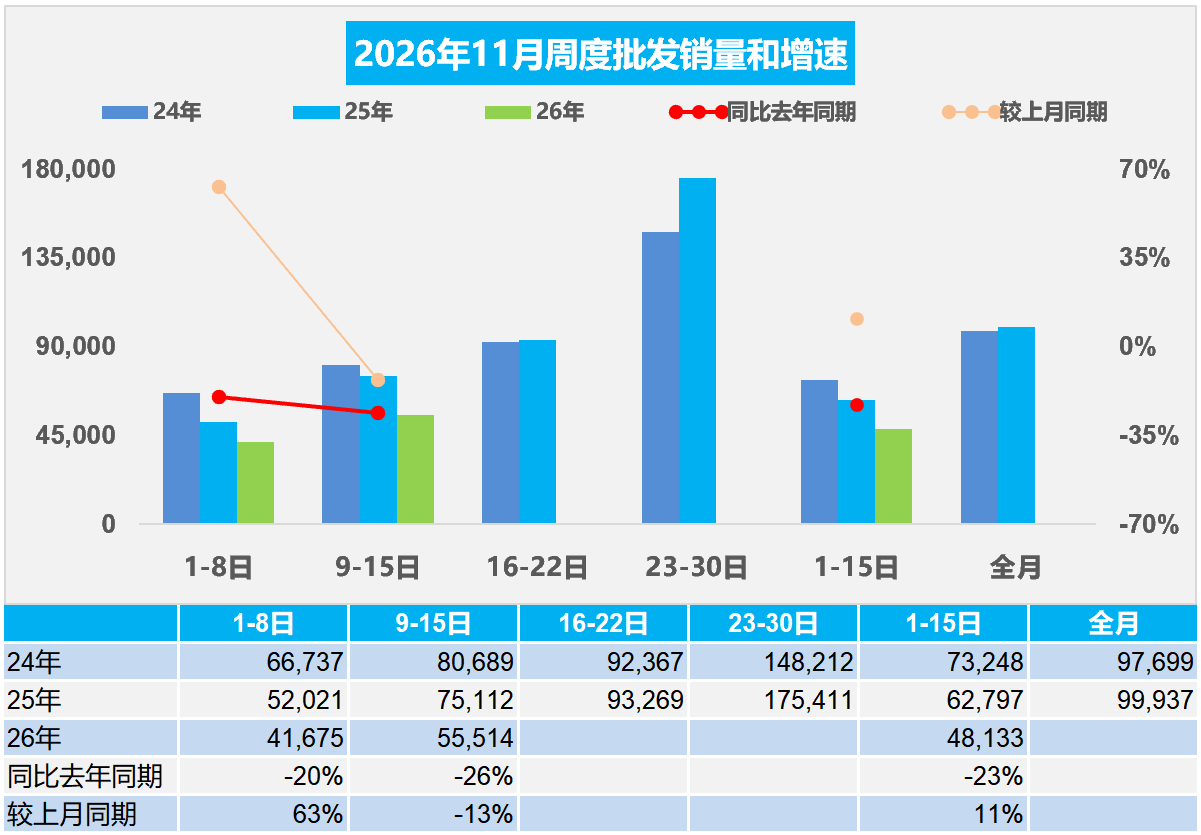
In the first week of November, passenger car manufacturers across the country sold 42,000 vehicles per day, down 20% from the same period in November last year, and up 63% from the same period last month.
In the second week of November, passenger car manufacturers across the country sold 56,000 vehicles per day, down 26% from the same period in November last year and 13% from the same period last month.
From November 1 to 15, passenger car manufacturers across the country sold 722,000 vehicles, down 23% from the same period last year, and up 11% from the same period last month; a total of 23.092 million units have been sold since this year, down 7% from the previous year.
In November, wholesale manufacturers showed weak repair characteristics of “a weak start and pressure on the back.” November was mainly pressured by an increase in working days, the warm-up of new cars at the Guangzhou Auto Show, and sales targets at the end of the year. High-demand models on the supply side have entered a phase of increasing production capacity, and manufacturers are speeding up the pace of new car launches to support wholesale data. However, this is essentially a “push” act by the manufacturer to transfer inventory to the channel.
Currently, dealers generally face tight capital chains and high inventory pressure, compounded by early policy overdrafts, sluggish fuel vehicle production and sales, and declining willingness to pick up vehicles at terminals. Although the share of new energy wholesalers continues to rise, the “wholesale gap” is large, indicating that the increase in wholesale sales is not a reflection of actual terminal digestion. It is difficult for dealers to survive, channel reservoirs have peaked, and the subsequent wholesale growth rate will be constrained by weak retail sales.
3. The value added of the automobile industry increased by 0.9% in October 2026
From January to October of this year, the country's production and supply grew steadily, the scale of market sales expanded, foreign trade grew rapidly, employment prices were generally stable, new quality productivity grew vigorously, and the overall operation of the national economy continued to be stable, showing a new and positive development trend. However, under the impact of high international oil prices, the pressure on traditional automobile consumption is high.
From January to October 2026, automobile production was 26.41 million units, down 4% year on year; new energy vehicle production was 14.48 million units, up 13% year on year, with a penetration rate of 55%; fuel vehicle production was 11.93 million units, down 19% year on year. In October 2026, automobile production was 3.05 million units, down 8% year on year; new energy vehicle production was 2.03 million units, up 17% year on year, penetration rate 67%; fuel vehicle production was 1.02 million units, down 35% year on year. The value added of the automobile industry increased by 0.9% in October, and the value added of the automobile industry increased by 6.5% from January to October, showing strong performance.
The automobile industry has a strong ability to eliminate production. From January to October 2026, fixed asset investment in the automobile industry fell 7.9% year on year. It is still higher than the average of all industries of -8.1%, but higher than the decline in investment of -2.4% in the manufacturing industry.
In October 2026, total retail sales of consumer goods amounted to 4,466.3 billion yuan, an increase of 0.4% over the previous year. Among them, automobile consumption was 330.1 billion yuan, a year-on-year decrease of 21%; retail sales of consumer goods other than automobiles were 4316.2 billion yuan, an increase of 2.5%. From January to October, total retail sales of consumer goods amounted to 41,646.4 billion yuan, an increase of 1.0% over the previous year. Among them, automobile consumption was 3,265.3 billion yuan, a year-on-year decrease of 16%; retail sales of consumer goods other than automobiles amounted to 38,381.1 billion yuan, an increase of 2.8%.
Automobile consumption in 2026 presents a complex situation of “policy continuation, market fragmentation, and pressure on demand”. The trade-in policy continues to gain strength, but the total retail volume is still declining due to factors such as the accelerated contraction of fuel vehicles, high prices suppressing consumer confidence, and a slump in the low-end market. The steady increase in consumption of petroleum products reflects the fact that residents' demand for travel is still rigid, and weak automobile consumption is more indicative of a marginal weakening of the will to spend on durable goods and disposable income.
Since the 2026 trade-in passenger car subsidies were far less strong than commercial vehicles, commercial vehicle subsidies contributed particularly well to the growth of NEV retail sales, and NEV passenger vehicles plummeted. Currently, there is a lot of pressure on entry-level passenger car consumption, and the high-end consumption of Chinese cars is too strong, and the level of popularity is too low. It is expected that there will be long-term strong policies, such as reducing personal taxes for car buyers, promoting new energy vehicles to the countryside, setting standards for economical electric vehicles, optimizing C7 economy electric vehicle driver license applications, giving more preferential purchase taxes to compliant pure electric vehicles with a battery life of less than 200 kilometers, and encouraging marriage and childbearing car purchases to promote economic growth.
4. The average length of domestic retail passenger cars in China is 4.72 meters
China's passenger car market is experiencing a “morphological revolution” driven by new energy technology and consumption upgrades. In ten years, the average length of new cars increased to 4.72 meters, and the market pattern was completely disrupted: SUVs reigned strongly with a 56% share; MPVs bid farewell to the low-end and move towards extreme luxury of 5.2 meters or more; traditional sedans withdrew, and hatchback crossovers bucked the trend. In terms of overall structure, the traditional “gold size” of 4.5-4.8 meters was severely squeezed, and the market showed a “dumbbell type” characteristic of polarizing large cars above 4.8 meters and pure electric scooters below 4.5 meters. The essence of size expansion is a joint result of the release of space on pure electric platforms and the attack on car companies' “advanced internal volume” downsizing. It marks that the Chinese car market has left the old era of classification of levels according to wheelbase and has fully entered a new era of scene competition where large space is deeply integrated with intelligence.
The average length of a passenger car broke through the “4.7 meter” mark. Climbing all the way from 4.61 meters in 2022 to 4.72 meters in 2026, the average length of the car increased by 11 cm in five years. In the context of limited physical space for car building, this is an extremely exaggerated leap forward, marking the official entry of the Chinese car market into the “big car era.”
The explosion of models over 5.2 meters is the most shocking data: oversized passenger cars over 5.2 meters soared from 1.5% in 2022 to 6.7% in 2026 (up to 7.5% in a single month in October 2026)
5. Analysis of the national pickup truck market in October 2026
Pickup truck production and sales: In October 2026, the pickup truck market sold 61,000 units, up 22.1% year on year, down 9.2% month on month, at the highest level in the past 5 years; sales volume in January-October was 583,000 units, up 19.4% year on year.
The pattern of the domestic market and export market is clearly differentiated. Domestic demand is generally stable. Exports are more than 2 times domestic sales, and the Chinese pickup truck has become the world's pickup truck. Great Wall Motor continues to maintain its leading position as a strong pickup truck, and its performance at home and abroad is relatively stable. Driven by continued year-on-year growth in exports, SAIC Chase, JAC, Zhengzhou Nissan, and Changan have performed well. In the domestic pickup truck retail market, Great Wall Motors, Jiangling Motors, Zhengzhou Nissan, Radar Motors, Jiangxi Isuzu, etc. performed well, and the domestic “one super pickup truck” pattern continues to be maintained.
Pickup truck exports: Overseas markets have huge domestic market demand. Going overseas is the only choice for pickup truck companies. In October 2026, the country exported 47,000 pickups, up 85% year on year, up 24% month on month; from January to October 2026, the country exported 352,000 vehicles, up 49% year on year, and the share of industry exports continued to be high. Pickup truck exports accounted for 45% of total pickup truck sales in 2024, pickup truck exports reached 50% in 2025, cumulative pickup truck exports reached 60% in 2026, and pickup truck exports reached 64% in October 2026. China's autonomous pickup truck exports increased quite well.
New energy pickup trucks: In 2024, sales of new energy pickups were 21,000 units, up 170% year on year; in 2025, 73,000 new energy pickups, up 243%; in October 2026, up 45% year on year, down 7% month on month, and 80,000 new energy pickup trucks in January-October 2026, up 34% year on year, forming a recent trend where new energy pickups are slightly weaker than the overall growth rate of fuel pickups.
With the development of electrification and passenger use, the overseas space in the pickup truck market will gradually increase. Among new energy pickup truck sales in October: Overseas sales of BYD pickups were 4,370 units, Geely Radar electric pickup trucks were 1,831 units, Changan Zengcheng pickup truck of 916 units, Zhengzhou Nissan 817 units, and new energy vehicles from other pickup truck companies were also on a certain scale. With the launch of the domestic new energy pickup truck market and the gradual cultivation of the market, it is expected that Chinese pickups will develop faster in the future to meet domestic and foreign demand.