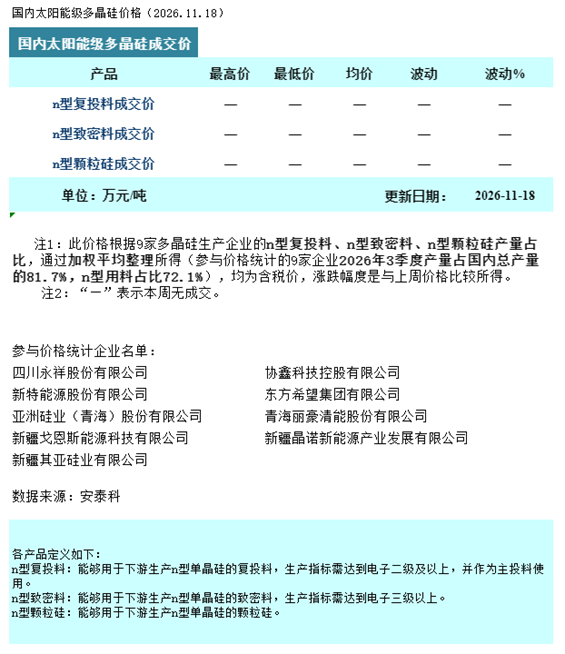
The Zhitong Finance App learned that on November 18, the Silicon Industry Branch released the Polysilicon Weekly Review. Domestic polysilicon market transactions continued to decline this week compared to last week. The actual number of orders signed was limited. Only a few companies reached a small number of transactions. Some companies mainly executed early orders, and the order execution speed was significantly slower than in the previous period. Judging from the downstream situation, the price of silicon wafers continues to decline. The transaction price of the N-type has declined. The industry inventory is about 34 GW. Downstream battery companies mainly digest their own inventory, and most new order purchases are rigid; the price of the battery chain operates in a differentiated manner, and the price on the component side is under pressure, and companies exchange price for volume, further reducing the space for upstream price increases. Polysilicon manufacturers insist on selling at no less than full cost. Upstream and downstream prices have not yet formed an effective link, making it more difficult to negotiate new orders. At the same time, prices are still expected to decline, and downstream goods tend to be delayed. Towards the end of the year, companies are also controlling raw material inventories and capital use. Purchasing intentions are further suppressed, and overall market transactions are sluggish.
According to statistics from the Silicon Industry Branch, the operating rate of domestic polysilicon manufacturers in October was about 46.9%. Among them, there are 7 companies with a production capacity of more than 100,000 tons/year of polysilicon plants, including Yongxiang Co., Ltd., Xinte Energy, Daquan Energy, Dongfang Hope, Lihao Qingneng, and Asia Silicon, with a total output of 993,000 tons, accounting for 90.7% of the total domestic output, and an operating rate of about 47%. The total output of enterprises with a production capacity of 50,000 to 90,000 tons/year is 9,600 tons, accounting for 8.8% of the total domestic output, and the operating rate is about 68%. The total output of the remaining enterprises is about 600 tons, accounting for 0.5%.
Overall, the supply-side contraction trend continues, and the industry's operating rate is expected to drop further to 36% in November. The demand side is still dominated by inventory digestion in the short term, procurement is mainly based on rigid inventory replenishment, and price relationships in various parts of the industrial chain are still being adjusted. In the later stages, we need to pay attention to the degree of implementation of production adjustments by various enterprises, the implementation of energy consumption limit standards, and changes in the pace of downstream inventory replenishment.