


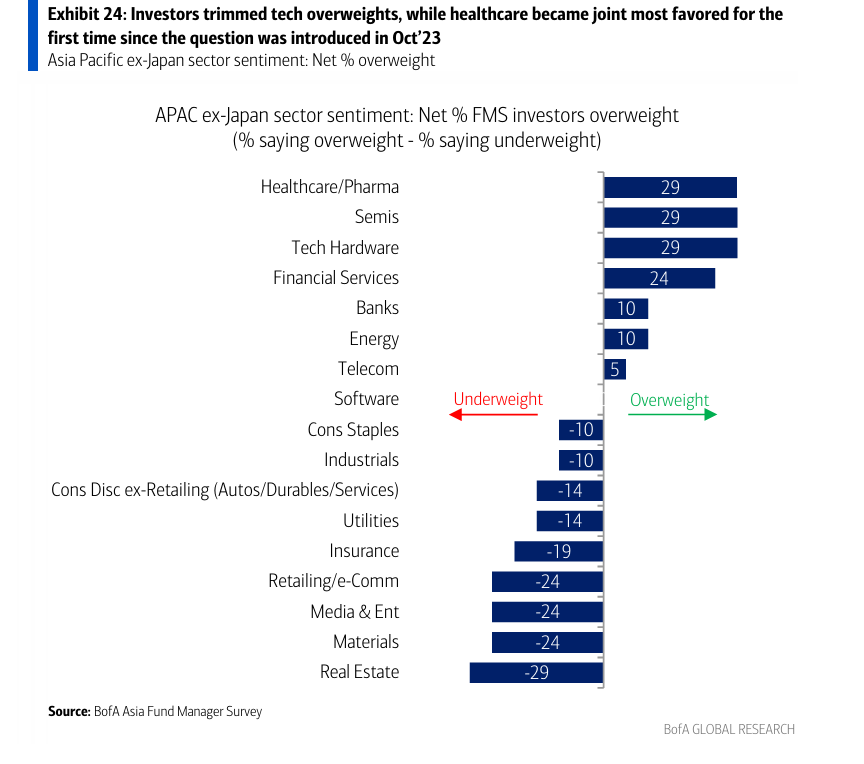
The Zhitong Finance App learned that the Asian fund manager survey report released by Wall Street financial giant Bank of America on November 17 showed that as economic growth and corporate profit expectations weakened, the fund managers interviewed generally drastically reduced their overallocation ratio to the semiconductor sector in the East Asian market and a wide range of technology stocks around the world. The Indian stock market, which has extremely low AI computing power and semiconductor exposure, turned net overallocation for the first time since January of this year, while healthcare recorded the highest net overallocation ratio since the title was set in October 2023. For the first time, it is tied with semiconductors and key technology hardware as the most popular capital allocation industry.
The Bank of America Fund Managers Survey Report generally showed that the characteristics of this round of large-scale position adjustments by global fund managers focused on cooling their preferences for technology topics such as semiconductors, while increasing the relative position of traditional defense sectors such as healthcare, consumer, and utilities in investment portfolios. The survey period for Bank of America's Asian fund managers survey is from November 6 to 12, 2026. The report was released on November 17, a few hours after Bank of America's global fund managers survey; the Bank of America questionnaire had a total of 94 respondents in each region, with total assets under management of US$241 billion. Among them, 21 listed the Asia-Pacific region as their investment expertise. However, Bank of America did not separately disclose the size of the assets managed by these 21 people.
Market data shows that the Philadelphia Semiconductor Index, which can be called the global AI computing power trend vane, fell into a technical bear market as early as July. Based on the closing price, Fee Ban hit a record high of 14,634.72 points on June 22 and retreated 20.23% on July 17, crossing what is commonly known as a bear market threshold. The index fell to 9,011.14 points on November 5, then rebounded 17.23% over the next four trading days, but fell 5.28% on Monday, November 16, and only rebounded 0.34% to close at 9,642.88 points on Tuesday before Nvidia's earnings report was released.
Based on this calculation, the fee is 34.11% lower than the historical closing high in June and 27.05% lower than the October 6th high. The Nasdaq 100 index fell 2.67% and 0.72% on Monday and Tuesday, respectively, during the same period, with a cumulative decline of 4.87% since November. The day before, the Dow, S&P 500, and Nasdaq Composite fell by 1.41%, 1.92%, and 2.49%, respectively, on Monday, while chips and semiconductors can be said to have borne the larger market pressure.
Bank of America's global fund manager survey from November 6 to 12 explained why the drastic reduction in positions still did not trigger its reverse buying signal. The 169 respondents to the global questionnaire managed a total of 461 billion US dollars. The net share of respondents who overmatched technology stocks fell from 37% to 12%, down 25 percentage points in a single month, the biggest drop since June 2006. However, the average cash position also unexpectedly fell from 3.9% to 3.6%, and only 3% expect a recession in the next year. This survey can be said to highlight that the overall risk exposure of the stock market is still high.
Meanwhile, 34% listed the AI bubble as the biggest tail risk, 31% chose hyperscale cloud vendor credit incidents, and 52% expect at least one major cloud vendor to cut capital expenses in the next six months. Bank of America strategist Michael Hartnett, who has the title of “Wall Street's Most Promising Strategist,” maintains a tactical defensive stance based on this: the most attractive technology stock buying points in history often occur after positions drop further to a net low allocation and a sharp increase in cash positions.
India is back in excess, and healthcare is tied for the first time with the semiconductor sector for the first time
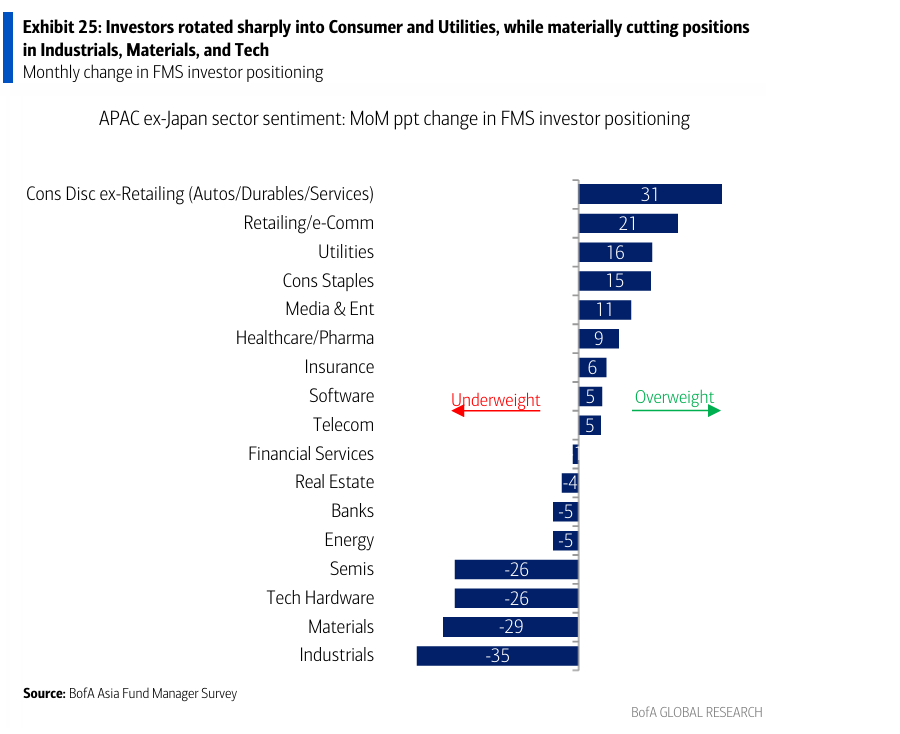
How healthcare and chips are in the same position is more indicative of changes in funding preferences than the juxtaposition ranking itself. The net medical and pharmaceutical oversupply ratio in the Asia-Pacific market, excluding Japan, rose 9 percentage points to 29% month-on-month, while semiconductor and technology key hardware configuration topics each fell sharply by 26 percentage points to 29%.
According to the Bank of America survey, non-retail optional consumption, retail e-commerce, and utilities rebounded by 31, 21, and 16 percentage points, respectively, and the three sectors are still at a net low level. The decline in industrial and material allocation was even greater, by 35 and 29 percentage points, respectively. It can be seen from this that global fund managers are doing two things at the same time: reducing centralized holdings in semiconductors/chips, AI computing power infrastructure, which is closely linked to the slowing pace of growth, and in some cyclical industries, to make up for domestic demand industries that previously had less allocation and a defensive tone.
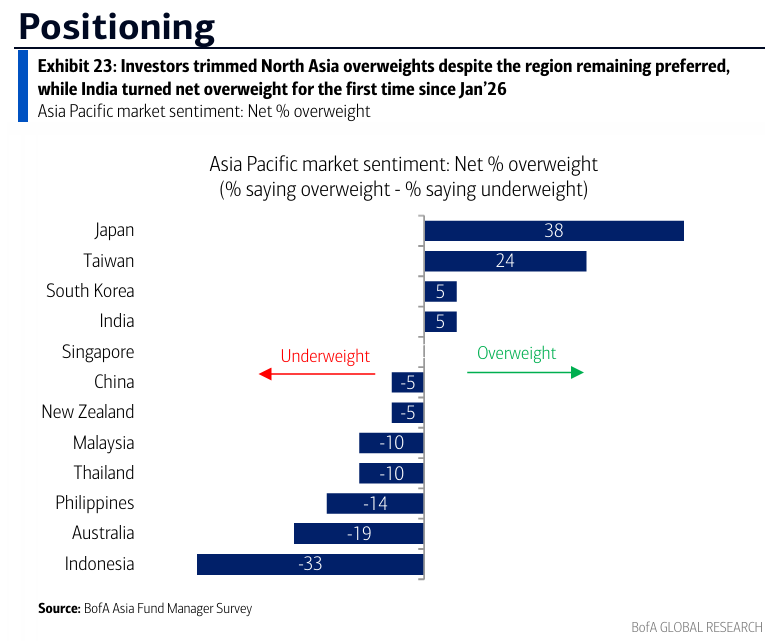
India's transformation is also worth watching closely. Its net overallocation ratio rose to 5%, roughly the same as the Korean market, and still lower than Japan's 38% and Taiwan's 24%. Respondents' biggest concern about India is still the lack of listing targets directly benefiting from AI, with 29% selected; however, the percentage that listed weak economic growth as the primary concern has dropped from 15% to zero.
Actual trading also shows that India has a profit driver independent of the chip/semiconductor supercycle in the Northeast Asian stock market. On November 17, when the Northeast Asian stock market continued to weaken sharply, India's Nifty 50 bucked the trend and rose 0.38%; as of the 18th, the index was still up 9.4% during the month. The fall in oil prices improved the investment costs of some Indian companies. Coupled with the resilience of corporate profits, foreign securities investors flowed in about 10 billion US dollars during the same period.
AI computing power valuation is cheaper, so why should fund managers keep an eye on AI-related revenue generation data?
The paradox faced by Asian investors is that while valuation attractiveness has improved, profit prospects are insufficient to support high return expectations. The net profit improvement ratio of Asia-Pacific companies excluding Japan is expected to fall from 55% to 5% in the next year, and the net ratio of the increase in inflation is expected to fall from 50% to 5%. At the same time, net 29% believed that stocks were undervalued, but the average expected increase over the next year fell to 4.7%, slightly lower than the historical average.
According to a survey on the Chinese stock market, a net share of 19% of the fund managers surveyed expected the economy to weaken, but when selecting the two most promising investment themes, AI and semiconductor themes were still overmatched by 48%. However, the traditional safe-haven and defense sector healthcare ranked second with 29%, a record high since the issue was set up in April 2023. Macro judgment has weakened, and optimism about specific industries is still acceptable. At the same time, risk aversion and defense attitudes are also becoming more obvious. This is particularly reflected in the fact that the health care selection ratio hit a new high since Bank of America established this issue in April 2023.
Japan shows the same differentiation. The net rate of improvement in the Japanese economy is expected to be 33%, falling to the 16th percentile in history, and 62% expect the Bank of Japan to raise interest rates in December; respondents still expect a 5.1% increase in Japanese stocks over the next year, which is higher than the historical average of 4.8%. Corporate profits continued to be the primary driver of Japanese stocks, and the importance of the yen exchange rate rose to the same level as the normalization of monetary policy.
In the selection of the markets that will benefit the most from the next phase of the AI cycle, Japan rose from 20% to 33%, surpassing Taiwan's 29% in the same month; if you look at May, the popularity of Japan and South Korea has reversed. The most popular industry in Japan is still semiconductors, with 67% ranking it as the top two overfit industries, followed by 48% of banks.
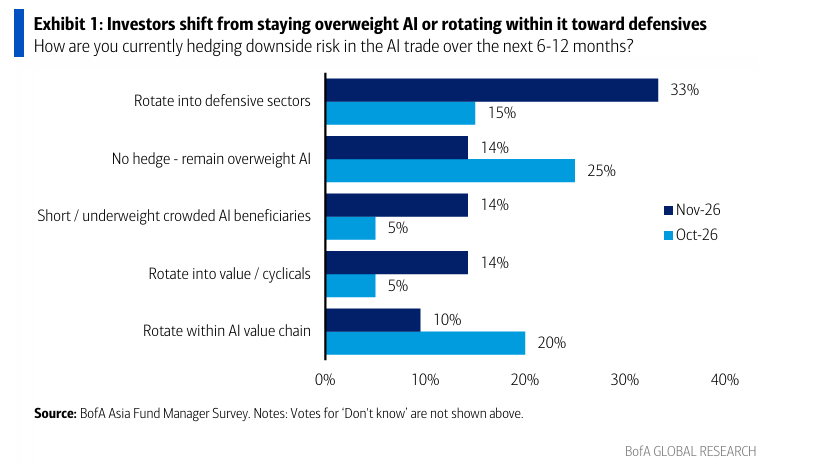
When it comes to AI itself, investors' biggest concern has changed from “how much more to build” to “how much money can be earned after it is built”. Semiconductor cycle confidence, measured by growth in exports from South Korea and Taiwan, fell to a net negative 5%, which is at the 12th percentile in history. The proportion that chose to switch to the defense industry to hedge against the downside risks of AI rose from 15% to 33%, yet 86% still listed AI capital expenditure and commercial monetization as the primary factors affecting the Asia-Pacific stock market in the coming year.
Within the industrial chain, the proportion of software, platforms, and AI computing power with the best risk return increased from 5% and 10% to 24%, respectively; storage dropped from 30% to 19%, network interconnection dropped from 20% to 10%, and data center infrastructure dropped from 15% to 5%. What best explains this round of fund managers' financial trade-offs is that 67% believe that actual AI revenue will best enhance their confidence in increasing positions, while only 5% chose cloud computing supergiants to speed up AI capital expenditure again.
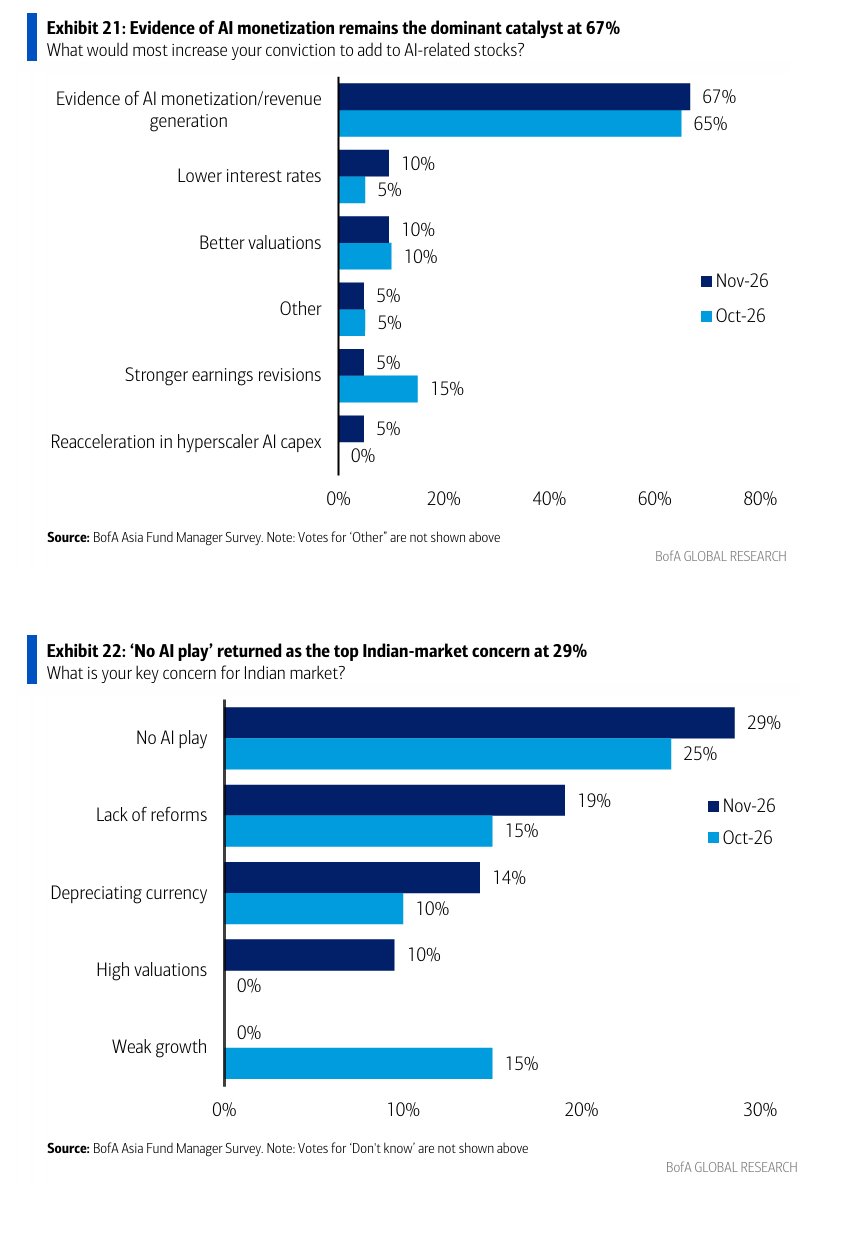
Overall, the Bank of America survey showed that in the entire AI industry chain, software, platform, and AI computing power were ranked first with a 24 percent selection ratio, with storage ranking behind 19%; as to what would enhance confidence in adding positions, 67% of respondents valued the most evidence that companies have earned revenue through AI business, and only 5% value cloud giants once again speeding up capital expenditure. Compared to a new round of computing power procurement plans, investors clearly prefer to see customers already pay for AI products and services.
Nvidia's earnings report mitigates order concerns, and East Asia Semiconductor's massive rebound is still awaiting profit relay
The Bank of America's global survey provided a cautious and pessimistic downward background in risk appetite in this round of Asian position adjustments. The net technology overallocation ratio of global fund managers plummeted from 37% to 12%, down 25 percentage points in a single month, the biggest drop since June 2006. However, the cash ratio also fell from 3.9% to 3.6%. Only 3% expect a recession in the next year, while 52% expect at least one hyperscale cloud vendor to announce capital expenditure cuts in the next six months.
Bank of America strategist Michael Hartnett believes that technology is still net overallocated, and cash is low, and there is still a gap from the more attractive reverse buying points in the past. The cautious phrase “insufficient level of panic” in his report was his judgment on the timing of expanding his holdings and bottom-up capital entering the market.
The Fei Ban Index has already entered a technical bear market, and the recent rebound has not recovered its major losses. On Tuesday, Fee Half rose slightly by 0.34% to close at 9,642.88 points before Nvidia released its earnings report, which is still 34.11% lower than the historical closing high in June and 27.05% lower than the October 6 high. The Nasdaq 100 index fell 2.67% and 0.72% respectively on Monday and Tuesday, with a cumulative decline of 4.87% in the month ending February.
Governance uncertainty before and after Hwang In-hoon left office, combined with tightening export rules and financing concerns, further lowered the valuation of chip stocks. Prior to the earnings report, Goldman Sachs lowered Nvidia's target price from 300 US dollars to 220 US dollars, Citi from 285 US dollars to 225 US dollars, and UBS from 300 US dollars to 240 US dollars. All three companies retained “purchases.” Goldman Sachs specifically pointed out that on-hand orders will help support profits over the next 12 to 18 months, and changes in leadership may have a greater impact on valuation multiples. The decline in the Northeast Asian market reflects this level of concern: South Korea's KOSPI fell by 3.59% and 2.59% on Monday and Tuesday, China's Taiwan weighted index fell 6.03% and 2.31% over the same period, and the Nikkei 225 index fell 2.42% and 1.34%, respectively.
Nvidia's after-market earnings report on Tuesday gave evidence that recent hashrate purchases are still strong. Revenue for the third fiscal quarter increased 103% year over year to US$115.8 billion, and data center revenue increased 110% to US$107.6 billion. Vera Rubin contributed nearly $20 billion to the month-on-month increase in revenue. The median revenue guide for the fourth fiscal quarter was US$130 billion, about 3.8% higher than the market's consensus forecast, and did not include data center computing revenue in China. The board of directors stated that it has no intention of reinstating Hwang In-hoon, while Kress raised the 2028 revenue growth forecast from about 70% to about 75%, while stressing that it will selectively support new cloud projects. Nvidia rose more than 4% after the market, followed by Broadcom, Micron, CoreWeave, and Nebius. The South Korean stock market rebounded 1.99% on Wednesday, while Taiwan and Japan rebounded about 0.26% and 0.28%, respectively. None of the three recovered from the previous two days' declines.
For investors holding shares in the Asian AI computing infrastructure supply chain, this financial report answered “customers are not purchasing yet.” The next question revealed by the Bank of America survey is “why do customers continue to buy”. Foundry, advanced packaging, and high-bandwidth storage are the first to benefit from rack delivery; to allow orders to continue to the next round of expansion, cloud vendors also need to convert the deployed computing power into paid usage and obtain sufficient revenue to cover depreciation, power, and financing costs. This explains why the same group of respondents can continue to overequip semiconductors while improving medical configurations, and listed AI commercial monetization as the most important evidence when investing in additional investments.