



Off-price retail company TJX (NYSE:TJX) announced better-than-expected revenue in calendar Q3 2026 [fiscal Q3 2027], with revenue up 5.5% year on year to $15.95 billion. Its non-GAAP profit of $1.34 per share was in line with analysts’ consensus estimates.
For more on TJX, read our free full research report.
TJX Q3 CY2026 highlights:
- Revenue $15.95 billion vs. consensus estimates of $15.85 billion, according to S&P (5.5% year-on-year growth, 0.7% beat)
- Adjusted EPS $1.34 vs. consensus estimates of $1.34, according to S&P (in line)
- Adjusted EPS guidance Management slightly raised its full-year adjusted EPS guidance to $5.19 at the midpoint
- Operating margin 12.8%, in line with the same quarter last year
- Free cash flow margin 7.1%, similar to the same quarter last year
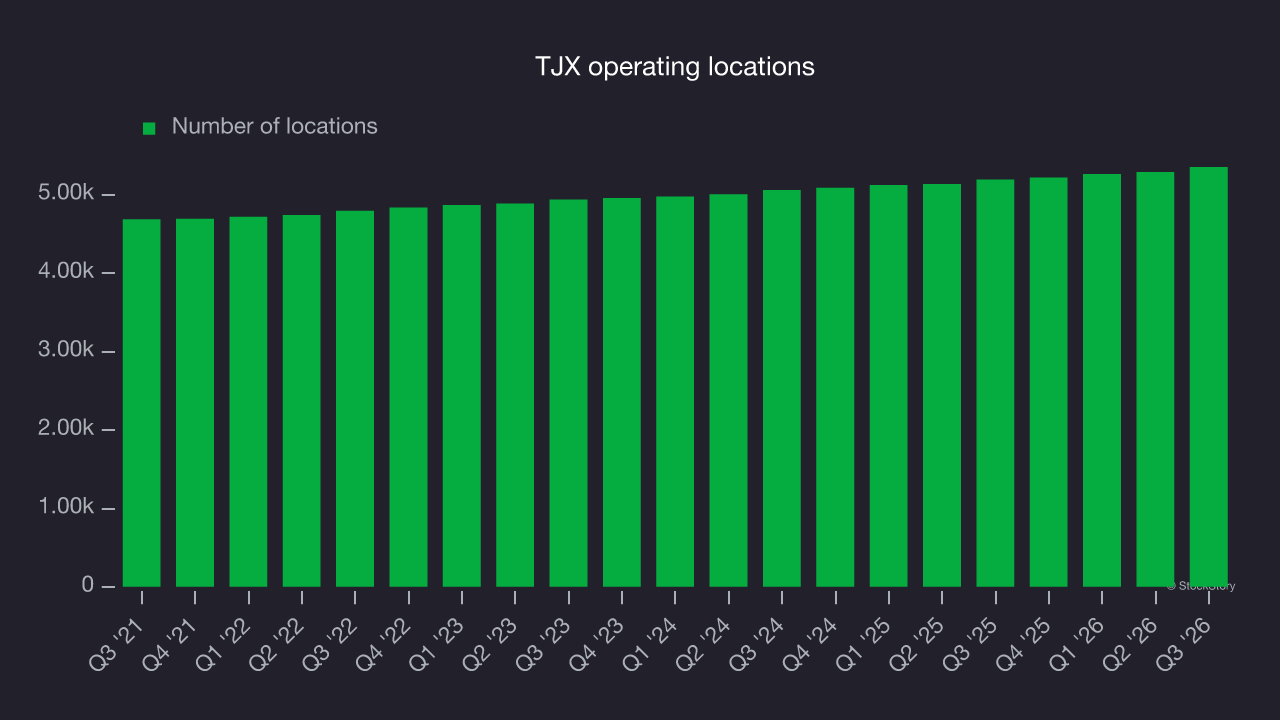
- Locations 5,349 at quarter end, up from 5,191 in the same quarter last year
- Same-store sales rose 4% year on year (5% in the same quarter last year)
- Market capitalization $142.8 billion
Ernie Herrman, Chief Executive Officer and President of The TJX Companies, Inc., stated, “I am very pleased with our consolidated third quarter results. Overall sales, profitability, and earnings per share all exceeded our expectations. Consolidated comparable sales grew 4%, driven by continued strength at HomeGoods, TJX Canada, and TJX International, and we saw improved sales at Marmaxx. Importantly, we expect further improvement at Marmaxx in the fourth quarter. We believe our above-plan results in the third quarter highlight the benefit of our global, diversified business. Looking ahead to the fourth quarter, while we believe the unseasonably warm weather in the U.S. and Canada has been holding back consumer demand in some categories, we are expecting sales momentum to accelerate throughout the holiday season. We are confident in our plans for the holiday selling season and availability of quality merchandise continues to be outstanding. All of our retail banners are very strongly positioned as gifting destinations and we are confident that consumers will be very pleased with our holiday gift giving assortment. Further, we will be flowing fresh merchandise and exciting gifts to our stores and online multiple times a week throughout the season. Longer term, we remain energized by the opportunities we see to further drive sales, grow our retail footprint, and keep capturing market share around the globe.”
Revenue growth
Examining a company’s long-term performance can provide clues about its quality. Even a poor business can perform well for one or two quarters, but a high-quality one grows for years.
With $63.2 billion in revenue over the past 12 months, TJX is a major player in the consumer retail sector and benefits from economies of scale, giving it an edge in distribution. This also gives it more leverage on its fixed costs than smaller competitors and the flexibility to offer lower prices. However, its scale is a double-edged sword because there are only a finite number of places to build new stores, making it harder to find incremental growth. For TJX to boost its revenue, it likely needs to adjust its prices or expand in foreign markets.
TJX’s revenue grew at a tepid 6.5% compounded annual growth rate over the last three years, but to its credit, it opened new stores and increased revenue at existing, established locations.
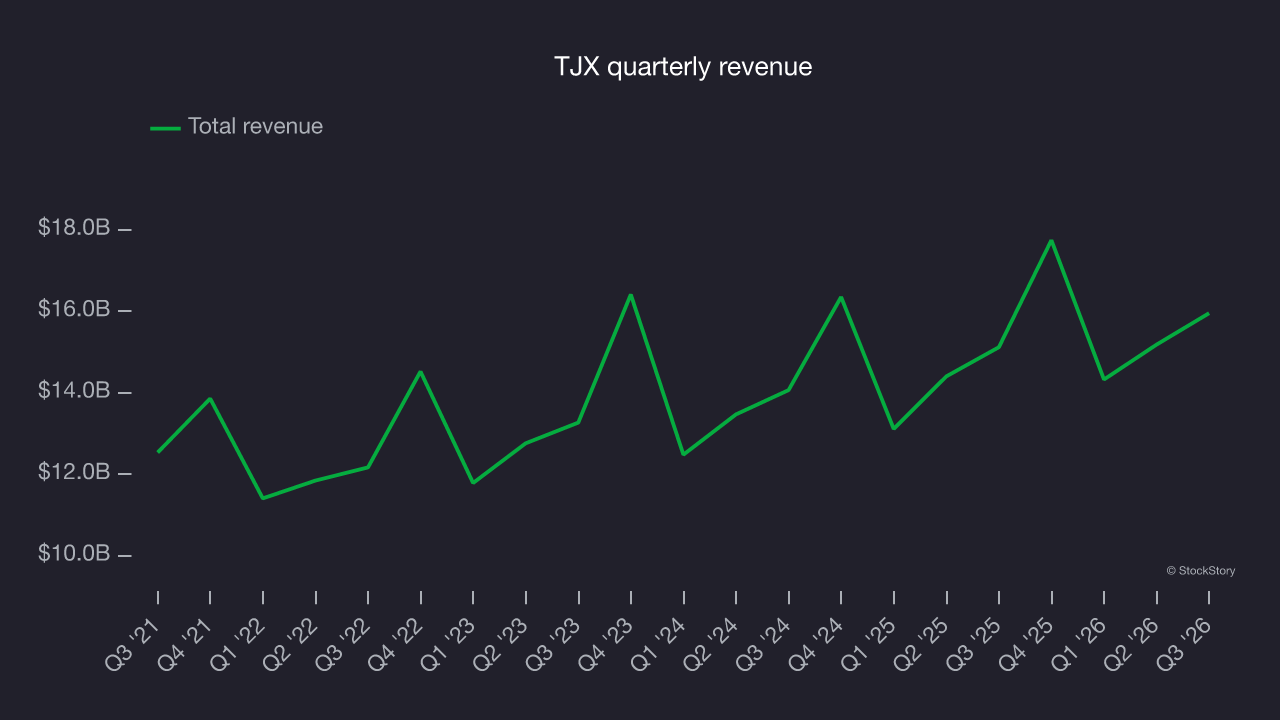
This quarter, TJX reported year-on-year revenue growth of 5.5%, and its $15.95 billion of revenue exceeded Wall Street’s consensus estimates by 0.7%.
Looking ahead, sell-side analysts expect revenue to grow 5.4% over the next 12 months, according to S&P, similar to its three-year rate. Its growth trajectory remains attractive given its scale and suggests the market is pricing in success for its products.
Store performance
Number of stores
A retailer’s store count influences how much it can sell and how quickly revenue can grow.
TJX operated 5,349 locations in the latest quarter. Over the last two years, it has opened new stores quickly, averaging 2.8% annual growth. This was faster than the broader consumer retail sector.
When a retailer opens new stores, it usually means it’s investing for growth because demand is greater than supply, especially in areas where consumers may not have a store within reasonable driving distance.
Same-store sales
A company’s store base only paints one part of the picture. When demand is high, it makes sense to open more. But when demand is low, it’s prudent to close some locations and use the money in other ways. Same-store sales provide insight into this topic because they measure organic growth for a retailer’s e-commerce platform and brick-and-mortar shops that have existed for at least a year.
TJX has been one of the most successful retailers over the last two years thanks to growing demand within its existing locations. On average, the company has posted strong year-on-year same-store sales growth of 4.5%. This performance suggests its rollout of new stores is beneficial for shareholders. This favorable backdrop gives TJX multiple sources of revenue growth: new stores, e-commerce or increased foot traffic and higher sales per customer at existing locations.
In the latest quarter, TJX’s same-store sales rose 4% year on year. This performance was more or less in line with its historical levels.
Key takeaways from TJX’s Q3 results
TJX’s narrow beats on revenue and gross margin came with a softer outlook: EPS guidance for next quarter missed Wall Street’s consensus estimates, and full-year EPS guidance fell slightly short. That made for a mixed quarter overall. Shares surged 7.1% to $139.13 immediately after the results.
The latest quarter is only one piece of the longer-term business quality puzzle. Quality, when combined with valuation, can help determine if the stock is a buy. Read more in the full research report here (it’s free).