



Quarterly earnings results are a good time to check in on a company’s progress, especially compared to its peers in the same sector. Today we are looking at Lennar NYSE:LEN and the best and worst performers in the home builders industry.
Traditionally, homebuilders have built competitive advantages with economies of scale that lead to advantaged purchasing and brand recognition among consumers. Aesthetic trends have always been important in the space, but more recently, energy efficiency and conservation are driving innovation. However, these companies are still at the whim of the macro, specifically interest rates that heavily impact new and existing home sales. In fact, homebuilders are one of the most cyclical subsectors within industrials.
The 9 home builders stocks we track reported a softer Q3. As a group, revenues missed analysts’ consensus estimates by 1.7%.
In light of this news, share prices of the companies have held steady. On average, they are relatively unchanged since the latest earnings results.
Lennar NYSE:LEN
One of the largest homebuilders in America, Lennar (NYSE:LEN) is known for constructing affordable, move-up, and retirement homes across a range of markets and communities.
Lennar reported revenues of $8.05 billion, down 8.7% year on year. This print fell short of analysts’ expectations by 3.2%. Overall, it was an underwhelming quarter for the company with a significant miss of analysts’ EPS estimates.
Stuart Miller, Executive Chairman, Chief Executive Officer and President of Lennar, said, "Our third quarter 2026 results reflect consistent focus on our operating strategy of maintaining volume and production while navigating a challenging economic environment. While our earnings of $1.19 per share were below expectations, they reflect the nature of the environment in which we are operating, which has deteriorated since our last earnings call."
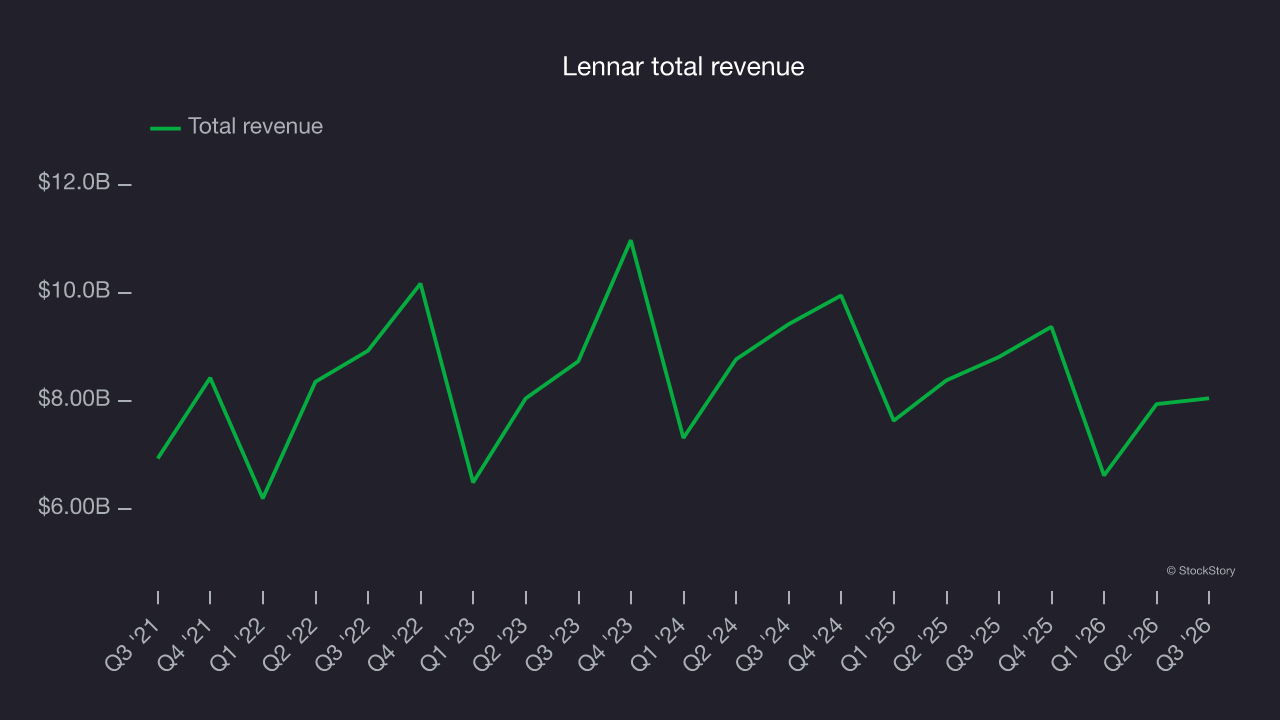
Interestingly, the stock is up 5.9% since reporting and currently trades at $83.00.
Read our full report on Lennar here, it’s free.
Best Q3: LGI Homes (NASDAQ:LGIH)
Based in Texas, LGI Homes (NASDAQ:LGIH) is a homebuilding company specializing in constructing affordable, entry-level single-family homes in desirable communities across the United States.
LGI Homes reported revenues of $437.5 million, up 10.3% year on year, outperforming analysts’ expectations by 1%. The business had a very strong quarter with a beat of analysts’ EPS estimates.
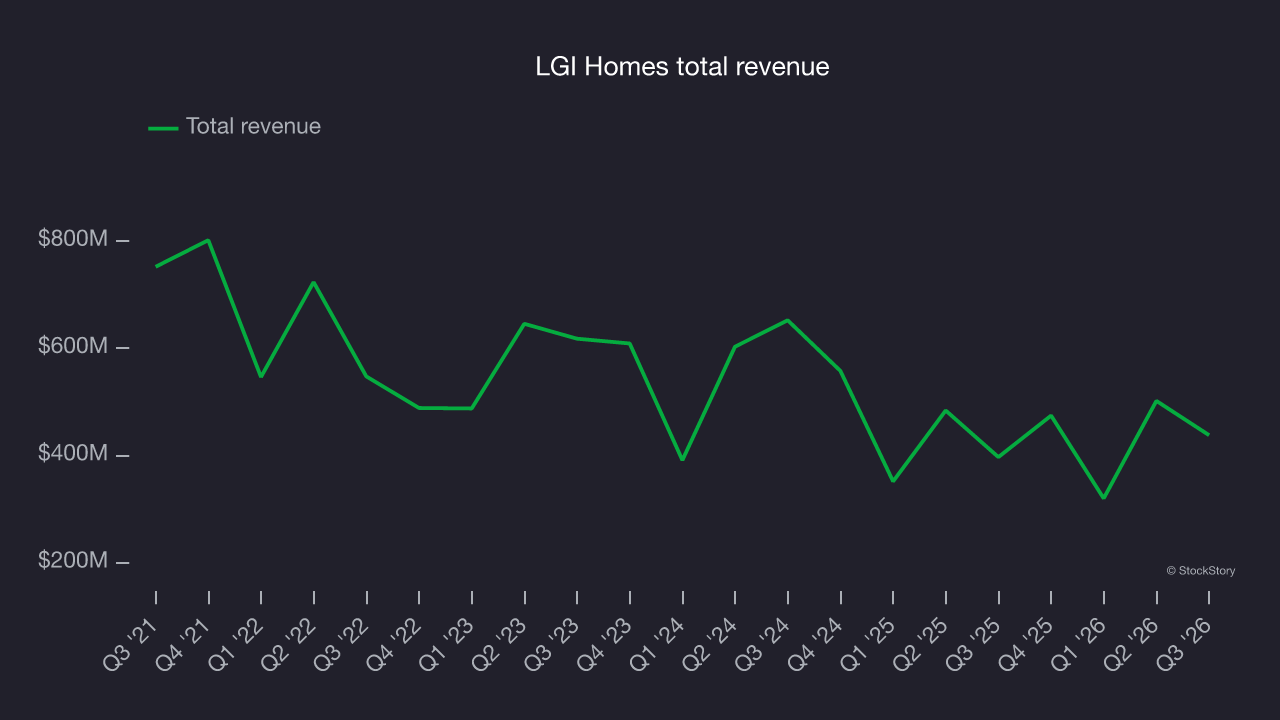
LGI Homes delivered the fastest revenue growth of the whole group. Although it had a fine quarter compared to its peers, the market seems unhappy with the results as the stock is down 15.2% since reporting. It currently trades at $40.21.
Is now the time to buy LGI Homes? Access our full analysis of the earnings results here, it’s free.
Weakest Q3: NVR (NYSE:NVR)
Known for its unique land acquisition strategy, NVR (NYSE:NVR) is a respected homebuilder and mortgage company in the United States.
NVR reported revenues of $2.40 billion, down 7.9% year on year, falling short of analysts’ expectations by 6.4%. It was an underwhelming quarter as it posted a significant miss of analysts’ EPS estimates.
As expected, the stock is down 4.4% since the results and currently trades at $5,638.
Read our full analysis of NVR’s results here.
KB Home (NYSE:KBH)
The first homebuilder to be listed on the NYSE, KB Home (NYSE:KBH) is a homebuilding company targeting the first-time home buyer and move-up buyer markets.
KB Home reported revenues of $1.30 billion, down 20% year on year. This number was in line with analysts’ expectations. Zooming out, it was a mixed quarter as it also logged a beat of analysts’ EPS estimates but full-year revenue guidance missing analysts’ expectations.
KB Home scored the highest full-year guidance raise but had the slowest revenue growth in the group. The stock is down 4.2% since reporting and currently trades at $46.53.
Read our full, actionable report on KB Home here, it’s free.
PulteGroup (NYSE:PHM)
Having delivered over 850,000 homes since its founding in 1950, PulteGroup (NYSE:PHM) is one of America's largest homebuilders, constructing single-family homes, townhouses, and condominiums for first-time, move-up, and active adult buyers across 46 markets in 25 states.
PulteGroup reported revenues of $3.97 billion, down 9.8% year on year. This result missed analysts’ expectations by 4.2%. Overall, it was an underwhelming quarter as it also produced a significant miss of analysts’ EPS estimates.
The stock is up 10.9% since reporting and currently trades at $125.15.
Read our full, actionable report on PulteGroup here, it’s free.
Market update
Over the past year, investors have been forced to repeatedly answer the same question: What is the market’s biggest risk? The answer has changed several times, and each shift has reshaped market leadership.
Late in 2025 and early 2026, artificial intelligence became the market’s primary uncertainty. Investors questioned whether AI would erode software pricing power and weaken competitive moats as AI made it easier to replicate once-differentiated products.
By the spring, technology took a back seat to geopolitics. The U.S. conflict with Iran briefly became the market’s dominant narrative, raising concerns about oil prices, inflation, and global growth. But as energy markets remained orderly and fears of a prolonged supply disruption faded, investors quickly turned their focus back to fundamentals.
Want to invest in winners with rock-solid fundamentals? Check out our Strong Momentum Stocks and add them to your watchlist. These companies are poised for growth regardless of the political or macroeconomic climate.